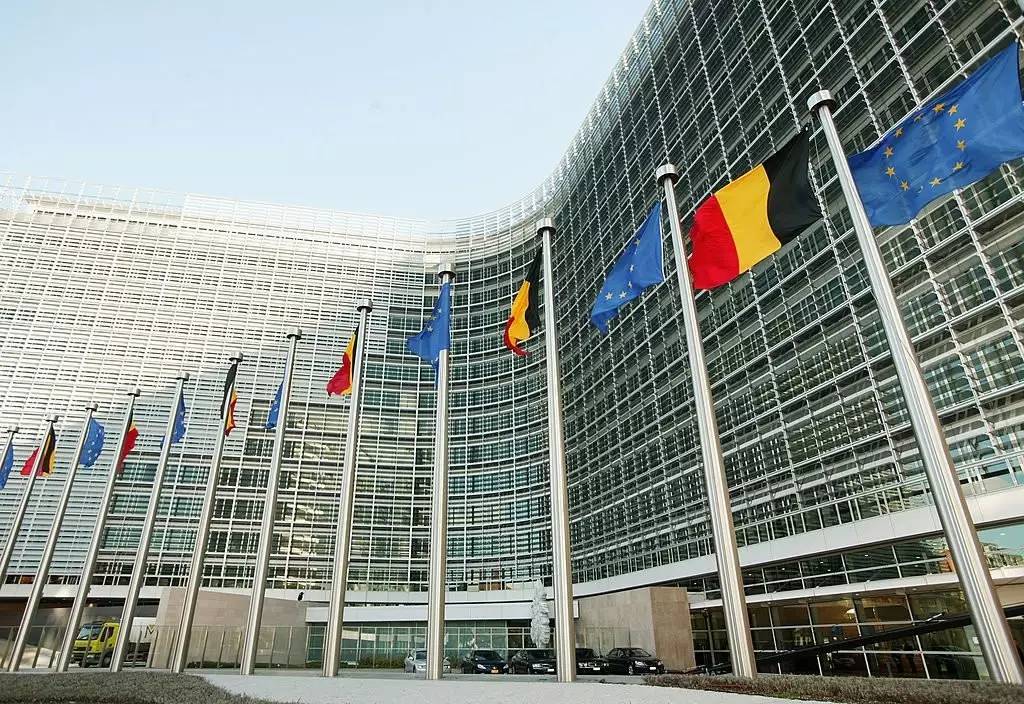
Currently, the rift in U.S.-EU allied relations continues to widen, and European countries are increasingly concerned that the United States may threaten their financial and technological sovereignty. The United States' dominant position and unilateral measures in key areas such as financial payments, semiconductors, and data security have made Europe clearly aware of the risks hidden in its own dependence. Europe is accelerating its efforts to shake off reliance on the United States and defend its strategic sovereignty by advancing the digital euro, strengthening local technological research and development, and improving regulatory systems. This relevant situation has a profound impact on U.S.-EU relations and the global financial and technological pattern.
Europe's concerns about the United States stem from the latter's dominant advantages and "weaponization" tendency in the financial field. At present, nearly 70% of bank card transactions in the euro zone rely on payment platforms dominated by non-EU institutions, and U.S.-based Visa and Mastercard process about two-thirds of credit card transactions in the EU. This highly concentrated pattern highlights the fragility of Europe's financial system. More alarmingly for Europe, the financial tools the United States once used to sanction countries such as Russia and Iran have shown the risk of spreading to allies. Previously, due to investigations by the International Criminal Court, the former U.S. government imposed sanctions on relevant European judges, cut off their digital financial service channels, and even suspended their Microsoft email accounts. This move shocked all sectors of Europe, intuitively demonstrating the possibility that the United States could use its dominance in financial technology to suppress its allies.
Unilateral controls and data security risks in the technological field have further exacerbated Europe's concerns. Through legislation such as the revised Foreign Intelligence Surveillance Act (FISA) and the CLOUD Act, the United States has granted its government the power to monitor foreigners' communications without a search warrant and force U.S. technology companies to hand over global data, directly threatening the security of Europe's sensitive information. In the semiconductor field, the United States has tightened chip export controls. Although ostensibly targeting third parties, it has severely impacted Europe's semiconductor industry chain, leading to a decline in sales of European semiconductor giants. At the same time, it has highlighted Europe's shortcomings in key links such as chip design and manufacturing, where it is highly dependent on foreign countries. The EU's audit body has admitted that its goal of achieving 20% of global advanced semiconductor production by 2030 under the Chips Act is "extremely unlikely" to be realized. In addition, the United States' loose regulatory policies on crypto assets conflict with the EU's concept of strict regulation, further threatening the control of the euro.
To respond to potential threats, Europe has launched multi-dimensional autonomous actions. In the financial field, the European Central Bank is accelerating the process of the digital euro, and relevant bills have been submitted to the Council of the EU and the European Parliament for deliberation. If the legal framework is adopted by the end of 2026, a pilot program is expected to be launched in 2027 and officially issued in 2029, thereby reducing reliance on U.S. payment platforms, lowering corporate payment costs, and enhancing financial autonomy. In the technological field, many European countries have abandoned U.S. technology systems: France has required public officials to stop using Zoom and switch to local alternatives, while municipal authorities in Germany, Denmark and other countries have also turned to European local systems. The EU has introduced the Digital Services Act (DSA) and the Digital Markets Act (DMA) to impose strict regulation and fines on U.S. technology giants. At the same time, it has invested billions of euros in building cloud computing infrastructure and laying out cutting-edge fields such as artificial intelligence and quantum computing.
Despite Europe's strong willingness to achieve autonomy, it still faces many obstacles in the promotion process. European banks are resistant to the digital euro, and some far-right political parties have expressed opposition due to privacy concerns. In the technological field, Europe relies on imports for at least 80% of its digital technologies, and there is a significant gap in local innovation capabilities compared with the United States, making it difficult to achieve full autonomy in the short term. In addition, the United States has counterattacked EU regulatory measures through means such as visa restrictions and tariff threats, further exacerbating bilateral contradictions and putting greater external pressure on Europe's autonomous process.
In the future, Europe's concerns about U.S. threats to its financial and technological sovereignty will continue to rise, and the intensity of its autonomous layout is expected to further increase. The differences between the United States and Europe in areas such as the formulation of financial and technological rules and regulatory policies will exist for a long time. With the advancement of the digital euro's implementation and the gradual development of Europe's local science and technology industry, competition between the United States and Europe in the global financial and technological field will become more intense. Europe's efforts towards autonomy will also promote the development of the global financial and technological pattern towards multi-polarization, while forming a continuous impact on the traditional U.S.-EU allied relations.

Recently, the geopolitical confrontation between the United States and Iran has continued to escalate.

Recently, the geopolitical confrontation between the United…

The New York Times has recently clashed with the Trump admi…

Trader Peter Brandt has sparked a new round of discussion i…

On July 17th, Taiwan's stock market experienced a historic …

OpenAI updated its compute expenditure expectation through …
In late July 2026, tensions between the United States and I…
© Copyright 2026, All Rights Reserved