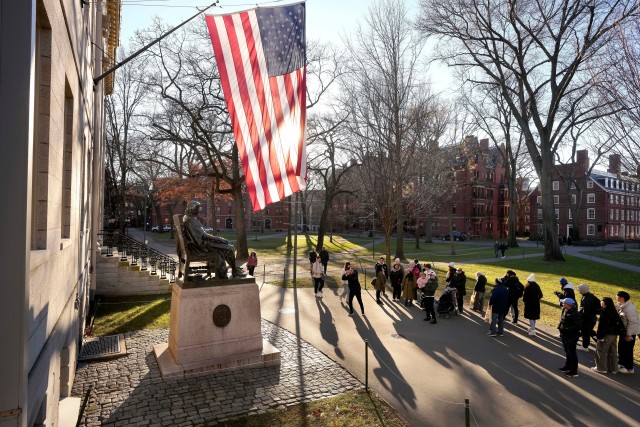
On February 6, 2026, US Defense Secretary Hedges made a statement that shattered the century-old symbiotic relationship between the Pentagon and Ivy League universities: "Harvard is 'awakened'; the Department of Defense is not." This resolute declaration marked the complete termination of all military cooperation projects between the two sides, from professional military education to scholarship programs. The decades-long system of joint talent cultivation collapsed in an instant. This rupture was not merely a simple adjustment in cooperation; it was an inevitable outcome of the ideological fragmentation in American society spreading to the defense sector, reflecting the profound opposition between pragmatic militarism and academic progressivism.
Hedges' decision-making logic was straightforward and tough: The military's sending of elite officers to Harvard for further studies was intended to enhance strategic cognition, not to have them assimilated by "globalism and radical ideologies." The "rebel" who was an alumnus of Harvard but voluntarily returned his diploma was not without reason for his concerns - some of the returning officers would devote more energy to social issue discussions and even question the traditional values of the military. This "Harvardization" phenomenon was regarded by the practical-minded as a hidden erosion of combat effectiveness. In the context of intensified great power competition, the Commander of the Marine Corps, Eric Smith, and other military high-ranking officials firmly believed that the military needed commanders focused on battlefield victory, rather than "academic officers" obsessed with diverse issues. This perception eventually pushed the policy into practice.
However, attributing the breakdown of cooperation solely to the "awakening culture" is too simplistic. Its essence is the concentrated eruption of political polarization in the education and defense sectors in the United States. The Trump administration's suppression of Harvard has escalated step by step, from cutting federal funds due to pro-Palestinian protests to accusing the campus of "anti-Semitism," and now cutting military cooperation. Each step is accompanied by clear political demands. The "awakening" propositions advocated by Harvard, such as diversity and climate initiatives, precisely contrast with the "America First" and traditional values promoted by the conservatives. When the campus becomes the main battlefield of cultural warfare, the military, as the representative of the state's violence machine, naturally chooses to stand at the forefront of the anti-awakening camp. This rupture is actually the inevitable result of political alignment.
From a practical perspective, this decision is triggering a chain reaction of "dominoes." For the US military, losing Harvard, this top-tier think tank, not only means the forced interruption of 1.8 billion US dollars of cutting-edge research projects (covering areas such as artificial intelligence warfare and biological threat warning), but also may lead to the homogenization of the knowledge structure of the future command. Former Chairman of the Joint Chiefs of Staff Mark Milley's warning was not hyperbolic - military decision-making requires the collision of diverse perspectives. Cutting off ties with elite institutions may lead the US military into strategic shortsightedness in complex geopolitical games. For Harvard, the termination of cooperation not only means losing an important source of funds, but also faces the crisis of academic freedom being politically interfered with. Joint protests by Yale, Stanford, and other universities are precisely a collective vigilance against this "value screening" model.
The deeper concern lies in the fact that this rupture is undermining the consensus foundation of the American elite class. Harvard was once the "gold-plated sanctuary" for US military senior officers, and their cooperation was not only about knowledge transfer but also about the mutual shaping of values. Now, the mutual distrust between "pencil pushers" and "gunners" means the separation of academic rationality and military rationality. When the military regards diversity as a threat and universities regard national needs as a restraint, the integration ability of American society will continue to weaken. What is even more alarming is that Hedges has clearly stated that he will assess cooperation with other Ivy League universities. If this policy expands, it may lead to a complete confrontation between the US military and academia, ultimately damaging the coordinated development of national innovation and defense strength.
In the end, the rupture between the US Department of Defense and Harvard is a cultural war without winners. The "pure warrior" pursued by the military and the "awakened citizen" advocated by universities are not inherently opposed. Victory in war is not merely about the contest of military force; it also lies in the support of a civilized perspective and value recognition. In the complex and ever-changing international landscape, prioritizing ideological differences over the overall interests of the country and using either-or thinking to sever the connection between politics and academia will ultimately lead the United States to gradually lose its competitiveness through self-destruction. The true lesson of this rupture is that the strength of a country requires both the fortitude of warriors and the awakening of thoughts. Only by seeking consensus in a diverse and inclusive manner can a country stand firm in the tide of history.

The international crude oil market saw a sharp one-sided rise this week, with multiple geopolitical supply disruptions driving oil prices to the biggest weekly gain in months.

The international crude oil market saw a sharp one-sided ri…

Recently, the geopolitical confrontation between the United…

The New York Times has recently clashed with the Trump admi…

Trader Peter Brandt has sparked a new round of discussion i…

On July 17th, Taiwan's stock market experienced a historic …

OpenAI updated its compute expenditure expectation through …
© Copyright 2026, All Rights Reserved