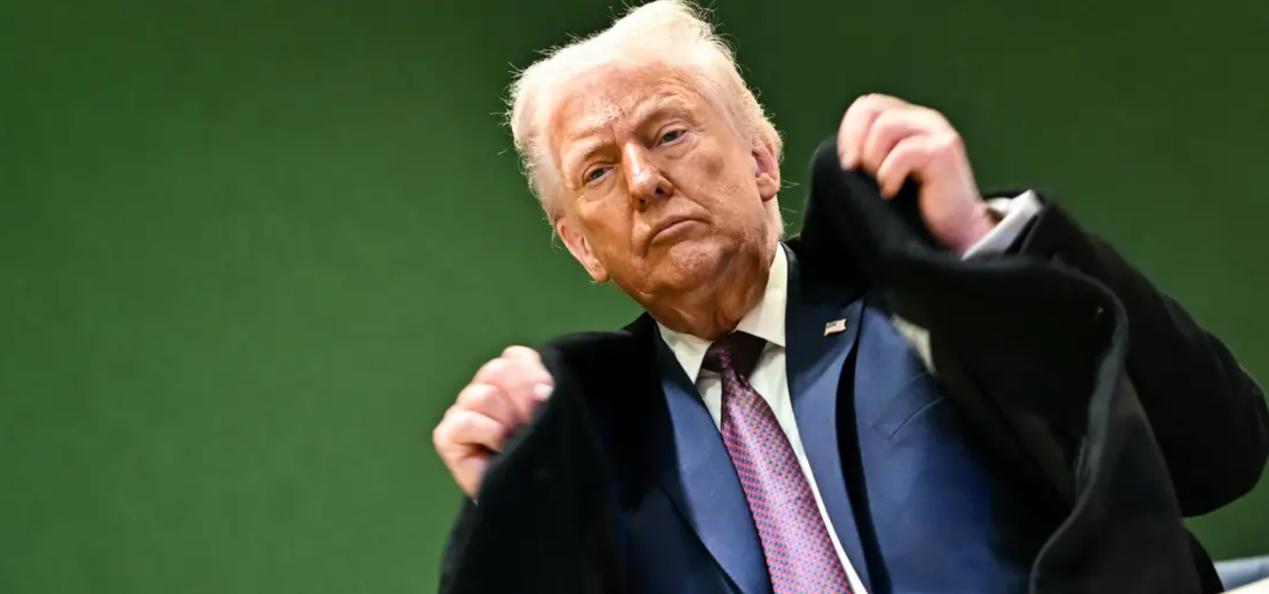
On January 20, 2026, it will be one year since Donald Trump's second term as the President of the United States began. Multiple polls show that his approval rating remains persistently low. A CNN poll indicates that only 39% of respondents approve of his performance in office, while 58% consider his governance a failure. However, does this apparent "unpopularity" truly reflect the full picture of public opinion? Is there a possibility that his approval rating is underestimated?
I. Economic Policy Controversies: The Discrepancy Between Data and Public Concerns
During Trump's tenure, the U.S. economy has experienced a paradox of "data prosperity" and "public anxiety". In the third quarter of 2025, the GDP growth rate reached 4.3%, but this growth was mainly driven by consumption from the wealthy and government spending, and the actual experience of ordinary families was disconnected from the macro data. The average tariff rate soared to 16.8% due to his tariff policies, which, while increasing federal revenue by approximately 200 billion dollars, imposed an additional annual cost of 1,600 dollars on each household. According to the Department of Labor, the unemployment rate rose to 4.6% in November 2025, with the unemployment rate among young people increasing at a much higher rate than other groups. Manufacturing jobs shrank, and the middle class shrank while the number of homeless people surged, creating a "discontinuous poverty" phenomenon.
This contradiction is directly reflected in the polls: 55% of respondents believe that the economic situation has worsened, and 60% oppose the tariff policy. However, Trump still insists on rating the economy as "A+++++". This gap between the "government self-assessment" and "public perception" reveals an imbalance in the distribution effects of economic policies - the growth benefits are concentrated among the top 10% of high-net-worth individuals, while the middle and lower-income groups bear the brunt of inflation.
II. Limitations of Polling Methods: Sample Bias and Emotional Expression
The current poll results may have systematic biases. Firstly, the response rate of traditional telephone surveys has been continuously declining, and the coverage of young people and mobile populations is insufficient. These groups were key to Trump's 6-percentage-point lead among young voters in the 2024 election. Secondly, poll questions often focus on short-term economic feelings and ignore the impact of long-term policy commitments. For instance, Trump's tough stance on immigration and trade, although controversial, has solidified his "anti-establishment" image, and this emotional identification is difficult to fully capture through quantitative polls.
Furthermore, poll results are easily influenced by sudden events. After the military operation in Venezuela in January 2026, his approval rating briefly dropped to 36%, but it rebounded to 45% after Congress passed relevant bills to stabilize the situation. This volatility indicates that polls more reflect immediate emotions rather than stable positions.
III. Core Voter Stickiness: The Structural Support of the MAGA Base
Despite his overall low approval ratings, Trump's position within the Republican base remains solid. A Reuters poll shows that his approval rating among Republicans still exceeds 90%, and although his support among independent voters has dropped by 21 percentage points, this group only accounts for one-third of the electorate. More importantly, Trump has successfully transformed "Make America Great Again" into a cultural symbol, continuously reinforcing voter identity through social media and rallies.
IV. Backlash from International Image: Alienation of Allies and Global Public Opinion Transmission
Trump's "America First" policy has triggered a chain reaction on the international stage, indirectly weakening his domestic support. A survey by a European think tank reveals that only 16% of Europeans view the United States as an ally, while 20% consider it a competitor or even an enemy; in emerging market countries like South Africa and Brazil, 85% and 73% of the population respectively see China as a "necessary partner". This shift in global public opinion has been transmitted to the United States through the media, intensifying the doubts of swing voters regarding Trump's foreign policy. During the 2026 Greenland crisis, his tough measures of imposing tariffs on eight European countries temporarily boosted the support of the MAGA base, but it led to a "strategic autonomy" propaganda campaign by the Democratic Party in key states, further narrowing his policy space.
Overall, the low approval rating of Trump is not due to polling errors, but rather a direct result of economic policy imbalance, damaged international image, and loss of support from the middle electorate. However, the high loyalty of his core voters, their continuous consumption of "anti-establishment" narratives, and the structural support within the Republican Party still leave him with the possibility of a political comeback. Before the 2026 midterm elections, if there is a marginal improvement in economic data or if the Democratic Party exposes its internal contradictions and weaknesses, Trump's approval rating still has the potential for a rebound. But in any case, his "unpopular" label has been deeply imprinted in the American political ecosystem and has become an important prism for interpreting current American politics.

The international crude oil market saw a sharp one-sided rise this week, with multiple geopolitical supply disruptions driving oil prices to the biggest weekly gain in months.

The international crude oil market saw a sharp one-sided ri…

Recently, the geopolitical confrontation between the United…

The New York Times has recently clashed with the Trump admi…

Trader Peter Brandt has sparked a new round of discussion i…

On July 17th, Taiwan's stock market experienced a historic …

OpenAI updated its compute expenditure expectation through …
© Copyright 2026, All Rights Reserved