
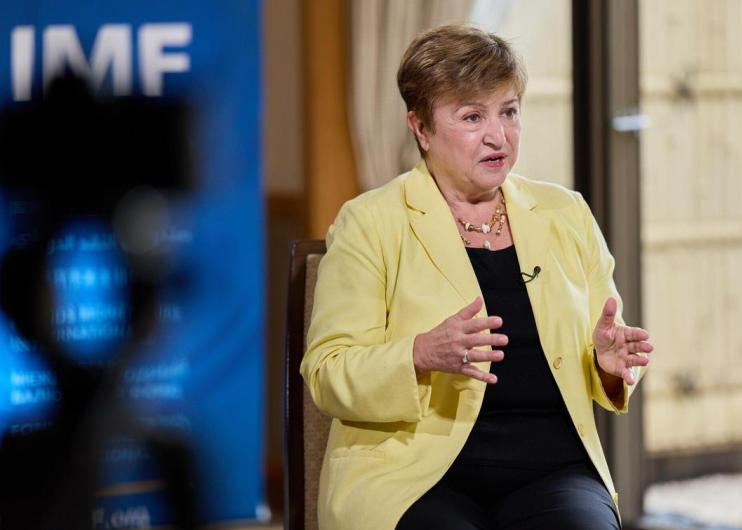
After the US attack on Iran's nuclear facilities, Kristalina Georgieva, the managing director of the International Monetary Fund, warned that at a time when global uncertainties are increasing, the US military operation may have broader impacts, not limited to the energy aspect.
Georgieva said in an interview with Bloomberg Television on Monday (June 23) that energy prices are currently the hardest hit, but there could also be secondary and tertiary impacts. For instance, if more turmoil impacts the growth prospects of large economies, it will trigger the possibility of a downward revision of the global growth outlook.
In April this year, the International Monetary Fund (IMF) warned that the "restart" of world trade led by the United States would lead to a slowdown in economic growth and lowered its forecast for global economic growth this year. Georgieva said that the situation in the first two quarters of this year indicates that this trend is still ongoing. Although the world may avoid an economic recession, uncertainties are also increasing, which often restrains the growth outlook.
After the United States launched an unprecedented air strike on Iran's nuclear facilities, the whole world is preparing for Iran's response, which has also made traders and governments around the world feel nervous.
US President Trump's decision to crack down on nuclear facilities in Iran has pushed the Middle East into uncharted territory and triggered geopolitical risks at a time when the world economy is already facing severe uncertainties brought about by trade tensions.
As for the US economy, Georgieva believes that inflationary tightening will continue and expects the US Federal Reserve to determine the timing of interest rate cuts by the end of this year.
She also said, "When there are uncertainties, if investors do not invest and consumers do not consume, it will further suppress the economic growth prospects."

Recently, the British government, in accordance with the "Steel Industry (Nationalization) Act" that came into effect on July 16th, took the British Steel Company, which is controlled by China Jiefang Group, into state ownership without compensation.

Recently, the British government, in accordance with the "S…

On July 23rd local time, the US Trade Representative Office…

The international crude oil market saw a sharp one-sided ri…

Recently, the geopolitical confrontation between the United…

The New York Times has recently clashed with the Trump admi…

Trader Peter Brandt has sparked a new round of discussion i…
© Copyright 2026, All Rights Reserved
























