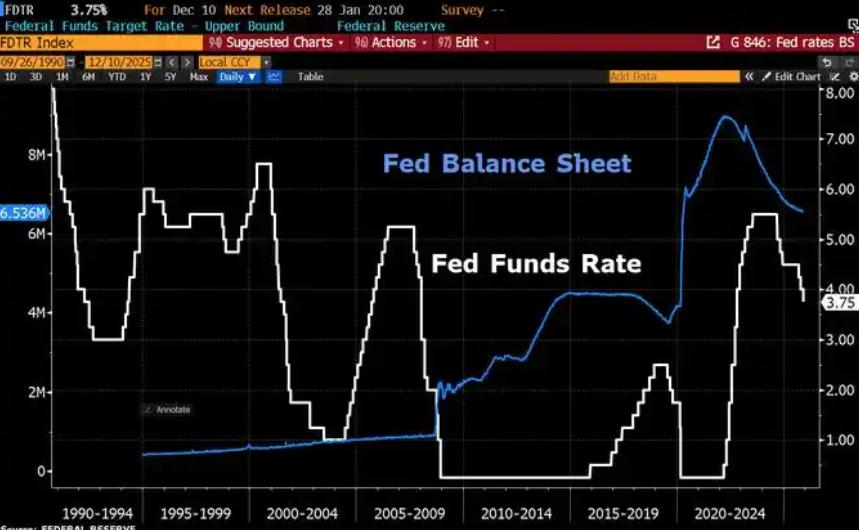
Since 2022, the Fed has cumulatively reduced its balance sheet by $2.4 trillion through quantitative tightening (QT) policies, leading to a near depletion of liquidity in the financial system. Key indicators such as the overnight repo rate (SOFR) have repeatedly exceeded the policy rate ceiling, indicating a shift from "abundance" to "scarcity" of bank reserves and an intensifying risk of funding shortages at the end of the year. Recently, the Fed concluded its interest rate decision for the year by cutting interest rates by 0.25 percentage points. As a result, the target range for the US federal funds rate was lowered to 3.50% to 3.75%. The Fed announced on Wednesday that it would launch a short-term Treasury bond purchase program to regulate market liquidity levels and ensure the Fed maintains a firm grip on its interest rate target system. As part of the latest Federal Open Market Committee meeting policy statement, the Fed indicated that this technical operation would commence on December 12. The first round of operations would purchase approximately $40 billion in short-term Treasury bonds. The Fed also added that the scale of bond purchases would "remain at a high level for several months" and then "significantly reduce" thereafter.
This action by the Fed to resume bond purchases immediately after ending its balance sheet reduction has a particularly significant impact on the financial sector. Firstly, it affects the US financial market. The main purpose of the Fed's resumption of bond purchases is to alleviate the liquidity shortage in the money market. By purchasing short-term Treasury bonds, the Fed increases the reserves in the banking system, helping to stabilize repo market interest rates and preventing them from further soaring. This helps maintain financial market stability and reduces market volatility. The Fed's bond purchase operations increase the demand for US Treasuries, thereby putting downward pressure on US Treasury yields. Especially the yields of short-term Treasury bonds, due to the Fed's direct purchase, may significantly decrease. This helps further reduce the financing costs for enterprises and promote economic activities. The Fed's bond purchase operations are typically seen as a positive signal for the market, helping to enhance market risk appetite. Under the influence of bond purchase operations, the US stock market may experience an upward trend. However, due to the Fed's emphasis that this bond purchase is not a shift in monetary policy, the rise in the stock market may be limited. At the same time, the Fed's bond purchase operations may increase the supply of the US dollar, thereby putting downward pressure on the US dollar exchange rate. This helps enhance the international competitiveness of US goods and promote export growth. However, the depreciation of the US dollar may also trigger intensified global currency competition, having a negative impact on other economies.
Secondly, it affects global financial markets. The Fed's bond purchase operations may change the direction of global capital flows. As the US dollar is the main reserve currency and trading currency in the world, the Fed's monetary policy adjustments often have a significant impact on global capital flows. The Fed's resumption of bond purchases may lead to some capital flowing back from emerging markets to the United States in search of higher returns and safer assets. However, as emerging markets have taken a series of measures to enhance their economic resilience and attractiveness in recent years, the impact of this capital flow back may be relatively limited. The Fed's bond purchase operations may intensify global currency competition. To respond to the Fed's accommodative policy, other central banks may also adopt similar easing measures to maintain their currency's competitiveness and stable exchange rates. This global easing competition may reignite the risk of asset bubbles and lead to increased volatility in global financial markets. The Fed's bond purchase operations may have an impact on the global debt market. As US Treasuries are one of the most important bond markets in the world, the Fed's bond purchase operations may change the supply and demand pattern and interest rate levels in the global debt market. This may affect the debt financing costs and debt sustainability of other economies.
The Fed's swift resumption of bond purchases after ending its balance sheet reduction, although it may inject liquidity into the market and boost risk appetite in the short term, still requires vigilance in the long run against risks such as inflation pressure, policy uncertainty, and rising volatility in the global debt market. Financial market participants need to closely monitor the Fed's subsequent policy moves to cope with potential market fluctuations and risk challenges.

Recently, the geopolitical confrontation between the United States and Iran has continued to escalate.

Recently, the geopolitical confrontation between the United…

The New York Times has recently clashed with the Trump admi…

Trader Peter Brandt has sparked a new round of discussion i…

On July 17th, Taiwan's stock market experienced a historic …

OpenAI updated its compute expenditure expectation through …

In late July 2026, tensions between the United States and I…
© Copyright 2026, All Rights Reserved