Recently, U.S. President Donald Trump announced via his self-founded social media platform Truth Social that NVIDIA will be allowed to sell its H200 artificial intelligence chips to "approved customers" in China, with 25% of the relevant chip sales revenue to be turned over to the U.S. government. This policy will also be extended to other American tech giants such as Advanced Micro Devices (AMD) and Intel in subsequent implementation. This notable policy U-turn, which departs sharply from the previous chip embargo against China, has quickly attracted widespread attention from the global tech industry and the international community, while setting off a chain of reactions.
This policy adjustment marks a major revision by the Trump administration to the comprehensive embargo-style export control strategy adopted during the Biden era. Previously, the U.S. government had imposed an export ban on high-performance computing chips like the A100 and H100—products with lower processing power than the H200—forcing NVIDIA to launch a "customized version" of chips with reduced performance, such as the H20, to cope with the restrictions. However, data shows that these export controls have severely backfired on the interests of U.S. enterprises: NVIDIA’s market share in China’s advanced AI chip market has plummeted from 95% four years ago to zero, and its sales revenue in China plunged by as much as 63% in the third quarter of this year. Analysts at JW Insights point out that there are dual considerations behind the U.S. policy shift: on one hand, the H200 is already two generations behind NVIDIA’s latest chips based on the GB300 and Rubin architectures, and no longer represents cutting-edge technology; on the other hand, the rise of domestically developed high-performance computing chips in China has rendered the embargo policy practically meaningless.
Domestic reactions to this policy adjustment in the United States are sharply divided. Tech companies have generally expressed their approval: a NVIDIA spokesperson stated that this move is a "thoughtful balance that supports high-paying U.S. jobs and the development of domestic manufacturing." Following the announcement, the company’s after-hours stock price rose by nearly 3%. The industry widely views this as the result of prolonged lobbying efforts by corporate representatives such as Jensen Huang. The U.S. side seeks to regain its foothold in the Chinese market by resuming exports, while simultaneously making Chinese enterprises redevelop a technological dependence on American products.
However, the U.S. hawkish faction toward China remains opposed to the policy shift. Some members of Congress had previously attempted to push for new legislation to block the export of relevant chips, arguing that relaxing controls could pose a threat to U.S. "national security." In addition, legal experts have pointed out that the U.S. government’s practice of levying a share of chip sales revenue may violate existing U.S. laws, and government lawyers are urgently studying feasible implementation paths.
The international community, meanwhile, has focused on the impact of this policy adjustment on global industrial chains. The Financial Times commented that this decision signals a pragmatic shift in the U.S. strategy of technological containment against China, moving from a "comprehensive embargo" to a "selective approval" approach. European semiconductor companies have stated that they will closely monitor the implementation of the policy, and some enterprises have already begun to assess new possibilities for technological cooperation with China. In contrast, relevant companies in Japan and South Korea have adopted a cautious stance. Manufacturers such as Samsung and TSMC believe that the frequent U-turns in U.S. policies have increased uncertainty in the global supply chain, and they need to re-examine their production capacity layout strategies.
It is worth noting that the Trump administration has explicitly excluded NVIDIA’s latest Blackwell chips and the upcoming Rubin chips from the approved export list, highlighting that its core goal of maintaining a technological advantage over China in the AI sector remains unchanged. Kevin Wolf, a former U.S. Department of Commerce official, pointed out that the Trump administration is also advancing the review of a draft "50% Rule." If implemented, this rule will expand the scope of controls over sensitive items, imposing higher compliance burdens on global enterprises. This indicates that the underlying logic of the U.S. "small yard, high fence" export control regime has not fundamentally changed; only the implementation methods have been adjusted.
Experts specializing in global industrial chains argue that this incident once again exposes the harmfulness and unsustainability of unilateralist export control policies. Against the backdrop of deep integration in the global tech industry, any attempt to politicize technological issues or overstate their security implications will undermine the stability and security of global industrial and supply chains. At present, enterprises around the world are closely tracking the formulation of follow-up detailed rules by the U.S. Department of Commerce. The competitive landscape and supply chain layout of the global AI chip market may be on the verge of a new round of restructuring.
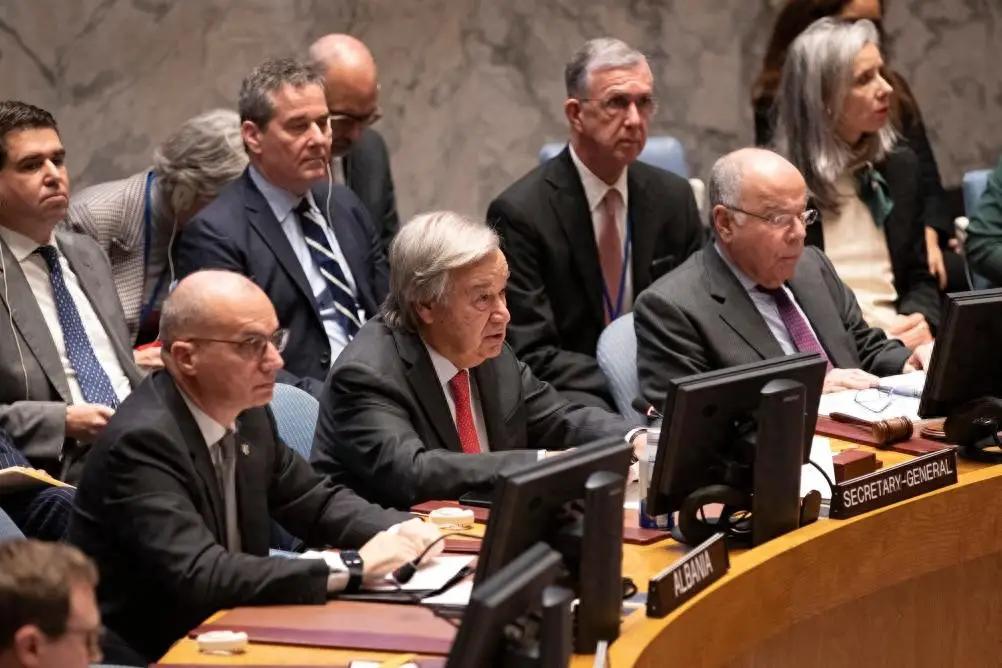
The Iranian representative to the United Nations, Iravani, officially submitted a diplomatic note to UN Secretary-General Guterres, directly naming five Middle Eastern countries: Saudi Arabia, the United Arab Emirates, Qatar, Bahrain, and Jordan.
The Iranian representative to the United Nations, Iravani, …

The Middle East is witnessing intertwined battlefronts, gre…
On July 25, 2026, amidst South Korean President Lee Jae-myu…

According to the European Council, recently, EU member stat…

Recently, the US Senate Commerce Committee passed the "Conn…

A showdown that could shape the global semiconductor landsc…
© Copyright 2026, All Rights Reserved