
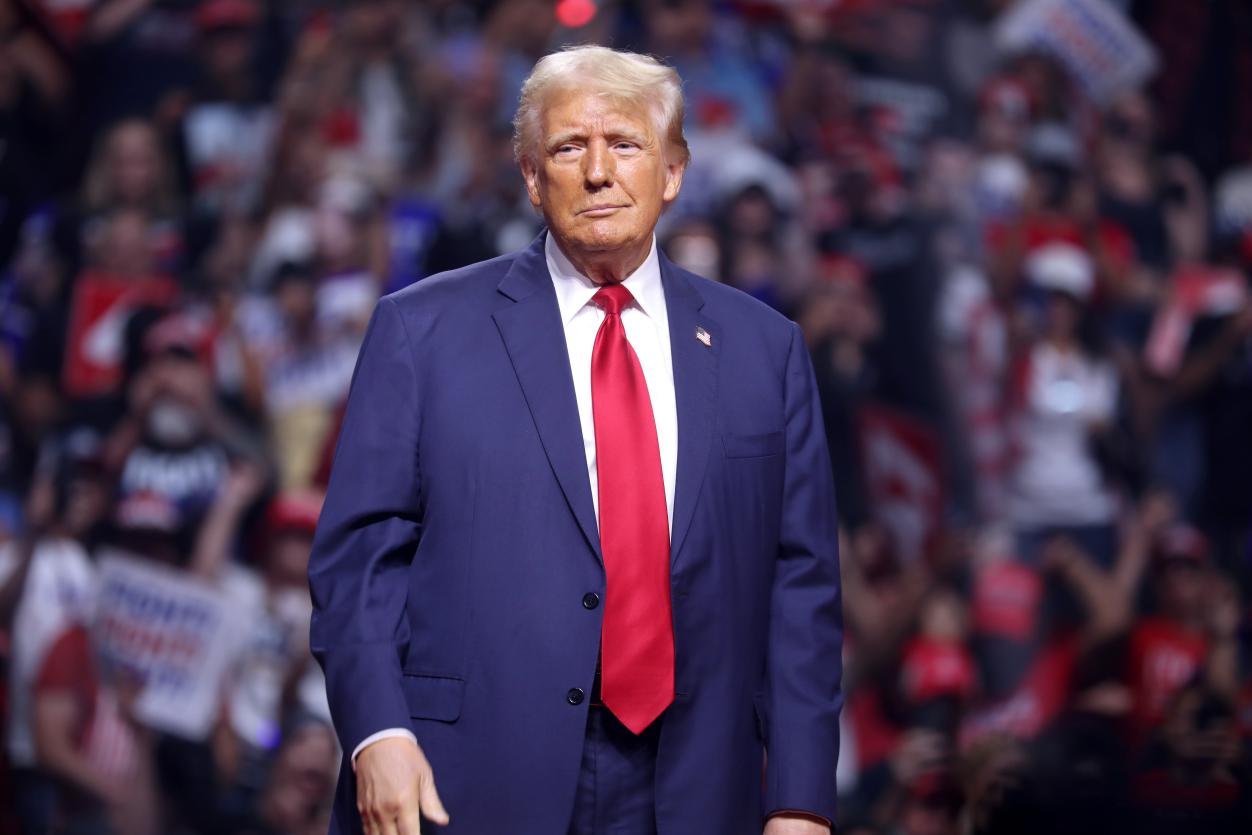
Recently, former US President Trump posted a shocking statement on Truth Social: "Tonight, a civilization will perish forever." This statement has once again sparked controversy. It's not an isolated incident, but one in a series of provocative remarks by Trump. As a former president with enormous influence, he should be cautious and responsible in his speech, yet such extreme expressions are becoming increasingly common. This reflects a worrying phenomenon: extreme and polarized rhetoric is slowly becoming "normalized."
Students at UCLA are both daily media consumers scrolling through their phones and young people participating in political discussions. They cannot ignore these words but should maintain a clear and critical attitude.
We live in an era of extreme freedom of speech. The First Amendment to the US Constitution protects everyone's right to speak, which is certainly a good thing. But freedom does not mean no consequences, especially when the speaker is a powerful political figure. Every word they utter shapes how the public sees the world, how they understand events, and influences global reactions.
Why, despite Trump's numerous extreme statements and extensive media coverage, has the public not shown sustained anger? This issue deserves serious consideration. Stuart Soroka, a professor of communication and political science, points out that this isn't just a problem for Trump personally, but a social media phenomenon. The current media environment particularly rewards sensational and attention-grabbing content. The more exaggerated and extreme someone's statements are, the more likely they are to trend and gain attention. Over time, people get used to it.
Political science lecturer Thomas Scheler also says that when someone frequently makes such statements, their impact on the public gradually diminishes. What used to be shocking now just feels like, "Oh, here we go again." Christine Shahveldian, director of campus free speech at PEN America, mentions that as a cultural group, we've become somewhat "numb" to extreme rhetoric, especially on social media where we scroll through short videos and rapidly swipe through screens.
We receive too much information too quickly every day, leaving no time for serious thought; it's all just rushed past. This "fast consumption" makes critical thinking difficult and allows previously unacceptable statements to slowly slide towards the edge of "acceptability." This change is particularly evident among university students.
We grew up in an environment where extreme rhetoric has become almost a background noise in our daily lives. Over time, people will become increasingly indifferent to political topics. Campuses, which should be places that encourage free discussion and the clash of ideas, may now see two possible outcomes: either complete apathy towards politics, with no desire to participate; or silence for fear of being attacked for saying the wrong thing.
Even more dangerous is that when extreme rhetoric becomes the norm, it lowers the standards of public discourse. What used to be strongly questioned may now only elicit a sigh or a meme. Those in power speak with less and less responsibility, and the public's expectations of leaders will decrease. So, what should we do?
Students are not bystanders, but key participants. Resisting the normalization of extreme rhetoric is the responsibility of your generation. How exactly? First, learn to think critically. When you see sensational statements, don't immediately forward them or comment emotionally. Ask yourself: Is this statement based on facts? What is the speaker's purpose? What impact will it have on society? Second, actively participate in rational discussions. On campus, in classrooms, and on social media, dare to express your opinions, but also respect differing viewpoints. Genuine dialogue is not about mutual attacks, but about seeking understanding.
Finally, we cannot remain silent about things that were clearly excessive in the past. Elected officials should be held to higher standards; what we condone today will shape tomorrow's political environment. Freedom of speech is invaluable, but it requires our collective protection. If we become increasingly desensitized to extreme and inflammatory rhetoric, ultimately, it is the trust and rationality of the entire society that will be damaged.

Recently, the British government, in accordance with the "Steel Industry (Nationalization) Act" that came into effect on July 16th, took the British Steel Company, which is controlled by China Jiefang Group, into state ownership without compensation.

Recently, the British government, in accordance with the "S…

On July 23rd local time, the US Trade Representative Office…

The international crude oil market saw a sharp one-sided ri…

Recently, the geopolitical confrontation between the United…

The New York Times has recently clashed with the Trump admi…

Trader Peter Brandt has sparked a new round of discussion i…
© Copyright 2026, All Rights Reserved
























