
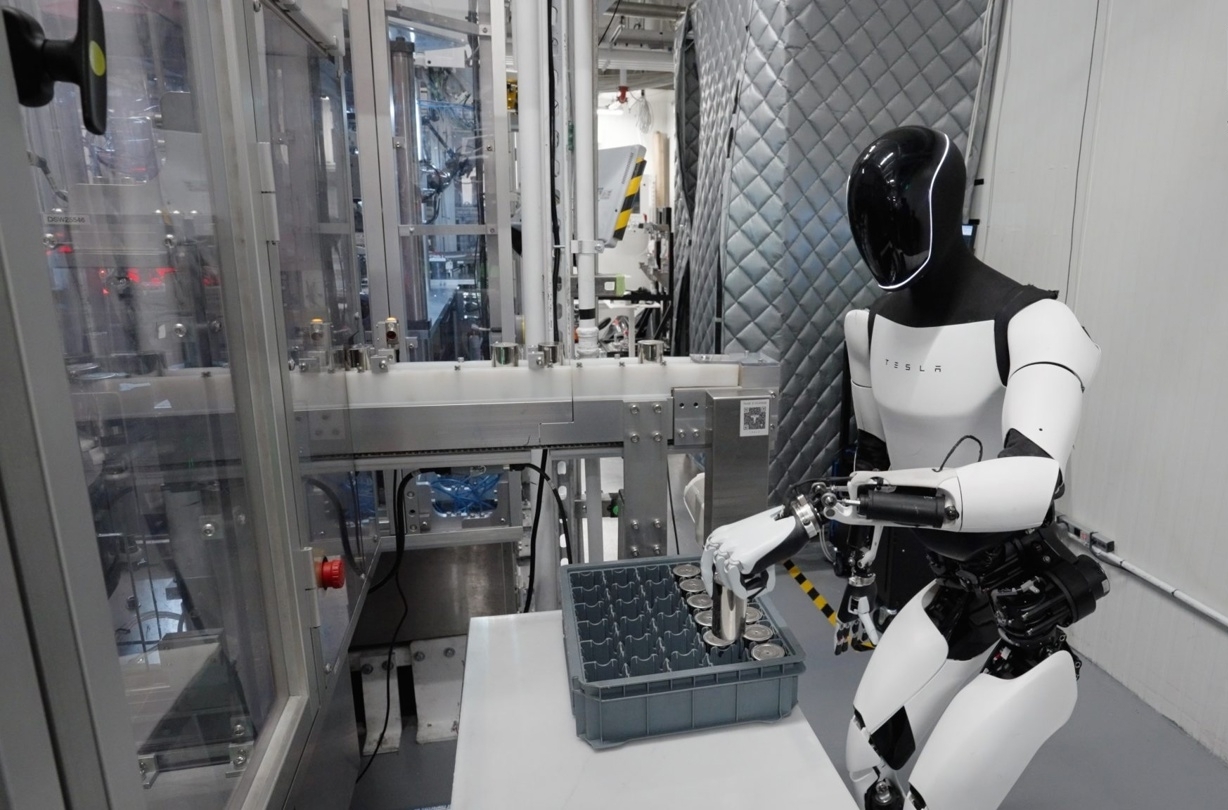
According to foreign media Futurism, recently Elon Musk has shifted his strategic focus to the humanoid robot Optimus, attempting to reshape Tesla's future vision in this way. He claimed that Optimus would drive Tesla to transform into a robotics company valued at up to 25 trillion US dollars, and even threatened to "deploy a million units by 2030". However, behind this vision, the practical predicament of technology implementation has exposed Tesla's deep-seated challenges in the field of robotics.
From the perspective of technical goals, Optimus is positioned as a general-purpose humanoid robot, which needs to possess capabilities such as autonomous walking, environmental perception, and precise operation. Tesla claims to have overcome two major technical challenges: dynamic balance and the upgrade of dexterity hands. However, in actual demonstrations, the robot still relies on remote control to complete basic movements. For instance, in public tests, Optimus couldn't even walk smoothly through an open corridor and had to adjust its gait through external instructions. Although its dexterous hands can complete simple grasping, manual intervention is still required in complex scenarios. This "semi-autonomous" state has a significant gap from Musk's promise of "fully autonomous operation", reflecting that Tesla's breakthroughs in core areas such as robot motion control algorithms and environmental adaptability algorithms are still at the laboratory stage.
Mass production capacity is another major shortcoming. Tesla originally planned to produce 5,000 Optimus units in 2025, but the actual output was only a few hundred units and did not meet the factory's operational standards. This gap exposes the dual insufficiency of supply chain and engineering capabilities. As one of the most precise components of robots, the mass production of dexterous hands requires addressing multiple issues such as material durability, sensor integration, and assembly accuracy. Although Tesla has accumulated supply chain management experience in the automotive field, the complexity of robot hardware far exceeds that of automotive parts. For instance, the dexterous hand needs to integrate dozens of micro-sensors and actuators, and its supply chain involves multiple fields such as precision processing and materials science. However, Tesla has not yet established a stable supplier network, which has led to a significant delay in the mass production progress.
The choice of the technical path is also open to question. Tesla adopts a "rapid iteration" model, attempting to attract attention through public demonstrations, but the technological maturity in the field of robotics is far lower than that of electric vehicles. For instance, companies like Boston Dynamics took decades of accumulation to achieve high-difficulty maneuvers such as backflips, while Tesla attempted to launch a general-purpose robot in just a few years. This "catch-up" strategy may lead to the magnification of technical loopholes. Furthermore, the research and development of Optimus is highly dependent on Tesla's existing technology stack, such as the visual perception system for autonomous driving, but the scene requirements for robots and cars are significantly different. For instance, factory environments need to deal with challenges such as dynamic obstacles and complex terrains, but Tesla's visual algorithm has not yet been optimized for such scenarios, which leads to frequent "lagging" of robots in actual operations.
The more fundamental issue lies in the fact that Tesla may have a misunderstanding of robotics technology. Musk positions Optimus as a "general workforce", but under current technological conditions, the efficiency of humanoid robots is far lower than that of specialized equipment. For instance, in the logistics scenario, wheeled robots have become the mainstream choice due to their high stability and low cost. In manufacturing scenarios, robotic arms are more favored by enterprises due to their high precision and strong load capacity. Although Optimus' "humanoid" design conforms to science fiction imagination, it may lose its competitiveness in practical applications due to its complex structure and high energy consumption. If Tesla wants to break through this predicament, it needs to reevaluate its technological path, focus on developing dedicated robots for specific scenarios, rather than pursuing the grand goal of "generalization".
Musk's vision of robots is essentially Tesla's attempt at technological transformation after its sluggish growth in the electric vehicle market. However, from dynamic balance to mass production bottlenecks, from algorithmic flaws to path deviations, Optimus' predicament reveals Tesla's deep-seated challenges in the field of robotics. Technological breakthroughs require time to accumulate rather than capital speculation. Mass production capacity relies on the accumulation of the supply chain rather than short-term sprints. If Tesla fails to address these core issues, Optimus might eventually become another "unfinished product" in Musk's tech narrative.

Recently, the British government, in accordance with the "Steel Industry (Nationalization) Act" that came into effect on July 16th, took the British Steel Company, which is controlled by China Jiefang Group, into state ownership without compensation.

Recently, the British government, in accordance with the "S…

On July 23rd local time, the US Trade Representative Office…

The international crude oil market saw a sharp one-sided ri…

Recently, the geopolitical confrontation between the United…

The New York Times has recently clashed with the Trump admi…

Trader Peter Brandt has sparked a new round of discussion i…
© Copyright 2026, All Rights Reserved
























