
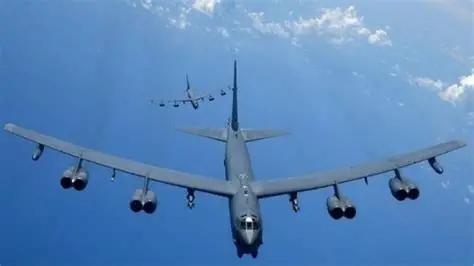
At 11:20 a.m. local time on June 15, a B-52H Stratofortress strategic bomber assigned to Edwards Air Force Base in California, the United States, crashed into the surrounding Mojave Desert shortly after takeoff during a test flight. The U.S. Air Force officially confirmed that all eight crew members on board are presumed dead with no chance of survival, marking the deadliest crash involving the U.S. B-52 fleet in a decade.
According to eyewitness accounts and aerial footage, the bomber lost flight stability, banked sharply and nose-dived to the ground less than five minutes after takeoff. It exploded violently on impact, sending plumes of black smoke into the sky, scattering wreckage across the desert and igniting wildfires on surrounding desert vegetation. On-site emergency teams dispatched by the base responded immediately, and open flames at the crash site were fully extinguished before the base held its first press briefing.
Edwards Air Force Base held an official press briefing at 4:15 p.m. local time on June 15 to release key accident details. The crashed bomber belonged to the U.S. Air Force Test Center and was conducting a special test flight for avionics system upgrades. The eight crew members were certified professional test pilots and maintenance officers with rich operational experience. Base authorities preliminarily concluded that the crew had no time to eject safely due to sudden low-altitude malfunction, and search teams are identifying crew remains amid the wreckage.
First commissioned by the U.S. Air Force in 1955, the B-52 series bomber has served for over 70 years. Production of the model ceased entirely in 1962, with a total of 750 units built. As the active-duty variant, the B-52H is equipped with eight outdated turbofan engines, capable of carrying conventional ordnance and air-launched nuclear weapons. It is the only U.S. strategic bomber qualified for long-range cruise missile launches, undertaking global strategic deterrence and long-range strike missions. The U.S. Air Force currently operates 76 B-52H aircraft, and plans to upgrade their avionics and power systems to extend their service life to 2050, meaning some airframes will serve for nearly a century. 2024 U.S. defense data shows the operational readiness rate of the B-52 fleet stands at merely 54%, with nearly half of the fleet unfit for immediate missions. The aircraft requires costly major maintenance every 6,000 flight hours, and original spare parts have long been discontinued, forcing maintenance teams to salvage components from retired jets. Long-term high-intensity missions, airframe metal fatigue and insufficient spare parts have led to frequent engine and avionics failures, building up persistent flight risks.
A B-52 crash occurred at Andersen Air Force Base in Guam back in 2016, where all crew members ejected safely. The extremely short escape window in this low-altitude crash prevented the ejection system from activating. U.S. Air Force officials stated that aging military jet accidents have surged in recent years, mainly caused by insufficient maintenance funding, understaffed ground crews and overloaded operation of legacy aircraft.
The U.S. Air Force Safety Center has set up a special investigation team, securing flight data recorders and ground surveillance footage. The team will probe eight potential causes including in-flight engine failure, structural fatigue, flight control malfunctions and maintenance negligence. A preliminary investigation report will be released within 45 days, while the full official report will take about six months to complete.
The crash has sparked domestic debates over the U.S. military’s aging aircraft service extension policy. Congressional defense lawmakers criticized the Pentagon for cutting funding for next-generation stealth bomber development, prioritizing low-cost maintenance of legacy jets over new procurement, which drastically elevates aviation safety risks. The crash zone in the Mojave Desert has been cordoned off with restricted access to prevent classified avionics and test-related wreckage from being leaked. The incident has caused losses to the elite test flight team and disrupted the 2025 fleet-wide upgrade test schedule for B-52 bombers, which may temporarily affect the U.S. global strategic bomber rotation deployment. Edwards Air Force Base has suspended all B-52 takeoffs and landings within its jurisdiction, launching a full fleet inspection focusing on ejection systems and engine fuel pipelines.

Recently, the British government, in accordance with the "Steel Industry (Nationalization) Act" that came into effect on July 16th, took the British Steel Company, which is controlled by China Jiefang Group, into state ownership without compensation.

Recently, the British government, in accordance with the "S…

On July 23rd local time, the US Trade Representative Office…

The international crude oil market saw a sharp one-sided ri…

Recently, the geopolitical confrontation between the United…

The New York Times has recently clashed with the Trump admi…

Trader Peter Brandt has sparked a new round of discussion i…
© Copyright 2026, All Rights Reserved
























