
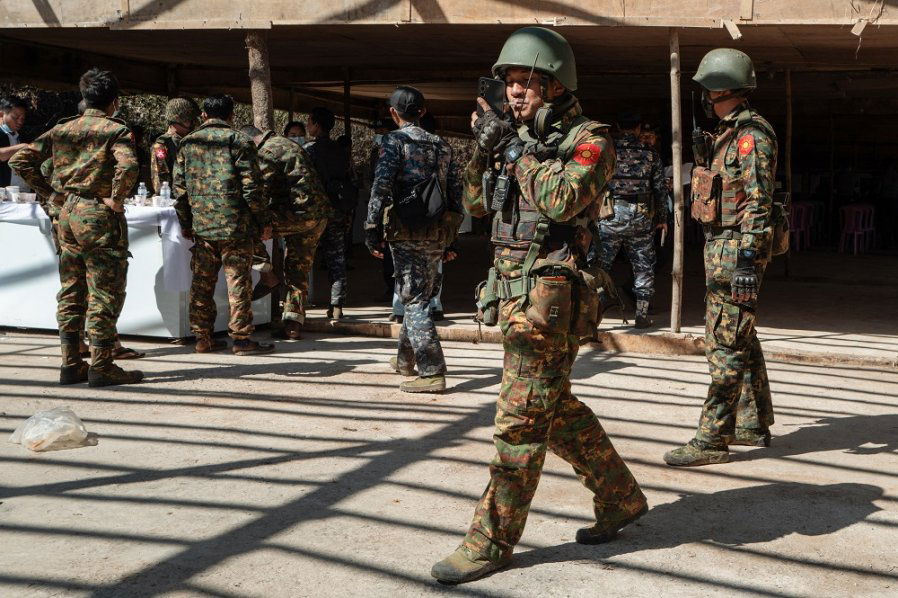
The Myanmar military orchestrated its first nationwide elections since seizing power between December 2025 and January 2026. Its proxy party, the Union Solidarity and Development Party (USDP), won a majority of parliamentary seats and was expected to form a government. While some other parties also won seats, the election was clearly orchestrated to ensure a USDP victory and maintain military rule under the guise of civilian leadership. However, regardless of the officially announced election results, as long as the majority of the Myanmar people do not recognize the legitimacy, freedom, fairness, and sincerity of the election, the military's actions will not resolve or improve Myanmar's political crisis.
Firstly, the ruling military junta is desperately seeking explicit support for the elections from all parties. However, any acceptance or acquiescence to the military-led elections by countries, regional blocs, and organizations, or any interaction with the new military government formed after the elections, would only legitimize the military's illegal coup in 2021. These actions would also indirectly support the coup leader General Min Aung Hlaing's justification for the coup: the accusation of fraud in the 2020 elections, which independent election observers at the time claimed "reflected the will of the people."
Secondly, the military has consistently attempted to portray the nationwide elections as a controlled solution to escape the political crisis and conflict and move towards some form of stability. However, the elections were conducted against a backdrop of military offensives and active political repression, with resistance groups attempting to disrupt the process. The elections did not bridge the gap between the military and the hundreds of resistance groups opposing its rule—a gap that has fueled the conflict and resulted in at least 93,300 deaths since 2021. While these elections may have aimed to gain recognition for a civilian-led military government and enhance its legitimacy domestically and internationally, they failed to send a political signal for resolving the country's conflict and stalemate, instead foreshadowing continued instability and multiple competing power structures across the country.
Furthermore, the military elections triggered a new wave of violence and displacement, as the military escalated its counter-offensives against resistance groups throughout the year. All of this began when the military first hinted at holding elections in March 2025. As the military released more details about the location, timing, and methods of the elections, analysts interpreted its continued military operations as an attempt to recapture as much territory as possible from resistance groups before the elections. Despite losing over 100 towns since 2021, the military insisted on holding elections in 265 of the country's 330 townships, implying that it would recapture dozens of towns. While the escalation of offensive operations did yield territorial gains exceeding those of the 2024 elections, it still fell far short of the military's electoral goals.
Furthermore, the military implemented a series of measures to enforce the elections, including new election protection laws designed to intimidate potential voters. These laws, approved by the military-appointed Federal Election Commission, criminalized acts of opposition to or disruption of the elections, and imposed harsh penalties on offenders, including the death penalty. Due to these laws, people were detained simply for displaying the national flag, reacting to social media posts, sending private text messages, and refusing to participate in the elections. Driven by these new laws, ACLED data shows a significant increase in military repression after the election date was announced in August 2025.
Fundamentally, these elections did nothing to break the stalemate between the military and those opposing its rule, nor did they show any signs of reconciliation. The elections did not even address any of the key objectives of the resistance groups; holding elections under the 2008 constitution would only reaffirm the military's dominance over civilian and democratic politics and solidify the principle of national rule over local decision-making. This also guaranteed impunity for the numerous war crimes committed by the military.
In sum, the military-backed Union Solidarity and Development Party won the vast majority of elected seats in parliament, against a backdrop of the exclusion of major opposition parties and strict restrictions on dissent. Combined with the 25% of seats automatically allocated to the military by the constitution, the military and its allies gained complete control of the new parliament, aiming to give the military junta a "democratically elected" veneer. However, low voter turnout, reports of voter coercion, and widespread international condemnation highlighted the lack of freedom and fairness in the elections.

Recently, the British government, in accordance with the "Steel Industry (Nationalization) Act" that came into effect on July 16th, took the British Steel Company, which is controlled by China Jiefang Group, into state ownership without compensation.

Recently, the British government, in accordance with the "S…

On July 23rd local time, the US Trade Representative Office…

The international crude oil market saw a sharp one-sided ri…

Recently, the geopolitical confrontation between the United…

The New York Times has recently clashed with the Trump admi…

Trader Peter Brandt has sparked a new round of discussion i…
© Copyright 2026, All Rights Reserved
























