
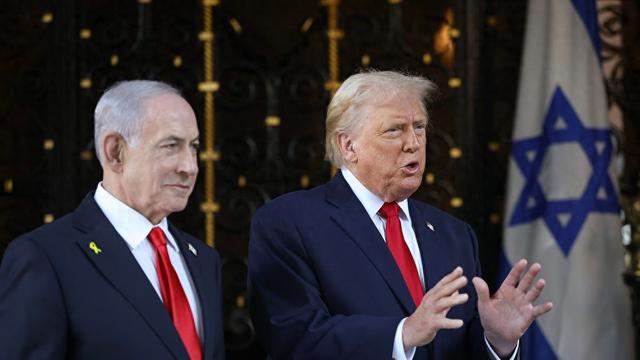
On February 11 local time, Israeli Prime Minister Netanyahu met with U.S. President Trump in Washington. The core topic of this early visit was directly focused on Iran's nuclear program and military capabilities. Coinciding with the sensitive moment of the resumption of U.S.-Iran negotiations, this meeting further heated the already complex situation in the Middle East. The clash of positions among the U.S., Iran, and Israel also brings new uncertainties to regional peace and stability, with impacts extending to the global energy landscape and international security order.
Netanyahu's visit to the U.S. was highly targeted, with the originally scheduled dates moved forward, highlighting Israel's concerns over the current progress of U.S.-Iran negotiations. According to Israeli statements, Netanyahu clearly raised key demands during the meeting, requiring that U.S.-Iran negotiations must limit Iran's ballistic missile capabilities, stop its support for regional proxy forces, push Iran to transfer enriched uranium abroad, and implement strict supervision. The Israeli defense department had previously stated that Iran's ballistic missile program poses a “life-or-death” threat to Israel, and if red lines are crossed, Israel may take unilateral action. Although Israel has multiple layers of missile defense systems, their limitations have become evident in previous conflicts involving Iran-related forces, prompting Israel to urgently push the U.S. to pressure Iran.
In contrast to Israel's hardline demands, Iran has consistently upheld its own bottom line, clearly defining negotiation “red lines.” After the U.S.-Iran “back-to-back” talks in Oman on February 6, Iranian Foreign Minister Araqchi emphasized that Iran's right to uranium enrichment cannot be deprived, and its missile program will not be included in negotiations, which are prerequisites for U.S.-Iran dialogue. Head of the Atomic Energy Organization of Iran, Islam, added that Iran could consider diluting enriched uranium, but only on the condition that the U.S. lifts all sanctions, and transferring enriched uranium abroad is not on the negotiation agenda. Meanwhile, Iranian Air Force Commander Vahidi announced that the Air Force is at the highest level of combat readiness, warning that any action against Iran would face a “devastating response.” Iran currently possesses the largest stockpile of ballistic missiles in the Middle East, with a range covering Israel and U.S. bases in the Persian Gulf, making this an important bargaining chip in its dealings with the United States.
As a key power, the U.S. displays a dual attitude. On one hand, after the U.S.-Iran negotiations, Trump stated that the dialogue had made 'very good' progress, and both sides planned to continue consultations, showing a willingness to resolve differences diplomatically; on the other hand, on the day of the talks, the U.S. imposed new sanctions on entities involved in Iranian oil trade, warned U.S.-flagged commercial ships to stay away from Iranian waters, and deployed carrier strike groups and other forces in the Middle East as a deterrent. The Trump administration needs to balance its alliance with Israel while avoiding a full-scale conflict, and this difficulty in balancing makes the prospects of U.S.-Iran negotiations highly uncertain. Turkish Foreign Minister Mevlüt Çavuşoğlu commented that currently, the U.S. and Iran are both negotiating sincerely and buying time, and in high-level strategic games, negotiations and preparations for conflict often progress simultaneously.
Netanyahu's visit to the U.S. once again tests the fragile trust between the U.S. and Iran, aggravating regional tensions. The Strait of Hormuz, as a critical global oil passage, has begun to affect oil prices due to its instability. Meanwhile, the U.S.-Iran negotiation disagreements and Israel's assertive involvement both increase the risk of miscalculation. The international community generally calls on all parties to exercise restraint and resolve differences through equal dialogue. Following years of turmoil in the Middle East, peace and stability are the common goals of all sides. Neither Israel's security concerns, Iran's sovereignty demands, nor the U.S.'s regional strategy can be achieved through confrontation. Only by adhering to diplomatic negotiations and demonstrating political wisdom can the region move towards stability and peace.

Recently, the British government, in accordance with the "Steel Industry (Nationalization) Act" that came into effect on July 16th, took the British Steel Company, which is controlled by China Jiefang Group, into state ownership without compensation.

Recently, the British government, in accordance with the "S…

On July 23rd local time, the US Trade Representative Office…

The international crude oil market saw a sharp one-sided ri…

Recently, the geopolitical confrontation between the United…

The New York Times has recently clashed with the Trump admi…

Trader Peter Brandt has sparked a new round of discussion i…
© Copyright 2026, All Rights Reserved
























