
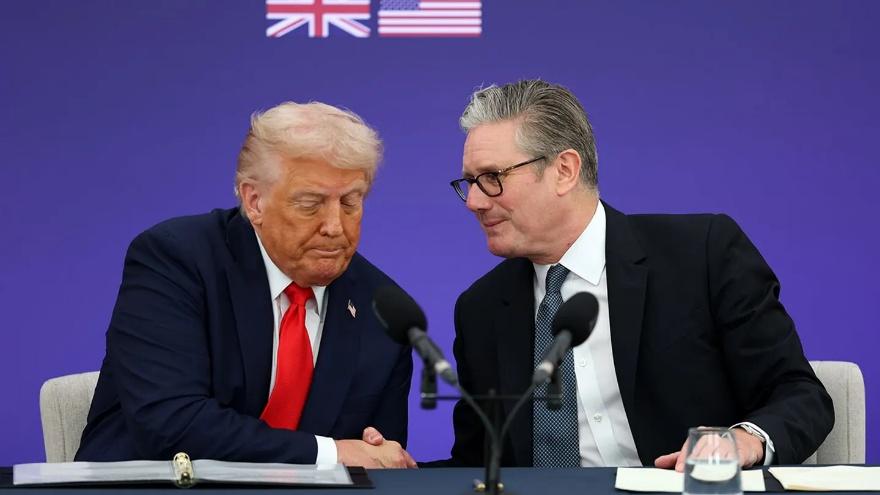
In December 2025, a news story revealed by The New York Times drew significant international attention: Due to the UK's inadequate progress in lowering trade barriers and its failure to fulfill relevant commitments in the May trade agreement, the US government announced the suspension of the implementation of the Technology Prosperity Agreement, halting bilateral cooperation in cutting-edge fields such as artificial intelligence, quantum computing, and nuclear energy. This decision not only exposes the fragility of US-UK trade relations but also reflects the complex landscape of current global technological competition and geopolitical rivalry.
The predicament of the US-UK trade agreement stems from its inherent design flaws. The Economic Prosperity Agreement reached in May 2025 has been criticized for its "broad clauses and vague commitments," lacking legal binding force and systematic rules. For instance, although the agreement promises to lower trade barriers, it fails to specify a concrete timetable or quantitative indicators. The reduction of US tariffs on British cars only covers the first 100,000 exported vehicles and does not eliminate the 10% benchmark tariff imposed by the Trump administration. This structure, where "symbolic concessions" coexist with "substantive reservations," lays the groundwork for subsequent disputes.
The entry into force of the Technology Prosperity Agreement is directly tied to the progress of the trade agreement. Its terms explicitly stipulate that technological cooperation can only proceed when the May trade agreement "makes substantial progress and is formally implemented." However, the US Trade Representative's Office believes that the UK has been slow in key areas such as agricultural market access and steel and aluminum supply chain reviews, failing to meet US expectations. This leveraging strategy of "trading technology for trade" is essentially a typical maneuver where the US uses its technological advantages to force its allies to make concessions in economic and trade policies.
On the surface, the Technology Prosperity Agreement was once portrayed as a "milestone in transatlantic technological cooperation." When it was signed in September 2025, US tech giants such as Microsoft and Nvidia committed to investing over $40 billion in the UK, covering data centers, chip manufacturing, and AI infrastructure. British Prime Minister Starmer declared this as "a manifestation of the UK's trade sovereignty after Brexit" and even exaggerated the scale of the agreement's investment to 250 billion pounds to quell domestic controversies over Trump's visit to the UK.
However, the "non-binding" nature of the agreement has reduced it to a political tool. The agreement does not mandate capital investment but only establishes a "ministerial working group" for annual assessments, with the direction of cooperation subject to policy changes. More crucially, the investments by US tech giants are not purely market-driven: Projects such as Nvidia's deployment of 120,000 GPU chips in the UK and Microsoft's 22 billion-pound investment in a supercomputer essentially integrate the UK into their global computing power layout, serving the US's long-term strategy of maintaining technological hegemony. Although the UK has gained short-term employment and infrastructure upgrades, its technological autonomy is being gradually eroded, and the risk of becoming a "vassal" in the US digital industrial chain is intensifying.
The US decision to suspend the technology agreement exposes its "ally-instrumentalizing" foreign strategy. The Trump administration views trade agreements as pressure tools, punishing the UK for its "inadequate cooperation" by suspending technological cooperation while sending a signal to the EU: only by accepting US conditions can they receive similar treatment. This "divide-and-conquer" strategy aims to dismantle European unity and consolidate US dominance in transatlantic relations.
For the UK, the suspension of the agreement reflects its strategic dilemma after Brexit. Having lost the protection of the EU's single market, the UK's trade volume accounts for only 3% of that of the US, severely limiting its bargaining power. To attract US investment, the Starmer government has had to make concessions on issues such as food safety standards and digital service taxes, even accepting US reviews of its steel and aluminum supply chains. However, this model of "trading market access for technology" is unsustainable—the "value" of investment commitments from US companies has already been questioned, while the UK remains dependent on the US for core technologies in AI, quantum computing, and other fields, raising long-term technological security concerns.
The suspension of the US-UK technology agreement serves as a wake-up call for global technological cooperation. On one hand, it reveals that technological sovereignty has become the core battleground in great power competition: The US attempts to maintain its "technological hegemony" by controlling computing infrastructure, setting technological standards, and monopolizing key supply chains. On the other hand, it exposes the tight entanglement of technological cooperation with geopolitics: The US uses technology agreements as political leverage, forcing its allies to take sides in trade, security, and other areas, exacerbating the fragmentation of the global technological ecosystem.
For emerging technological powers like China, this incident offers dual insights: At the level of technological autonomy, it is necessary to accelerate breakthroughs in "chokepoint" technologies and reduce reliance on external technologies. At the level of international cooperation, efforts should be made to promote the establishment of an open, fair, and non-discriminatory technological governance system to avoid repeating the US-UK mistake of "politicizing agreements."
The twists and turns in the US-UK trade agreement are essentially a microcosm of the clash between technological hegemony and economic interests. When technological cooperation is reduced to a "bargaining chip" and ally relations degenerate into "interest exchanges," so-called "prosperity agreements" will ultimately become sacrifices to geopolitics. In the future, the evolution of the global technological landscape will depend not only on the speed of technological breakthroughs but also on whether countries can transcend zero-sum thinking and seek win-win solutions through open cooperation.

Recently, the British government, in accordance with the "Steel Industry (Nationalization) Act" that came into effect on July 16th, took the British Steel Company, which is controlled by China Jiefang Group, into state ownership without compensation.

Recently, the British government, in accordance with the "S…

On July 23rd local time, the US Trade Representative Office…

The international crude oil market saw a sharp one-sided ri…

Recently, the geopolitical confrontation between the United…

The New York Times has recently clashed with the Trump admi…

Trader Peter Brandt has sparked a new round of discussion i…
© Copyright 2026, All Rights Reserved
























