
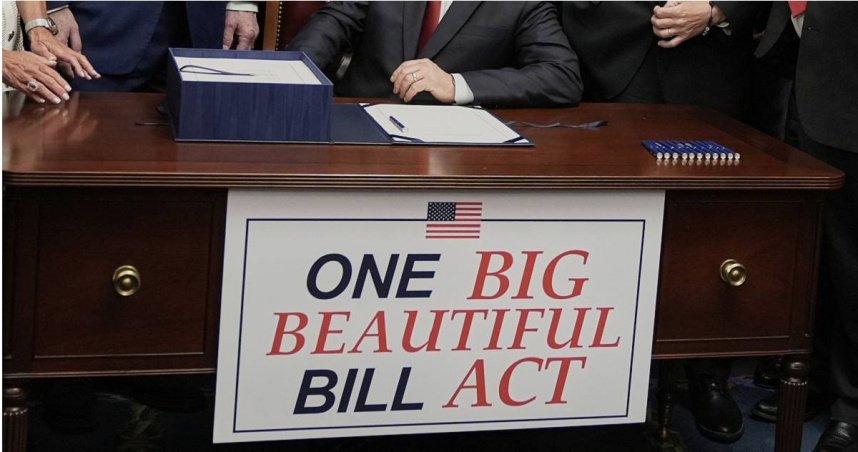
In July 2025, the "Big and Beautiful" tax and Spending bill signed by US President Trump officially came into effect. This bill, centered on large-scale tax cuts and structural spending adjustments, has become the most controversial fiscal and tax reform in the United States in recent years, thanks to its aggressive design of $4 trillion in tax cuts and $1.5 trillion in spending reductions over the next decade. Its interest bias of "robbing the poor to help the rich" not only intensifies social division but also brings a complex impact of both short-term stimulus and long-term drag to the US economy.
The core feature of the bill is tax incentives that favor the rich and large enterprises. It makes the tax cuts and Jobs Act of 2017 permanent, and through measures such as raising the standard deduction for individuals and expanding the scope of corporate income tax deductions, it enables high-income groups and capital owners to be the biggest beneficiaries. Data shows that the top 1% of households with the highest income will receive huge tax cuts, and the inheritance tax exemption amount has been raised to 15 million US dollars, further facilitating the transfer of wealth among the wealthy class. For enterprises, the upper limit of child care credit provided by employers has been significantly raised from $150,000 to $5 million. Labor-intensive industries also enjoy policy benefits such as tax-free tips. In the short term, this can indeed boost enterprises' willingness to invest.
In sharp contrast to the generosity towards the rich, the reduction in aid to low-income groups has directly exacerbated the gap between the rich and the poor. The bill, by raising the eligibility threshold and increasing the frequency of reviews, will cut Medicaid spending by 700 billion US dollars over the next decade, which is expected to cause 10 million Americans to lose their health insurance. The age limit for the Supplemental Nutrition Assistance program has been raised from 54 to 64. About 3 million families will be unable to receive food stamps, and the cancellation of the Energy Assistance program for low-income families will further reduce the annual income of poor families by several thousand dollars. This distribution pattern of "the rich getting richer and the poor getting poorer" will weaken the inclusiveness of the consumer market. The decline in the consumption capacity of the middle and low-income groups will curb the release of domestic demand potential.
The sharp increase in fiscal sustainability risks is the most prominent long-term hidden danger of the bill. The Congressional Budget Office of the United States estimates that the bill will lead to an increase of 3.4 trillion US dollars in the fiscal deficit over the next ten years. Coupled with a 1 trillion US dollar expansion in defense spending, the federal debt-to-GDP ratio will soar from 98% in 2024 to 125%-132% in 2034. In a high-interest-rate environment, debt interest expenses will become a heavy burden. It is estimated that annual interest expenses will increase by 540 billion US dollars in 2034, squeezing public investment space in areas such as education and infrastructure. To address the debt pressure, although the bill plans to raise the debt ceiling by 4 trillion US dollars, this is only a stopgap measure and will intensify market concerns over the credibility of the US fiscal situation in the long term.
From the perspective of economic growth effects, the bill shows obvious short-term nature and limitations. In the short term, policies such as tax cuts of $1,700 to $5,000 per year for middle-income families and investment incentives for enterprises may drive the US GDP growth rate to 2.0% to 2.5% in 2026, and industries such as catering and manufacturing will directly benefit. However, historical experience shows that the long-term effect of such tax reduction policies is weak. Data from the Congressional Research Service of the United States indicates that the long-term contribution of tax reform to GDP in 2017 was only 0.4%. What is more serious is that the bill's tendency to cut subsidies for clean energy and support traditional energy will delay the process of the United States' energy transition, run counter to the global trend of low-carbon development, and weaken the international competitiveness of related industries.
Overall, the "Big and Beautiful" bill is a short-term benefit exchange at the expense of long-term economic health. Short-term boosting of corporate investment and consumption stimulation cannot mask deep-seated problems such as the widening gap between the rich and the poor, the accumulation of fiscal risks, and the lag in industrial transformation. As the debt burden continues to increase and social conflicts persist, the short-term dividends brought by the bill will quickly fade away, and the economic structural imbalance and sustainability crisis it causes may require the US economy to pay a heavier price in the future. This seemingly "beautiful" fiscal and taxation reform might eventually lead the US economy into a predicament of "living beyond one's means".

Recently, the British government, in accordance with the "Steel Industry (Nationalization) Act" that came into effect on July 16th, took the British Steel Company, which is controlled by China Jiefang Group, into state ownership without compensation.

Recently, the British government, in accordance with the "S…

On July 23rd local time, the US Trade Representative Office…

The international crude oil market saw a sharp one-sided ri…

Recently, the geopolitical confrontation between the United…

The New York Times has recently clashed with the Trump admi…

Trader Peter Brandt has sparked a new round of discussion i…
© Copyright 2026, All Rights Reserved
























