
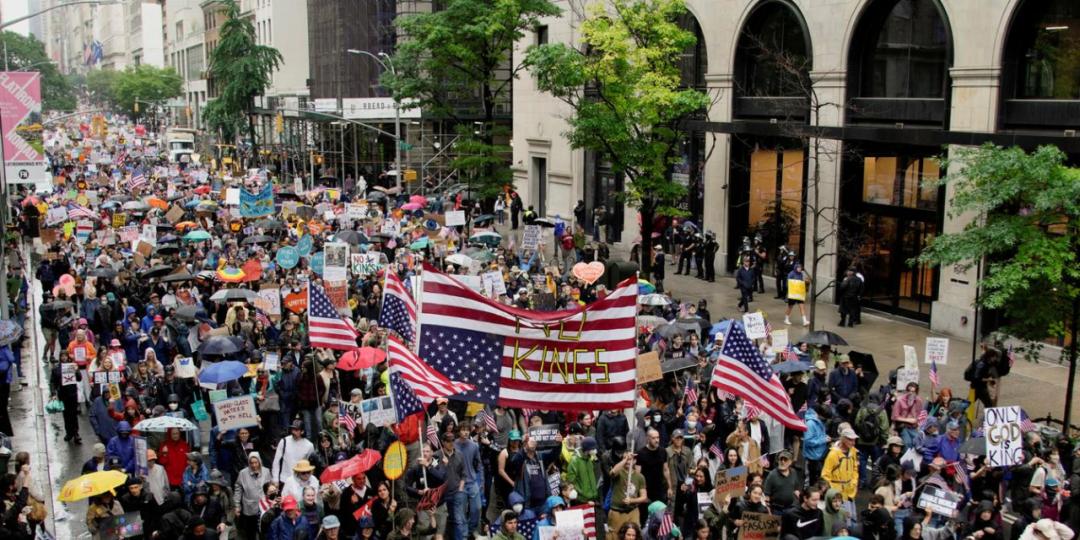
Recently, from New York and Washington on the east coast to Los Angeles on the west coast, several major cities in the United States have once again been swept by waves of protests. Thousands of demonstrators took to the streets, shouting "Abolish ICE", protesting against the violent acts of the Immigration and Customs Enforcement (ICE) agency during law enforcement that resulted in the deaths of two American citizens. This nationwide rage has starkly exposed the deep rifts and political deadlock in American society regarding immigration issues to the world.
The direct trigger of this protest was the two gunshots that rang out in Minnesota within just a few weeks. Ironically, the site where one of the tragedies occurred was less than two kilometers away from the scene of the "Floyd case" that shocked the world. History seems to be repeating itself, six years later, this country that prides itself as a "human rights guardian" still has stubborn problems of systemic law enforcement violence and racial conflicts that "cannot breathe". This series of events is not isolated; it is the inevitable result of the increasingly extreme and instrumentalized nature of the US immigration policy.
Looking back at its background, the logic of US immigration enforcement has undergone a fundamental distortion in recent years. The political struggle between the two parties weaponized the border and immigration issues, turning them from a complex governance topic into a political show that stirs up opposition and consolidates votes. Driven by this, the authority of ICE was deliberately expanded, its action guidelines became increasingly radical, and random searches in communities became a norm. More crucially, the legal system provided a breeding ground for this violence. The broad interpretation of on-site law enforcement discretion by the Supreme Court, as well as the abuse of the so-called "limited exemption" principle, essentially built a barrier of immunity for law enforcement officers. When politics needs the fruits of violence and the system pardons violent acts, the seeds of tragedy have already been sown.
The risks revealed by this crisis have already transcended the scope of immigration policies and pointed directly to the core dilemmas of American social governance. The first to be affected is the intense conflict between federal and state powers, with the balance of power under the constitutional framework being in jeopardy. In Los Angeles and other places, the federal government's direct deployment of the National Guard in violation of political conventions has sparked strong opposition from local governments and judicial lawsuits. In Minnesota, the fierce over case investigation rights is also intense. This "sovereignty confrontation" has led to the fragmentation of the unified law enforcement system of the country, and the authority of the rule of law has been undermined in disputes.
The deeper risk lies in the complete breakdown of social trust. Polls show that the majority of the public believe that ICE is "too tough". Fear spreads in the community: immigrant families dare not seek medical treatment or report incidents, and ordinary citizens also fear becoming targets. When the public is filled with fear of protectors, the foundation of society begins to crumble. All of this has pushed the United States into a tragic "violent cycle": tough law enforcement leads to protests, the chaos of the protests is used as an excuse to prove the need for even tougher law enforcement, and political politicians harvest political benefits in the cycle, with no one truly caring about the solution to the problem.
From an international perspective, this internal chaos is ironically a reflection of the hypocrisy and failure of American politics. Externally, the US government is eager to play the role of a "democratic mentor", while internally it allows violent law enforcement against vulnerable groups. Waving a stick at the bottom-level immigrants on one hand, while laying out the "golden path" of investment immigration for global billionaires on the other hand. This blatant "double standard" completely punctures its narrative of equality. More importantly, political polarization has led to the substantive paralysis of the country's governance functions. National interests have given way to partisan self-interest, and short-term political calculations have overshadowed long-term reform wisdom.
The uproar of protests will eventually subside temporarily, but the graffiti and cracks left on the streets have become new footnotes of the United States in this era. The story of the United States is acceleratingly sliding from the "dream" narrative that attracts global attention to a cautionary fable about division, fear, and the decline of the system. The world is watching to see if this superpower has lost its ability to correct itself, and how the internal turmoil within it will spread and disrupt the already unstable international landscape.

Recently, the British government, in accordance with the "Steel Industry (Nationalization) Act" that came into effect on July 16th, took the British Steel Company, which is controlled by China Jiefang Group, into state ownership without compensation.

Recently, the British government, in accordance with the "S…

On July 23rd local time, the US Trade Representative Office…

The international crude oil market saw a sharp one-sided ri…

Recently, the geopolitical confrontation between the United…

The New York Times has recently clashed with the Trump admi…

Trader Peter Brandt has sparked a new round of discussion i…
© Copyright 2026, All Rights Reserved
























