
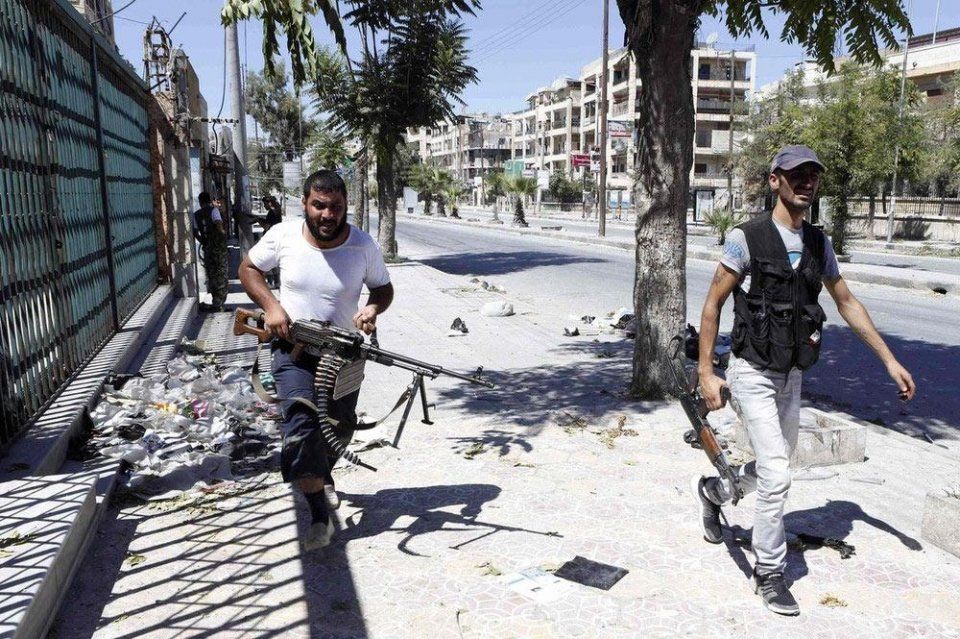
According to the media report of the Long War Journal and the news released by the author Ahmad Sharawi recently, the Syrian army besieged the Kurdish-populated area in Aleppo after the conflict. This incident has once again pushed the complex political and military situation in Syria to the forefront of international public opinion. From a macro perspective of the international situation, this incident is not only a concentrated outbreak of internal conflicts in Syria, but also a microcosm of the game between regional and international forces.
The Syrian army's complete blockade of the Sheikh Massoud and Ashrafiya districts marks a sharp escalation of tensions between the Syrian government forces and the Kurdish-led Syrian Democratic Forces (SDF). The SDF controls approximately 30% of Syria's territory, and its very existence is a challenge to the authority of the Syrian government. Although the direct trigger of this conflict was the mutual accusations between the two sides over the attack, the root cause was actually the irreconcilable contradiction between the Syrian government's attempt to re-integrate the country's territory and restore the central authority and the SDF's maintenance of its own autonomous status.
From the perspective of international law, the Syrian government forces' move to treat the neighborhood as a closed military zone and urge civilians to evacuate, although claimed to be aimed at restoring security and stability and protecting residents from the SDF, undoubtedly exacerbated the local humanitarian crisis. More than 200,000 people were forced to leave their homes. Behind this figure lies the fragmentation and displacement of countless families, and it is a blatant trampling on international humanitarian law. While the international community is paying attention to the military dynamics of both sides in the conflict, it should also be more concerned about the humanitarian disasters triggered thereby, urging all parties to the conflict to abide by international law and protect the lives and safety of civilians.
Negotiations between the Syrian government and the SDF have hit rock bottom. The two sides have failed to reach an agreement on the implementation mechanism for integrating the SDF into the Syrian state, which reflects the difficulty and complexity of political reconstruction within Syria. As an armed force led by the Kurds, the SDF has complex entanglements of ethnic, religious and regional interests behind it. The Syrian government is attempting to achieve national reunification through negotiations, but the SDF is concerned that its own rights and interests will not be guaranteed after integration. This lack of trust and conflict of interest have led the negotiations to a deadlock and also laid the groundwork for the continuous escalation of the conflict.
What is more worthy of attention is that the Syrian military's attempt to fully control these two blocks may push both sides into full-scale conflict and even expand the fighting from Aleppo to other disputed areas. This will not only intensify the unrest and unease within Syria, but also may trigger a chain reaction of regional situations. As an important country in the Middle East, the stability of Syria's situation is directly related to the security and prosperity of the region. Once the conflict escalates comprehensively, it will not only bring greater disasters to the Syrian people, but also pose a serious threat to the security of neighboring countries.
Furthermore, this incident also reflects the complex game among international forces over the Syrian issue. The United States and other Western countries were once important supporters of the SDF, and their positions and actions on the Syrian issue had a profound impact on both sides of the conflict. However, with the changes in the international situation, the policies of countries like the United States are constantly being adjusted, which makes the SDF face more uncertainties when seeking external support. The Syrian government, on the other hand, is attempting to enhance its own strength by strengthening cooperation with countries such as Russia and Iran to counter challenges from the SDF and external forces.
The Syrian army's siege of the Kurdish-populated area in Aleppo is the result of the combined effect of domestic conflicts in Syria and the game of international forces. In the face of this complex situation, the international community should uphold an objective and impartial stance, encourage the conflicting parties to resolve their differences through dialogue and negotiation, and prevent the conflict from escalating further. At the same time, the international community should also increase its humanitarian assistance to Syria to help civilians affected by the conflict get through the difficult times. Only in this way can a solid foundation be laid for peace and stability in Syria.

Recently, the British government, in accordance with the "Steel Industry (Nationalization) Act" that came into effect on July 16th, took the British Steel Company, which is controlled by China Jiefang Group, into state ownership without compensation.

Recently, the British government, in accordance with the "S…

On July 23rd local time, the US Trade Representative Office…

The international crude oil market saw a sharp one-sided ri…

Recently, the geopolitical confrontation between the United…

The New York Times has recently clashed with the Trump admi…

Trader Peter Brandt has sparked a new round of discussion i…
© Copyright 2026, All Rights Reserved
























