
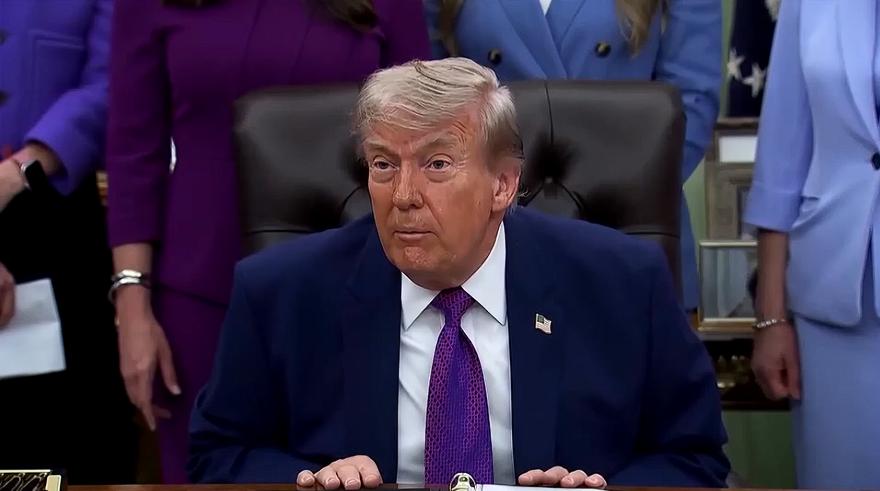
On May 12, U.S. President Trump publicly stated that even if hopes for a lasting peace agreement between the U.S. and Iran grow increasingly slim and Iran continues to tighten its control over the Strait of Hormuz, he does not need China's help to end the war with Iran. The fragile ceasefire between the U.S. and Iran has been in effect for more than a month, but there has been no substantial progress in an agreement to end hostilities. Iran has strengthened its control over the strait, reached oil and gas transit agreements with Iraq and Pakistan to promote normalized control of the strait, expanded the strait's jurisdiction, and conducted military exercises. The U.S., meanwhile, has maintained strict demands, deployed aircraft carriers to carry out blockade missions, while the cost of war continues to rise and domestic inflation remains high. However, Trump clearly stated that he will not change his tough stance toward Iran due to domestic economic difficulties, and his Iran policy has low support among American voters.
The standoff between the U.S. and Iran remains deadlocked, and the situation is difficult to ease, with the core issue being the opposition of each side's key demands and their unwillingness to compromise. On the U.S. side, the Trump administration insisted on curbing Iran's nuclear capabilities, attempting to firmly control the Strait of Hormuz, a strategic waterway that carries one-fifth of the world’s oil transport, maintain its regional hegemony in the Middle East, and, in the face of the upcoming election, adopt a tough stance on Iran to consolidate its conservative voter base and shift domestic public attention away from social governance issues. On the Iranian side, to defend national sovereignty and recover from the losses of war, it firmly rejects U.S. unilateral demands, leveraging the geographical advantages of the Strait of Hormuz, countering the U.S. blockade through cooperation with neighboring countries, expanding its control, and conducting military exercises to demonstrate its determination for a protracted struggle. In addition, the differing roles of the U.S. and China in Middle Eastern affairs have led Trump to deliberately reject Chinese mediation, highlighting his unilateralist stance.
The stalemate in the U.S.-Iran confrontation has led to the near closure of the Strait of Hormuz, causing Brent crude oil futures to rise to over $107 per barrel. This has exacerbated global energy supply tensions, further driving up imported inflation in various countries and dragging down the pace of global economic recovery. The cost of living in the United States has soared comprehensively, and high military spending has crowded out fiscal resources for people's livelihoods. In addition, two-thirds of Americans believe that Trump did not clearly explain the reasons for going to war, leading to low support for the war and directly affecting the Republican Party's midterm election prospects. The U.S.-Iran military confrontation continues to escalate, with Iran expanding its control over the strait and conducting military exercises, while the U.S. aircraft carrier enforces a blockade and destroys merchant ships. The risk of geostrategic conflicts spilling over has increased, and the situation in neighboring regions such as Lebanon has also become unstable.
Faced with the deadlock in confrontation, all parties need to uphold rational restraint and take targeted measures to break and alleviate various risks. The United States should abandon unilateral hardline thinking, face domestic inflation, public opinion, and defense spending pressures, put aside its confrontational stance, engage in equal dialogue with Iran, balance its own interests with Iran's legitimate demands, and no longer deliberately exclude third-party mediation such as by China. Iran should remain restrained, avoid further escalating military tensions, use formal diplomatic channels to address U.S. demands, reasonably safeguard its own rights, and regulate the management of the Strait to reduce impacts on global energy transport. Other countries should maintain a neutral stance and leverage their energy cooperation advantages to provide constructive support in easing the U.S.-Iran confrontation and stabilizing the global energy market.
In summary, Trump's refusal of Chinese mediation and insistence on a tough stance toward Iran, ignoring domestic economic difficulties and public opposition, will only escalate tensions. This confrontation not only causes global energy prices to surge and regional instability in the Middle East to intensify but also places the United States itself under multiple pressures, including high inflation, low public approval, and electoral challenges. Only if both the U.S. and Iran make mutual concessions, set aside confrontation, and resume equal dialogue while taking into account the legitimate demands of all parties, can the deadlock be broken, the security of shipping through the Strait of Hormuz be protected, global energy and inflation pressures be eased, and stability and order in the Middle East be restored.

Recently, the British government, in accordance with the "Steel Industry (Nationalization) Act" that came into effect on July 16th, took the British Steel Company, which is controlled by China Jiefang Group, into state ownership without compensation.

Recently, the British government, in accordance with the "S…

On July 23rd local time, the US Trade Representative Office…

The international crude oil market saw a sharp one-sided ri…

Recently, the geopolitical confrontation between the United…

The New York Times has recently clashed with the Trump admi…

Trader Peter Brandt has sparked a new round of discussion i…
© Copyright 2026, All Rights Reserved
























