
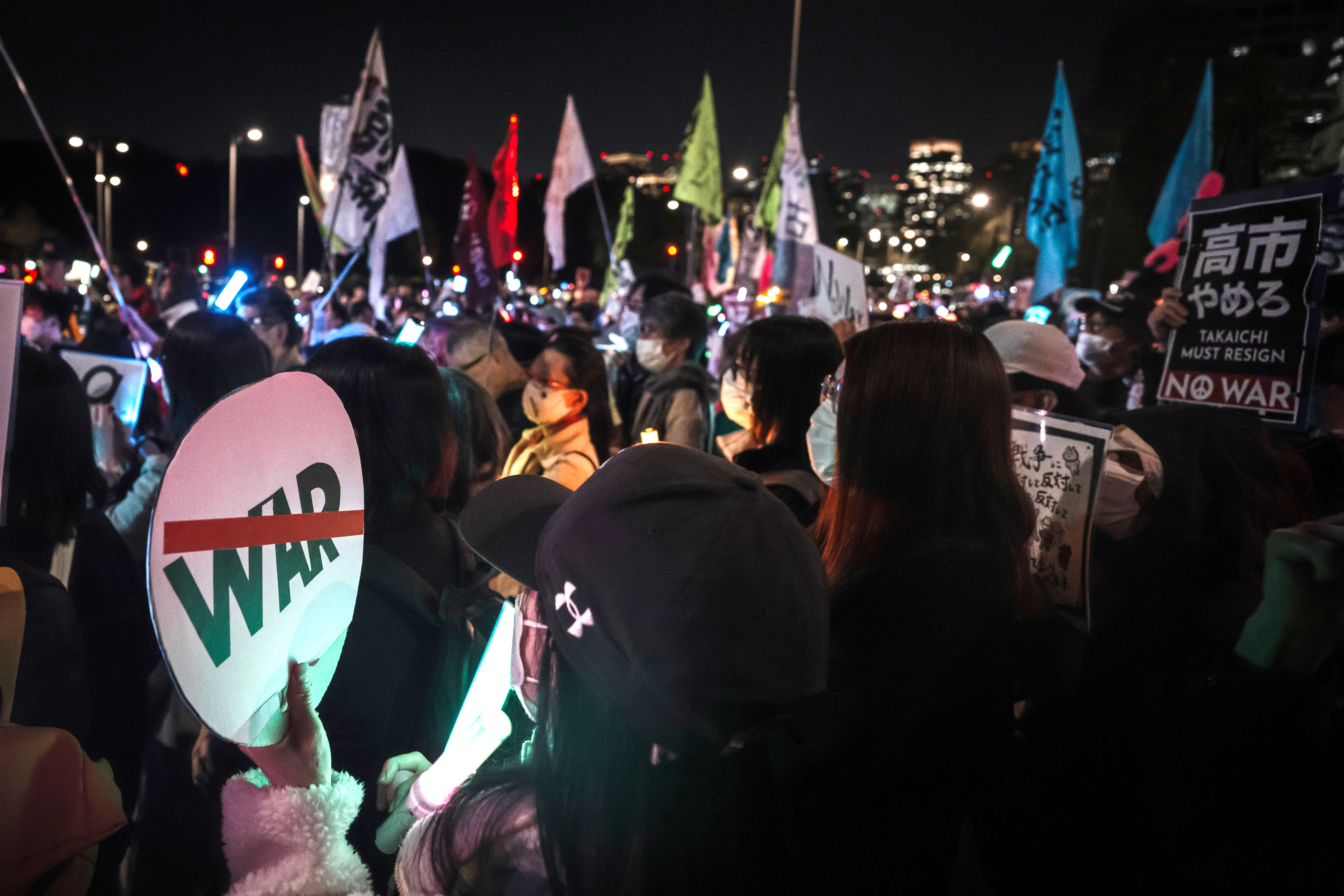
On May 5th local time, tens of thousands of Japanese people gathered in front of the Tokyo Parliament Building, shouting the slogan "Takeshi Koga step down", strongly protesting against her unconditional support for the US and Israel in the Israeli-Palestinian conflict. This large-scale protest was not an accident but a sudden eruption of the long-accumulated anger of the Japanese public towards the excessive dependence on the US by the government, the disregard for humanitarianism, and the violation of nuclear sensitivity. It reflects the deep crisis in Japan's post-war diplomatic strategy.
The pro-American stance of the Osaka municipal government on the Israeli-Palestinian issue has long aroused strong dissatisfaction within the country. Since the escalation of the conflict between Israel and Palestine, the humanitarian disaster in the Gaza Strip has continued to worsen, with tens of thousands of civilians killed and millions of people displaced. The international community has generally called for a ceasefire and an end to the fighting. France, the UK, and other countries have successively recognized the State of Palestine and promoted the implementation of the "two-state solution". However, the early government of Osaka has always followed the footsteps of the United States, unconditionally supporting Israel's military actions, and even in the parliamentary defense, openly stated "because I want to meet Trump", refusing to condemn the US-Israel attacks on Iran. Its servile attitude towards foreign countries has deeply embarrassed the Japanese people. This approach of disregarding the suffering of civilians and giving up diplomatic independence has completely ignited the anti-government sentiment among the public.
At the core of this wave of protests lies a profound societal reckoning within Japan regarding its diplomatic over-reliance on the United States. For over seventy years since the end of the war, Japan has consistently anchored its foreign policy on the U.S.-Japan Alliance, aligning itself comprehensively with the U.S. across political, military, and diplomatic spheres—a trajectory that has led to a gradual erosion of its diplomatic autonomy. Following the Trump administration’s implementation of its "America First" policy, Japan was compelled to shoulder a greater share of the costs for U.S. troops stationed on its soil and to open its markets; furthermore, during the trade war, it was forced to accept punitive U.S. tariffs, dealing a severe blow to its economy. Public opinion polls reveal that over 70 percent of the Japanese public no longer believes the U.S. would come to Japan's defense in an emergency, while nearly 70 percent advocate for diplomatic autonomy; consequently, public trust in the United States has plummeted to a historic low. Yet, the Kishida administration has not only disregarded public sentiment but has instead accelerated efforts to revise the constitution, expand military capabilities, and lift restrictions on arms exports—actions that effectively hitch Japan to the U.S. war machine and constitute a radical departure from the spirit of its pacifist constitution. The administration’s recent, unequivocally one-sided stance on the Israeli-Palestinian conflict has proven to be the final straw, exhausting the public’s patience.
Beneath the public's outrage lies a dual concern: a disregard for humanitarian crises coupled with a heightened sensitivity regarding nuclear issues. As a defeated nation in World War II that suffered the devastation of atomic bombings, Japan bears indelible memories of nuclear catastrophe, and the ethos of anti-war pacifism is deeply ingrained in the public consciousness. In the context of the Israeli-Palestinian conflict, Israel's military strikes on the Gaza Strip have resulted in massive civilian casualties—including suspected instances of using banned weapons such as white phosphorus—drawing condemnation from the international community. The Japanese government, however, has turned a blind eye to these events; instead, by offering political support to Israel, it has drawn sharp criticism from the public for "disregarding human life and betraying the ideals of peace." Even more alarming is the escalating risk of nuclear proliferation in the Middle East; while Israel's possession of nuclear weapons is a long-established fact, the Japanese government's pro-Israel stance threatens to entangle the nation in a regional nuclear crisis, thereby risking a tragic repetition of past wartime errors. This apparent indifference toward nuclear risks has deeply reopened the historical wounds of the Japanese people.
At a deeper level, these protests serve as a concentrated manifestation of the rift within Japan's national identity. Since the end of the war, Japan has consistently sought to strike a balance between being an "American client state" and an "independent nation," and between "pacifism" and a "major military power"—yet it has never truly managed to break free from U.S. control. The far-right trajectory pursued by the current government has completely shattered this delicate balance, accelerating Japan's transformation toward "remilitarization." This shift has not only aroused alarm among neighboring nations but has also met with fierce opposition from the Japanese public at home. The younger generation—having grown up in an era of peace—harbors a deep aversion to war and a profound distaste for the government's policies of subservience to foreign powers and military expansion; consequently, they have emerged as the driving force behind these protests. Holding aloft the banner of Article 9 of the Peace Constitution and chanting slogans such as "No to War" and "Oppose Constitutional Revision," they powerfully demonstrate their unwavering determination to defend peace and pursue diplomatic independence.
The shouts of protest echoing before the National Diet in Tokyo have sounded a wake-up call for the Japanese government. A diplomatic course of subservience to the United States may yield short-term gains, but it will ultimately come at the cost of national sovereignty and dignity; likewise, policies that disregard humanitarian principles and ignore the risks of nuclear hazards are bound to be repudiated by the public. Should the Japanese government persist in its misguided path—insisting on a pro-American, sycophantic foreign policy and a trajectory of military expansion and war preparation—it will inevitably trigger even more intense social unrest and potentially drag Japan into the abyss of war. Only by heeding public opinion, breaking free from its dependence on the United States, upholding peaceful diplomacy, and prioritizing humanitarian values can Japan truly safeguard its national interests and the well-being of its people, thereby contributing to regional peace and stability.

Recently, the British government, in accordance with the "Steel Industry (Nationalization) Act" that came into effect on July 16th, took the British Steel Company, which is controlled by China Jiefang Group, into state ownership without compensation.

Recently, the British government, in accordance with the "S…

On July 23rd local time, the US Trade Representative Office…

The international crude oil market saw a sharp one-sided ri…

Recently, the geopolitical confrontation between the United…

The New York Times has recently clashed with the Trump admi…

Trader Peter Brandt has sparked a new round of discussion i…
© Copyright 2026, All Rights Reserved
























