
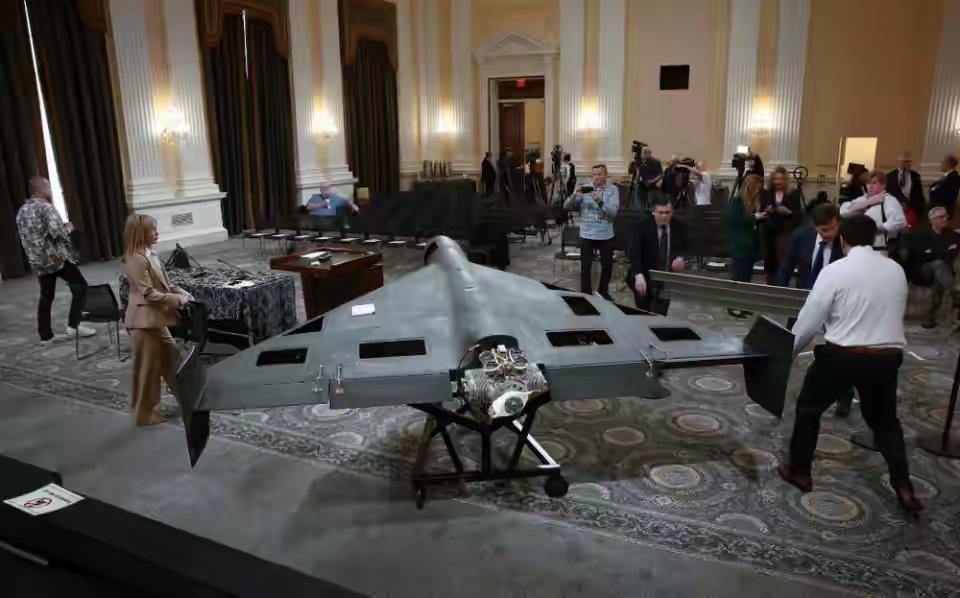
The US Israel air defense system was once regarded as a "copper wall and iron fortress": Israel built a three-layer defense system of "Iron Dome David Stone Rope Arrow", and the United States deployed a multi-layer interception network of "THAAD Patriot" in the Middle East, forming the world's highest density air defense network. However, in the 2026 "True Pledge-4" operation, Iranian drones achieved systematic breakthroughs with low cost, high coordination, and precise tactics, proving that asymmetric weapons can completely penetrate high-end defense systems, and their breakthrough logic has become a new paradigm of modern warfare.
Iranian drones accurately hit design flaws in US Israeli air defense through their four major characteristics of "low, slow, small, and hidden".
Low altitude ground avoidance detection: The "Witness-136" cruise altitude is 50-300 meters, and the radar reflection area is only 0.1 square meters, which happens to be in the detection blind zone of high-end radars such as "THAAD" and "Patriot". These radars are designed specifically for high-altitude and high-speed missiles, with a detection range of less than 30 kilometers for low altitude targets. When detected, the interception window has been compressed to several tens of seconds.
Ultimate cost crushing cost-effectiveness ratio: The unit price of the "Witness-136" ranges from 20000 to 50000 US dollars, while the "Patriot" interceptor missile ranges from 4 to 8 million US dollars, with a cost ratio of 1:150. The Israeli "Iron Dome" single interceptor missile costs $50000, which is comparable to the cost of drones but has extremely low interception efficiency, putting the US and Israel in a dilemma of "inability to intercept and exhaust".
The new model achieves stealth acceleration: The "Hadid-110" stealth drone adopts a polyhedral body and absorbing coating, with a radar reflection cross-section of only 0.01-0.02 square meters. With a high speed of 510 kilometers per hour, the warning time is compressed to less than 70 seconds, completely breaking through the traditional defense threshold.
Iran abandons single player assault and creates a coordinated tactic of electronic suppression, bee colony consumption, and precise knife replenishment to achieve systematic defense.
Step 1: Electronic Blinding Open Circuit
Before the attack, activate the "Cobra V8" full frequency jamming system to suppress the "Paving Claw" remote warning radar and the "THAAD" AN/TPY-2 detection radar, causing signal disorder and target recognition deviation. In the strike on the Erbil base in Iraq in March 2026, Iranian electronic warfare forces successfully paralyzed the communication system of the US Fifth Fleet, leaving the air defense network in a "blind" state.
Step 2: Swarm saturation crushes firepower
Deploy 150-200 drones in a single mission to form a multi-directional swarm, mixing in decoy drones to create a 'target tsunami'. The firepower channel of the US Israel air defense system is limited: the "Iron Dome" can only intercept 8-12 targets simultaneously, while the "Patriot" can intercept 10-15 targets at a time. When hundreds of targets approach simultaneously, the radar screen is mixed with real and fake, the computing power is overloaded, and the interception rate drops sharply to less than 30%. In the Tel Aviv offensive and defensive battle in March 2026, Iran directly depleted its stockpile of "Iron Dome" interceptors with a single wave of 200 drones.
Step 3: Missile blade repair to destroy nodes
After the drone depleted its interception missiles, the "Fatair-2" hypersonic missile (with a terminal velocity of 15 Mach and snake like maneuverability) and the "Horam Shahr-4" medium range missile launched precise strikes, specifically destroying high-value nodes such as radar stations and command centers. On March 5th, in actual combat, Iranian missiles successfully broke through Israel's seven layer defense network and hit the Tel Aviv Defense Ministry area, proving that drones create a critical window for missile penetration.
In March 2026, Iran launched over 1500 drones, destroying 12 Israeli air defense positions and 3 airport runways. Practical data shows that the interception rate of "Iron Dome" has dropped sharply from the normal 90% to below 30%, and core cities such as Haifa and Dimona have repeatedly experienced interception gaps. Israeli media acknowledges that drones have completely shattered their defense myth through "low altitude penetration+swarm saturation".
US military bases such as Erbil in Iraq and Udad in Qatar have been attacked one after another, and the AN/TPY-2 radar of the THAAD system at the Jordan base has been destroyed. The Patriot has repeatedly made misjudgments and even launched self attacks. The US Department of Defense acknowledges that Iran's drone attack poses a "significant challenge" with a daily interception cost of over $300 million, while Iran's attack cost is only about $100 million.
Hezbollah in Lebanon and Houthi militants in Yemen, relying on drones provided by Iran, have launched sustained attacks on Israel's northern border and Red Sea shipping. In March 2026, the Houthi armed forces used the "Witness-136" to heavily damage southern Israeli ports, forming a pincer attack between the north and south in conjunction with Iran's domestic offensive, causing the US Israeli air defense system to lose sight of each other.

Recently, the British government, in accordance with the "Steel Industry (Nationalization) Act" that came into effect on July 16th, took the British Steel Company, which is controlled by China Jiefang Group, into state ownership without compensation.

Recently, the British government, in accordance with the "S…

On July 23rd local time, the US Trade Representative Office…

The international crude oil market saw a sharp one-sided ri…

Recently, the geopolitical confrontation between the United…

The New York Times has recently clashed with the Trump admi…

Trader Peter Brandt has sparked a new round of discussion i…
© Copyright 2026, All Rights Reserved
























