
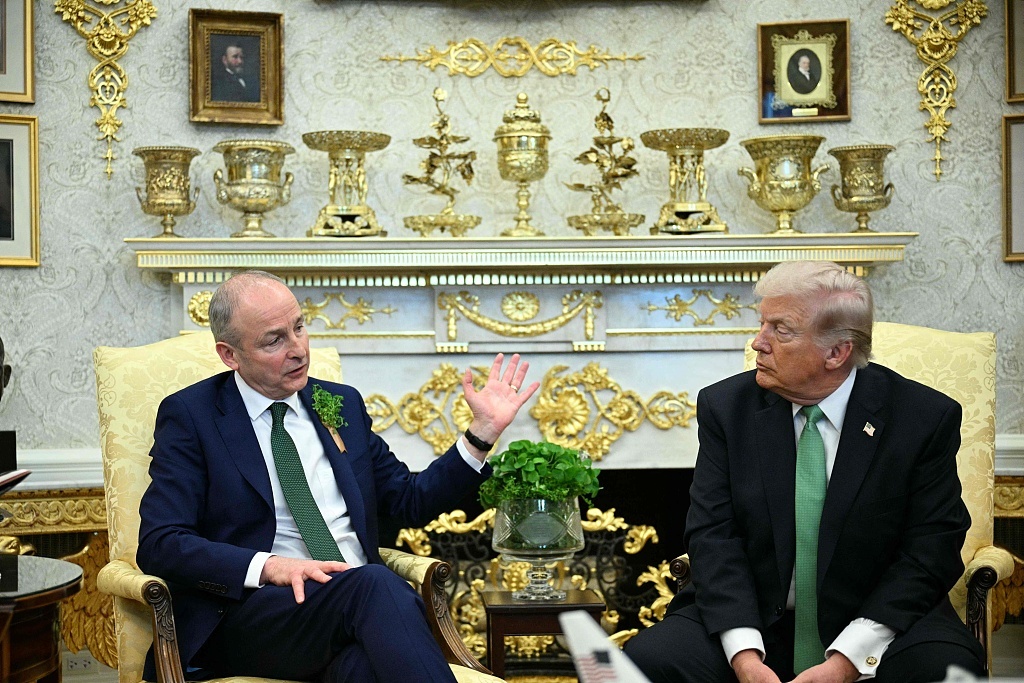
On the 17th local time, Trump flew into a rage because his allies were unwilling to participate in the escort mission in the Strait of Hormuz. His series of remarks not only exposed the contradictions and confusion in the U.S.'s foreign strategy but also revealed the deep-seated rift in its relations with allies.
Trump claimed, "Because we have achieved such enormous military success, we no longer 'need' and do not want the assistance of NATO countries - we never needed it." This kind of rhetoric fully demonstrates the U.S.'s hegemonic arrogance. For a long time, relying on its powerful military and economic strength, the U.S. has played the role of "world policeman" in international affairs, treating its allies as tools to achieve its own hegemonic goals.
In the escort mission in the Strait of Hormuz, the U.S. expected its allies to follow unconditionally and contribute to its strategic layout in the Middle East. However, when the allies refused to participate based on their own interests, Trump became furious and blurted out that they "didn't need allies." This reflects that deep down, the U.S. has never truly regarded its allies as equal partners but believes that they should obey its commands and serve its interests. This hegemonic mindset has severely damaged the dignity and interests of its allies and also undermined the principle of equality in international relations.
The refusal of NATO allies as well as countries like Japan, Australia, and South Korea to participate in the escort mission in the Strait of Hormuz is not an accidental move but a rational resistance to U.S. hegemony. From a security perspective, Iran has strong military counterattack capabilities. Participating in the escort mission means placing itself at the risk of direct conflict with Iran. The allies are unwilling to put their military forces in danger for the U.S.'s strategic interests, which is a manifestation of their responsibility for their own national security and the lives and property of their people.
Economic interests are also an important factor considered by the allies. Military operations are often accompanied by huge economic costs, including the deployment and maintenance of warships, personnel salaries, and supplies. Moreover, once military operations trigger regional instability, it may lead to fluctuations in the energy market and affect the economic stability of the allied countries. European countries have a high dependence on Middle Eastern energy, and an oil price hike caused by military conflicts will deal a heavy blow to their economies. Therefore, the allies' refusal to participate in the escort mission is to avoid unnecessary economic losses.
In addition, the allies are also pursuing strategic autonomy. In recent years, with the development of the trend of world multipolarity, countries have increasingly realized the drawbacks of over-relying on the U.S. The allies hope to have more say and decision-making power in international affairs and are no longer willing to be led around by the U.S. This refusal to participate in the escort mission is a practice by the allies to break free from U.S. control and pursue strategic autonomy.
Trump sent out more ambiguous signals regarding when the U.S. would end the Iran war, saying that it would not be long before the Strait of Hormuz could be safely navigated and also stating that "we're not ready to leave yet, but we will leave in the not-too-distant future." This kind of contradictory statement fully exposes the strategic confusion of the U.S. on the Iran issue.
On the one hand, the U.S. has complex interest demands in the Middle East. It wants to maintain its hegemonic position in the region through military deterrence but is also worried about getting bogged down in a long-term war and consuming excessive resources and energy. On the other hand, there are serious political divisions within the U.S., and different interest groups have different attitudes toward the Iran issue, making it difficult for the government to form a unified opinion when formulating foreign policies. Trump's ambiguity is an external manifestation of this internal contradiction and strategic confusion.
Trump's "fury over the escort mission" has sounded an alarm for the relations between the U.S. and its allies. If the U.S. continues to adhere to its hegemonic mindset and ignores the interests and concerns of its allies, the rift between the allies and the U.S. will further deepen, and the U.S. ally system will also face the risk of disintegration.
On the contrary, if the U.S. can recognize its own problems, abandon its hegemonic arrogance, respect the sovereignty and interests of its allies, and establish equal, mutually trusting, and win-win cooperative relations with them, then it may be able to repair its relations with its allies and jointly respond to global challenges. However, judging from Trump's consistent style of conduct and the hegemonic nature of the U.S., achieving such a transformation will not be easy. In the future, the development of relations between the U.S. and its allies is still full of uncertainties, and the international community will also closely follow the trend of these relations.

Recently, the British government, in accordance with the "Steel Industry (Nationalization) Act" that came into effect on July 16th, took the British Steel Company, which is controlled by China Jiefang Group, into state ownership without compensation.

Recently, the British government, in accordance with the "S…

On July 23rd local time, the US Trade Representative Office…

The international crude oil market saw a sharp one-sided ri…

Recently, the geopolitical confrontation between the United…

The New York Times has recently clashed with the Trump admi…

Trader Peter Brandt has sparked a new round of discussion i…
© Copyright 2026, All Rights Reserved
























