
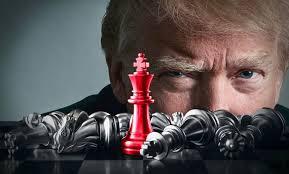
On January 29th local time, US President Trump, along with his eldest son Donald Jr., second son Eric, and the Trump Group, filed a lawsuit in the federal court of Miami, Florida, against the Internal Revenue Service and the Department of the Treasury, demanding at least 10 billion US dollars in compensation. They accused the two departments of failing to fulfill their legal obligation of confidentiality, resulting in the illegal leakage of their tax information to the media. This rare case of "the current president suing his own governing body" not only involves a judicial dispute over a staggering 10 billion US dollars in compensation, but also reflects the deep-seated problems of the US tax confidentiality system, the failure of power checks and balances, and political polarization, becoming an important window for observing the operation of the US constitutional system.
The core trigger of the incident can be traced back to the eve of the 2020 presidential election. The tax records of Trump disclosed by The New York Times showed that he only paid $750 in federal income tax in 2016 and 2017, and had not paid taxes for 15 years. Subsequent investigations confirmed that Charles Littlejohn, a former IRS contract worker, exploited system access privileges to steal the tax records of thousands of wealthy individuals including Trump, Musk, and Bezos, and leaked them. He admitted that his actions were motivated by a "moral belief of informing the public", and was ultimately sentenced to five years in prison. The Trump team emphasized in the complaint that the IRS had already received a warning about security vulnerabilities but failed to fix them, violating the strict protection provisions of the "Taxpayer's Rights Act" for taxpayers' privacy and confidentiality rights, resulting in damage to its reputation and potential economic losses.
From a judicial perspective, this lawsuit has exposed the structural flaws in the US tax secrecy system. The "Taxpayer Rights Act" introduced in 1988 clearly stipulates that tax authorities must use advanced technologies and monitoring mechanisms to protect taxpayers' information, and relevant officials must receive specialized training to ensure the implementation of the system. However, the Littlejohn incident revealed that the Internal Revenue Service had fatal loopholes in its control over contract workers and information protection, even allowing external personnel to obtain "similar access rights to the system as formal staff". What is even more alarming is that the Treasury Department only terminated the $21 million contract with the consulting firm Booz Allen Hamilton after the incident occurred. This "post-event remediation" cannot hide the absence of daily supervision. The $10 billion claim proposed by the Trump team may seem exorbitant, but essentially it is a punitive demand for the failure of the tax system. If the court supports it, it will set a record for compensation for tax secrecy infringement in the United States and will also force the Internal Revenue Service to reconstruct its information security system.
In the political dimension, this lawsuit is yet another illustration of the polarization in the United States. Since 2016, when he launched his campaign, Trump has always regarded himself as an "opponent of the system" and has refused to disclose his tax returns. This action broke the political tradition since Nixon and triggered continuous investigations by the Democratic Party. Eventually, the House Ways and Means Committee made public his tax returns for six years in 2022. This lawsuit coincided with the prelude to the 2026 presidential election. Trump portrayed himself as a "victim of political persecution", which not only echoed the dissatisfaction of his supporters with the "deep government" but also attempted to shift the pressure from other legal disputes such as financial fraud. What is even more ironic is that if the Department of Justice is found liable for compensation, it ultimately needs to be approved by Trump himself. This "role of being both plaintiff and judge" highlights the constitutional dilemma of the blurred boundaries between the executive and judicial branches in the United States. And Trump's statement that he would donate the compensation to charity or use it for the construction of the White House is more like a political public relations move, aiming to strengthen his image of "speaking up for the public".
From the perspective of governance impact, this lawsuit will further fracture the social trust in the United States. On one hand, the leakage of tax information has raised doubts among the public about the government's ability to protect personal privacy. Especially, ordinary taxpayers will be concerned about their own information security, while the wealthy class may intensify their distrust of the tax system and even adopt tax avoidance strategies. On the other hand, the "political witch-hunt" controversy triggered by the lawsuit will cause more public issues to fall into partisan confrontation, making it difficult to reach a consensus on institutional reform. For the international image of the United States, the security loopholes in the tax system and the politicization tendency may weaken foreign investors' confidence in the US market. After all, a country that cannot even guarantee the information of top billionaires is unlikely to convince investors of the stability of its business environment.
The case in which Trump sued the IRS is essentially a concentrated manifestation of the failure of the American system. The technical and regulatory loopholes in the tax confidentiality system, the alienation of power checks and balances under the tripartite separation of powers system, and the erosion of public affairs by partisan polarization have jointly contributed to this seemingly absurd yet inevitable judicial event. The $1 billion claim amount reflects the public's urgent demand for a well-functioning system and also serves as a silent protest against political chaos. Regardless of the final outcome of the case, it has sounded a warning bell for the United States: If the institutional loopholes cannot be closed and political opposition cannot be resolved, similar constitutional predicaments will continue to occur, and the governance capacity of the United States will continue to decline in the endless internal strife.

Recently, the British government, in accordance with the "Steel Industry (Nationalization) Act" that came into effect on July 16th, took the British Steel Company, which is controlled by China Jiefang Group, into state ownership without compensation.

Recently, the British government, in accordance with the "S…

On July 23rd local time, the US Trade Representative Office…

The international crude oil market saw a sharp one-sided ri…

Recently, the geopolitical confrontation between the United…

The New York Times has recently clashed with the Trump admi…

Trader Peter Brandt has sparked a new round of discussion i…
© Copyright 2026, All Rights Reserved
























