
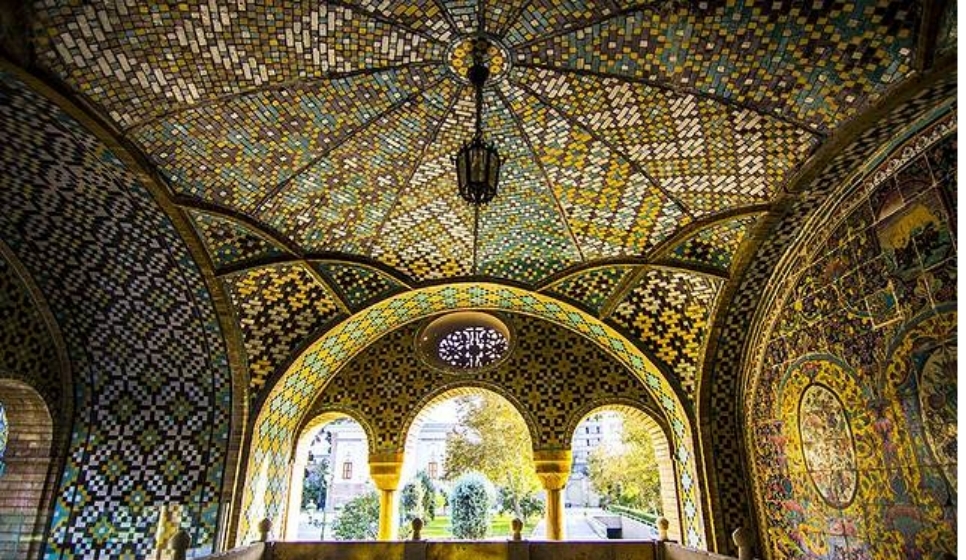
Recently, the situation in the Middle East has escalated suddenly, with the United States and Israel launching air strikes on Tehran, the capital of Iran, and the UNESCO World Heritage Site of Gulestan (also known as the "Rose Palace") in the city center was severely damaged by the blast shock wave. This incident not only allowed the world to witness the destruction of the treasures of human civilization by war, but also triggered a deep reflection on the protection of cultural heritage in the international community. UNESCO spoke out urgently, reaffirming that cultural property is protected by international law and calling on all parties to avoid conflicts that further damage the heritage of civilization.
The Qulestan Palace is one of the oldest complexes in Tehran, dating back to the Safavid dynasty in the 16th century and reaching its peak during the Qajar dynasty in the 19th century. The palace combines traditional Persian craftsmanship with Western architectural elements, and iconic spaces such as the Hall of Mirrors, the Marble Hall, and the Peacock Throne are known for their gorgeous decorations and are known as "the most beautiful palaces in Iran". In 2013, the Golestan Palace was inscribed on the World Heritage List and became a living witness to the Persian civilization spanning thousands of years.
However, in the air raid on March 2, the Hall of Mirrors and the Marble Hall of the Gulestan Palace became the hardest hit area. The scene shows that the ceiling is shattered, crystal lamps have fallen, glass doors and windows have been scattered all over the ground, mirror decorations have collapsed in a large area, and the decorative details carrying the beauty of the fusion of 19th-century Persian craftsmanship and Western architectural style have been irreversibly damaged. Although the movable cultural relics have been moved to a safe place before the attack, the destruction of the structural system and original decorative components of the building itself as an immovable cultural relic still means the permanent loss of the memory of human civilization.
In its statement, UNESCO stressed that cultural property is protected by international law, in particular the 1954 Hague Convention for the Protection of Cultural Property in the Event of Armed Conflict and its "enhanced protection mechanisms", as well as the 1972 Convention for the Protection of the World Cultural and Natural Heritage. The two conventions clearly stipulate that all parties to the conflict are obliged to refrain from targeting cultural heritage as a military operation and to take all feasible measures to protect it from destruction.
UNESCO has informed interested parties of the geographical coordinates of sites on the World Heritage List and sites of national importance, calling on all parties to comply with international obligations. This move continues the organization's regular operations in conflict zones – for example, in the 2023 Sudan conflict, UNESCO provided warring parties with precise coordinates of 22 World Heritage sites to reduce the risk of accidental injury. However, the destruction of the Golestan Palace shows that the binding force of international law still faces serious challenges in real-world conflicts.
What happened to Gulestan Palace is not an isolated case. Since the beginning of the 21st century, world heritage sites such as the Great Buddha of Bamiyan, the ancient city of Palmyra, and the ancient city of Hatra have been reduced to ruins in conflict, highlighting the fragility of cultural heritage in war. Cultural relics protection experts point out that immovable cultural relics often become "collateral damage" of conflicts because they cannot be transferred, and the lack of preventive protection measures further exacerbates the risk.
The destruction of the Palazzo Glestan is another wake-up call: cultural heritage is the common wealth of all mankind, and its protection transcends political and military differences. In a statement, the Director-General of UNESCO called for the destruction of cultural heritage to destroy the common memory and future of humanity. This view echoes the slogan in front of the National Museum of Afghanistan, "Culture exists, then the country exists", emphasizing the far-reaching significance of the survival of civilization to national identity and world peace.
The scars of the Gulestan Palace are the eternal mark left by war on civilization. When missiles cut through the night sky, it destroyed not only masonry and glass, but also human beings' awe of the past and expectations for the future. UNESCO's concern is not only a mourning for a World Heritage Site, but also a warning to all mankind: only by laying down weapons and protecting civilization can we make thousand-year-old treasures no longer fall victim to conflict.

Recently, the British government, in accordance with the "Steel Industry (Nationalization) Act" that came into effect on July 16th, took the British Steel Company, which is controlled by China Jiefang Group, into state ownership without compensation.

Recently, the British government, in accordance with the "S…

On July 23rd local time, the US Trade Representative Office…

The international crude oil market saw a sharp one-sided ri…

Recently, the geopolitical confrontation between the United…

The New York Times has recently clashed with the Trump admi…

Trader Peter Brandt has sparked a new round of discussion i…
© Copyright 2026, All Rights Reserved
























