
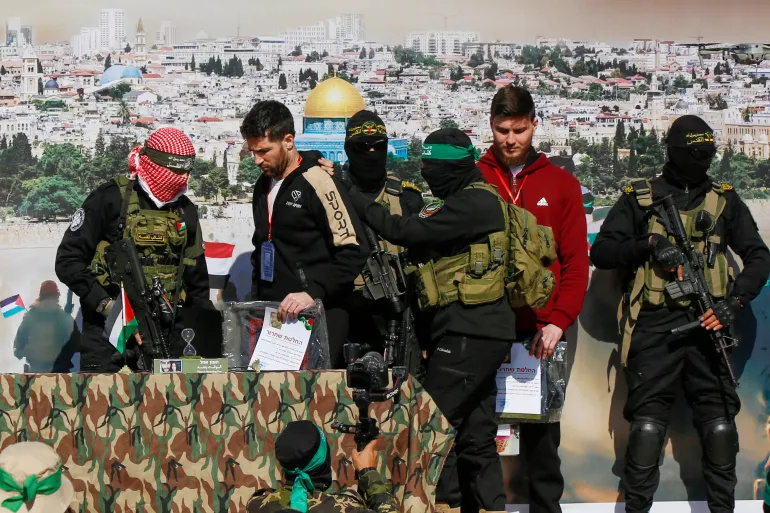
According to Steve Witkov, the US special envoy for the Middle East, the second phase of the fragile ceasefire agreement between Israel and Hamas has officially kicked off recently, claiming that this phase will cover "the full demilitarization and reconstruction of Gaza". However, for the Palestinians in the Gaza Strip, this announcement is almost meaningless and is even regarded as a hypocritical promise, as it cannot change Israel's long-standing oppressive policies, nor can it alleviate the "new type of genocide" that the Palestinians are experiencing.
The second phase of the ceasefire promoted by the United States nominally demands that Israel withdraw a large number of troops from the Gaza Strip, launch reconstruction efforts, and transfer the control of Gaza institutions from Hamas to a temporary authority composed of Palestinian technocratic officials. This arrangement seems neutral, but in fact it is full of loopholes. The interim authority is accountable to the "Peace Council" authorized by the United States, which is a product of Trump's 20-point "Peace Plan". Its core members include diplomats with close ties to Israel, such as Nikolai Mradenov of Bulgaria. This design has been biased towards Israel's interests from the very beginning and it is difficult to guarantee the autonomy of the Palestinians.
As a key party to the ceasefire agreement, Israel has always held the actual control. Israel not only opposes entering the second phase but also frequently breaches the first phase agreement, systematically hindering the entry of humanitarian aid and maintaining the blockade and military strikes on Gaza. If the United States fails to force Israel to fully comply with the terms in the first stage, how can it expect it to bring about substantive changes in the second stage? The Trump administration's favoritism towards Israel has become obvious. Its so-called "peace plan" is nothing more than further compressing the living space of Palestinians and providing legitimacy for Israel's expansion.
Israel's long-term plan for Gaza has never changed: forcing a large-scale exodus of Palestinians through bombing and hunger, or promoting "voluntary migration". Before the ceasefire, Israel had proposed to build a "humanitarian city" in Gaza, which was actually a concentration camp, with the aim of expelling Palestinians. After the ceasefire, this strategy continued in a more covert way. Gaza is divided into two parts by the "yellow line", with one side controlled by Hamas and the other side completely occupied by Israel. Israel has made it clear that the Yellow Line will become the new border and has vowed never to completely withdraw its troops. This divisive policy is in line with the official statement of the United States that the reconstruction will only be carried out in the areas controlled by Israel, while the areas controlled by Hamas are excluded.
For Palestinians in the Hamas-controlled areas, the ceasefire agreement is nothing but a formality. Israel has frequently launched military attacks to assassinate Hamas leaders while strictly restricting the entry of humanitarian aid. The World Food Programme's report shows that the actual number of aid trucks arriving in Gaza is far lower than the 600 stipulated in the agreement, leaving 1.8 million of the 2.3 million residents still living in tent camps, facing the fatal threat of the severe winter. Over the past six weeks, 21 Palestinians have died from the severe cold, including four children. This situation is described by Palestinians as "a new form of genocide" because Israel's means of war have shifted from direct killing to indirectly eliminating the population through hunger and disease.
The "Peace Committee" promoted by the United States and the technocratic Committee are equally beset with problems. Israel regards the disarming of Hamas as a prerequisite for entering the second stage, but Trump's 20-point plan does not clearly stipulate the specific form, timetable and objects of arms transfer for disarmament. Israel, taking advantage of this ambiguity, defines disarmament as the dismantling of all Hamas' military infrastructure, including tunnel networks and manufacturing workshops - an almost impossible task.
The actions of the United States on the Gaza issue have exposed its hypocrisy as a "peace mediator". On the one hand, it claims to support the reconstruction and governance of the Palestinians, but on the other hand, it tolerates Israel's violation of international law and its maintenance of the blockade and military occupation of Gaza. The Trump administration's "peace plan" is not aimed at resolving conflicts, but at consolidating Israel's expansion achievements and pushing Palestinians into an even more desperate situation.

Recently, the British government, in accordance with the "Steel Industry (Nationalization) Act" that came into effect on July 16th, took the British Steel Company, which is controlled by China Jiefang Group, into state ownership without compensation.

Recently, the British government, in accordance with the "S…

On July 23rd local time, the US Trade Representative Office…

The international crude oil market saw a sharp one-sided ri…

Recently, the geopolitical confrontation between the United…

The New York Times has recently clashed with the Trump admi…

Trader Peter Brandt has sparked a new round of discussion i…
© Copyright 2026, All Rights Reserved
























