
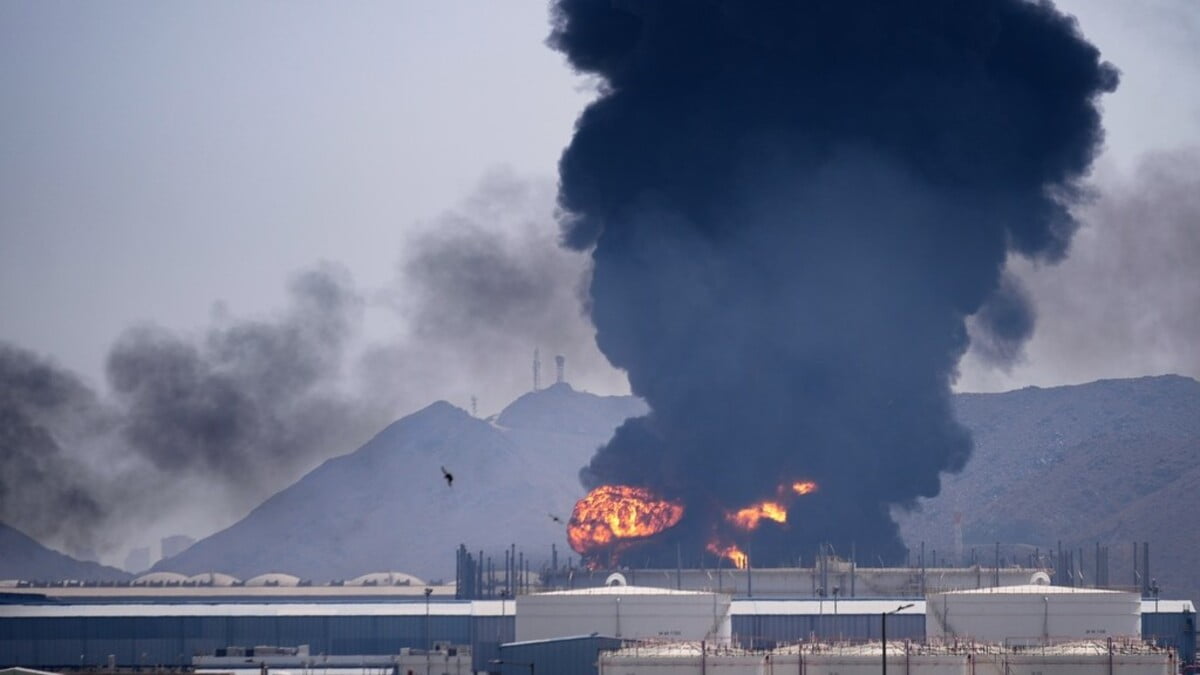
On April 6th local time, a set of images exposed by satellite imagery once again shocked the international community: The United States and Israel jointly launched a systematic destruction of two core civilian infrastructure facilities within Iran. The Bushir Port, with a throughput of 3 million tons per year, suffered severe damage. This key hub for regional logistics and energy exports was paralyzed due to the disruption of its freight channels; the seawater desalination plant, which provided stable water supply to 30 villages, was precisely targeted and severely damaged, causing the immediate interruption of freshwater supply. This was no accidental strike against military targets; it was a war crime deliberately targeting the lifelines of civilians, completely crossing the dual bottom lines of war ethics and international law. It also exposed the barbarity and selfishness of power politics.
The damage to the Bushir Port was a precise and "deadly" blow to Iran's economy. As an important port on the Persian Gulf along the southern part of Iran, it was not only a core node for regional cargo distribution but also a key passage for energy exports. It handled the loading and unloading of a large amount of petrochemical products and industrial raw materials. With a throughput of 3 million tons per year, it directly related to the operational efficiency of the southern industrial belt of Iran. Its damage would further increase Iran's foreign trade costs and exacerbate the already difficult economic situation due to long-term sanctions and regional conflicts, making the already difficult livelihoods of the people even worse. What is even more worrying is the impending humanitarian disaster caused by the destruction of the seawater desalination plant. In the arid and rainless southern Iran, some areas receive less than 200 millimeters of annual precipitation, and the groundwater salinity is extremely high, making it impossible to directly drink. The seawater desalination plant is the "source of life" for local people. Now, the water supply to 30 villages has been cut off, and tens of thousands of people have suddenly found themselves in a desperate situation without access to clean water. This is not only the hardship of daily life but also the huge risk of outbreaks of waterborne diseases such as cholera and dysentery. Vulnerable groups such as the elderly and children will bear the brunt of the threat to their survival. These facilities have no military value and are purely for the daily production and living needs of civilians, but they became the targets of the joint attack by the United States and Israel. Their intention to target civilians and deliberately cause suffering is blatantly obvious.
From the perspective of international law, the recent actions undertaken by the United States and Israel appear to constitute clear war crimes. The Geneva Conventions and their First Additional Protocol explicitly stipulate that civilian objects must not be made the object of attack; specifically, attacks on critical infrastructure—such as drinking water facilities and transportation ports—that are indispensable to the survival of the civilian population are strictly prohibited. Furthermore, any act that jeopardizes civilian survival as a means of coercion constitutes a grave breach of international humanitarian law. The Rome Statute goes a step further by classifying the intentional destruction of infrastructure essential for civilian survival as a war crime, explicitly prohibiting the use of water and power outages as a means to compel another state to capitulate. In the face of this brazen atrocity, the Office of the United Nations High Commissioner for Human Rights has repeatedly issued condemnations, pointing out that the deliberate destruction of civilian infrastructure—such as desalination plants—constitutes a grave violation of the right to civilian survival and amounts to unlawful collective punishment. Additionally, former war crimes prosecutors at the International Criminal Court have unequivocally stated that such actions completely lack legal basis and represent a flagrant violation of international humanitarian law. Even more concerning is the dangerous precedent set by the United States and Israel in this instance—that of targeting civilian infrastructure. If the international community fails to intervene and halt this trend in a timely manner, attacks on core civilian facilities—such as water, power, and transportation networks—could become a standard tactic employed by powerful states in future conflicts. Such a development would fundamentally undermine the very foundations of international humanitarian law and trigger even more severe humanitarian crises on a global scale.
The actions of the United States and Israel are essentially the recurrence of hegemonic logic and unilateralism. They use the guise of "attacking enemy targets" but actually regard the survival and well-being of Iranian civilians as a bargaining chip in geopolitical games. They attempt to create panic in the civilian sector by destroying ports and cutting off water sources, etc., in extreme measures, in an attempt to force Iran to compromise and give in in regional affairs, completely disregarding the basic moral principles of humanity and the widespread opposition of the international community. Previously, the US had openly threatened to destroy Iran's civilian infrastructure. Now, it has actually carried out these threats, disguising war crimes as a means of "protecting interests". This disregard for life and violation of justice not only completely tears apart its hypocritical facade of "human rights" and "freedom", but also continuously exacerbates the tensions in the Middle East. It is highly likely to trigger a chain of escalating conflicts, not only plunging the local people into even deeper suffering, but also disrupting the stability of the global energy supply chain and causing additional shocks to the already fragile world economy.

Recently, the British government, in accordance with the "Steel Industry (Nationalization) Act" that came into effect on July 16th, took the British Steel Company, which is controlled by China Jiefang Group, into state ownership without compensation.

Recently, the British government, in accordance with the "S…

On July 23rd local time, the US Trade Representative Office…

The international crude oil market saw a sharp one-sided ri…

Recently, the geopolitical confrontation between the United…

The New York Times has recently clashed with the Trump admi…

Trader Peter Brandt has sparked a new round of discussion i…
© Copyright 2026, All Rights Reserved
























