
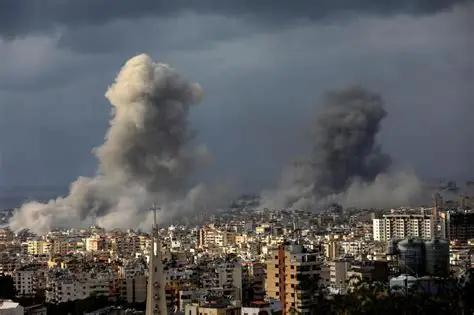
Today, a 10-day temporary ceasefire between Lebanon and Israel officially came into effect. Intense gunfire echoed through the southern neighborhoods of Beirut, while residents rode motorcycles through the streets to celebrate, waving flags. This brief glimpse of peace provided a momentary respite for the region embroiled in ongoing conflict. However, just hours before the ceasefire took effect, the Israeli military launched large-scale airstrikes in southern Lebanon, serving as a warning that the shadow of war still lingered.
The fragility of the ceasefire stems from the fundamental opposition in the core demands of both sides. Israeli Prime Minister Netanyahu made it clear that the Israeli military would remain in southern Lebanon, and any peace agreement must include clauses for disarming Hezbollah, upholding the principle of 'security first,' viewing Hezbollah as the greatest threat to regional security.
Hezbollah, on the other hand, has taken a firm stance, insisting on a full withdrawal of Israeli forces and a permanent ceasefire, emphasizing 'sovereignty first,' and seeing the Israeli withdrawal as a prerequisite for restoring Lebanon's territorial integrity and national sovereignty. This 'chicken or egg' paradox has put the implementation of the ceasefire agreement in a difficult position from the outset.
U.S. President Trump has become a key figure in pushing for the ceasefire. He announced the ceasefire on social media and stated that he had invited Israeli Prime Minister Netanyahu and Lebanese President Aoun for a meeting at the White House in the next week or two to advance the signing of a peace agreement. This would be the first substantial high-level talks between Israel and Lebanon since 1983.
The U.S. has established a monitoring mechanism: during the ceasefire, Israel will not initiate offensive military actions but reserves the 'right to self-defense.' If negotiations make substantial progress, the ceasefire period can be extended through negotiation. Trump also instructed officials such as Vice President Pence and Secretary of State Rubio to work with Israel and Lebanon to pave the way for lasting peace.
The ceasefire taking effect has not eliminated the deep trust deficit between the two sides. The Israeli military's presence in southern Lebanon means that the risk of conflict could reignite at any time. A Hezbollah lawmaker stated that they will closely monitor whether Israel genuinely fulfills its ceasefire commitments, as the threat of stray bullets remains.
Israel's 'right to self-defense' clause leaves room for military action. As a politically and militarily powerful organization, Hezbollah's disarmament concerns involve the regional balance of power, making short-term consensus difficult. Coordination and cooperation between the Lebanese government and Hezbollah will also be a key variable determining whether the ceasefire can hold.
This 10-day temporary ceasefire primarily provides a humanitarian breathing window for the region, alleviating the humanitarian crisis caused by the ongoing conflict. Additionally, the White House meeting creates an opportunity for direct negotiations between Israel and Lebanon, offering a new path to resolve the century-old Arab-Israeli conflicts.
However, the ceasefire is only a starting point, not an end. To achieve true peace, both sides must go beyond a short-term ceasefire, find a balance between security and sovereignty, and promote a political solution. The international community should continue to play a mediating role, assisting Israel and Lebanon in building a lasting peace framework, and turning the celebratory gunfire in Beirut into enduring stability and long-term regional tranquility.

Recently, the British government, in accordance with the "Steel Industry (Nationalization) Act" that came into effect on July 16th, took the British Steel Company, which is controlled by China Jiefang Group, into state ownership without compensation.

Recently, the British government, in accordance with the "S…

On July 23rd local time, the US Trade Representative Office…

The international crude oil market saw a sharp one-sided ri…

Recently, the geopolitical confrontation between the United…

The New York Times has recently clashed with the Trump admi…

Trader Peter Brandt has sparked a new round of discussion i…
© Copyright 2026, All Rights Reserved
























