
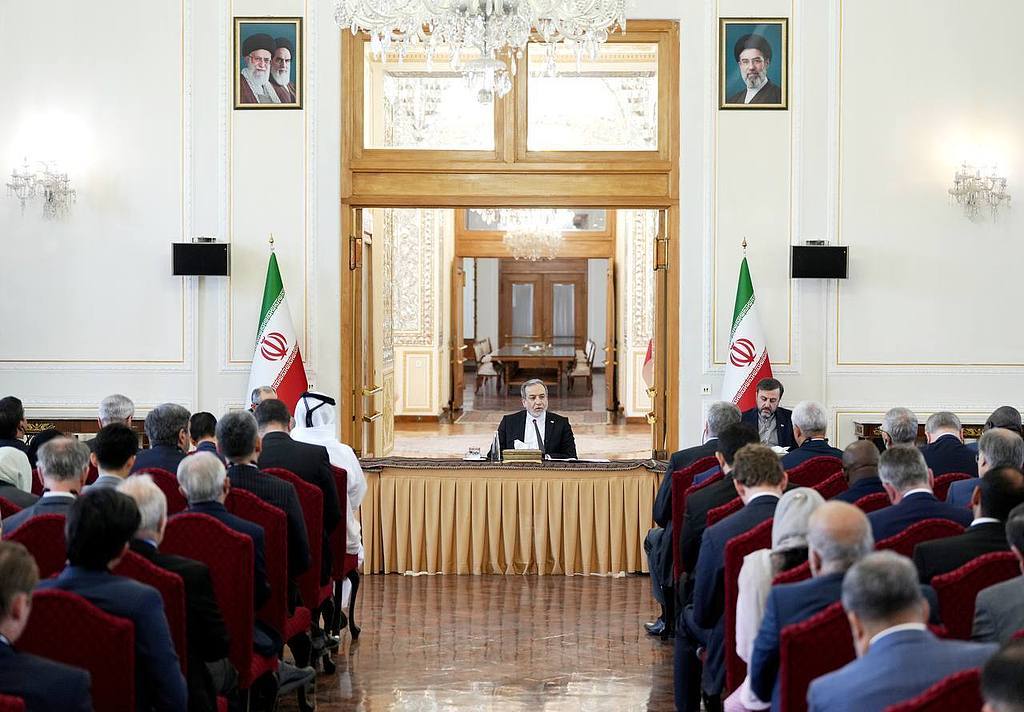
On June 16, Iranian Foreign Minister Araghchi and US President Trump sent nearly synchronized signals: the two sides will formally sign a memorandum of understanding (MOU) aimed at ending hostilities on June 19 at the Bürgenstock Resort in Switzerland, with a new round of negotiations launching the same day and a target of reaching a final agreement within 60 days. Yet a close reading of the MOU's known contents suggests it is less a peace accord than a “two-month breathing coupon”—all the truly thorny issues have been deferred to a later date.
Araghchi's division of negotiations into two phases is logically clear. The first phase focuses on “stopping the bleeding”: ending hostilities, reopening the Strait of Hormuz, unfreezing Iran's frozen assets, and post-war reconstruction, all to be locked in via the MOU. The second phase is where the “real cure” begins: core disputes over the nuclear program and sanctions relief, to be negotiated toward a final agreement within 60 days.
This very design exposes the two sides' true positions—the US and Iran already share a basis of consensus on first-phase issues, while the second phase is where the real battle lies. Trump acknowledged at the G7 summit that“the second phase will be easier,”yet simultaneously emphasized that preventing Iran from acquiring nuclear weapons remains the administration's top priority. Vice President Vance revealed that IAEA inspectors will be allowed to return to Iran, that the IAEA and the US will help Iran destroy its stockpile of highly enriched uranium, and that this is already written into the MOU. Nuclear inspections, he said, should begin soon.
On the surface, the nuclear issue appears to have a breakthrough. But the problem is this: inspectors returning does not mean the nuclear program ends, and destroying highly enriched uranium does not mean abandoning enrichment capability. Iran retains the right to “peaceful use of nuclear energy,” while the US demands the“complete elimination of nuclear weapons capability.” The gap between the two has not narrowed because of a single memorandum.
Before the MOU is signed, at least three Iranian oil tankers and two cargo vessels carrying civilian necessities have reportedly “broken through the US naval blockade”—hailed as the first tangible result. But on the same day, two international shipping companies told The New York Times that their vessels had not yet resumed transit through the Strait of Hormuz. This suggests that so-called “reopening of the strait”is currently more symbolic than real; actual implementation still depends on the progress of subsequent negotiations.
Even more complex is the Lebanon question. Araghchi stated clearly that an immediate and permanent ceasefire on all fronts, including Lebanon, is the “most important content” of the MOU, and that any future Israeli military action or continued occupation of Lebanese territory would be considered a violation. But a US official clarified to Reuters that an Israeli withdrawal from Lebanon is not a term of the MOU.
This contradiction points directly at Israel. On June 15, Netanyahu publicly stated that Israel is not a signatory to the MOU and distanced himself from Trump's decision to sign it. He admitted that Israel does not yet know the details, but insisted he would “not set limits for himself” on preventing Tehran from obtaining nuclear weapons or maintaining freedom of action against Hezbollah in Lebanon. Defense Minister Katz was even more direct: Israel will not withdraw from the Lebanese land it occupies. This means that even if the US and Iran achieve a ceasefire on paper, the actual trajectory of the Lebanon front will still be determined by Israel—not by Washington or Tehran.
It has been reported that Washington has discussed the possibility of establishing a $300 billion reconstruction fund, but it would not be directly funded by governments—it would be set up for enterprises interested in investing in Iran. Trump has also made clear that the US will not invest money in Iran. For Iran's economy, battered by years of sanctions, this is more of a distant promise than an immediate remedy.
Al Jazeera's reporting better reflects the real mood among ordinary Iranians: people on the streets of Tehran do not feel the crisis is over simply because an MOU has been finalized. Where the nuclear program is headed, how reparations will be settled, whether sanctions will truly be lifted—these unanswered questions leave most Iranians pessimistic about any long-term solution.
The Guardian's assessment is the most level-headed: the US and Iran have secured at least two months of breathing room for diplomacy, but the negotiations could easily stretch on for months or even years. Neither Trump nor Iran's leaders want another full-scale war, but no one can guarantee the two sides won't clash again.
The essence of this MOU is a “strategic pause”chosen by both sides when the cost of war became too high. It preserves space for diplomacy, but it does not eliminate the root causes of the conflict. When the second-phase negotiations begin 60 days from now, the real test will have just started. And before then, whether oil tankers can transit the Strait of Hormuz freely and whether the shelling in Lebanon can truly cease will be the first litmus test of this memorandum's true worth.

Recently, the British government, in accordance with the "Steel Industry (Nationalization) Act" that came into effect on July 16th, took the British Steel Company, which is controlled by China Jiefang Group, into state ownership without compensation.

Recently, the British government, in accordance with the "S…

On July 23rd local time, the US Trade Representative Office…

The international crude oil market saw a sharp one-sided ri…

Recently, the geopolitical confrontation between the United…

The New York Times has recently clashed with the Trump admi…

Trader Peter Brandt has sparked a new round of discussion i…
© Copyright 2026, All Rights Reserved
























