
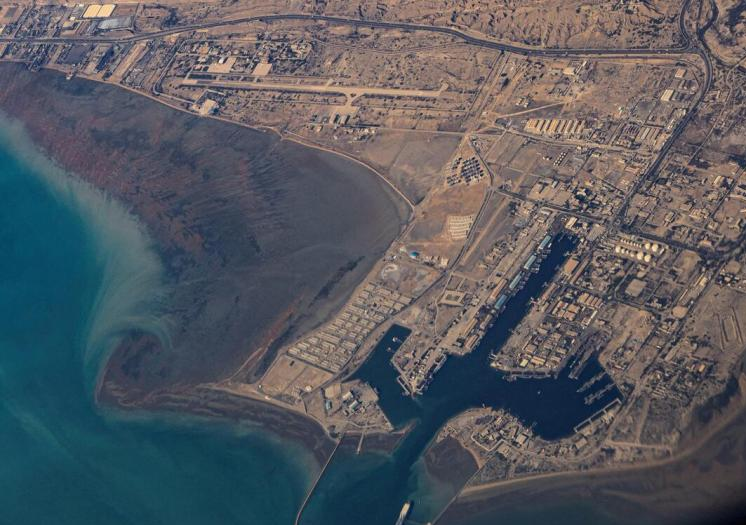
Iran's Secretary of the Supreme National Security Council, Larijani, said that as long as the United States and Israel continue to carry out military strikes against Iran, the security of the Strait of Hormuz will not be restored.
Xinhua News Agency reported that on Monday (March 9th), Larijani commented on French President Macron's remarks regarding the Strait of Hormuz on social media, saying, "In the ongoing war ignited by the United States and Israel, any security in the Strait of Hormuz is unlikely to be achieved", especially when it is still fueling the escalation of this war in certain aspects.
Earlier in the day, Macron said that France and its allies were preparing to launch a "defensive" naval operation aimed at restoring normal navigation in the Strait of Hormuz.
The Strait of Hormuz is one of the most important shipping routes in the world and also the most crucial chokepoint for oil transportation. To the north of the strait lies Iran, while to the south are Oman and the United Arab Emirates. At its narrowest point, the Strait of Hormuz and its shipping lanes are entirely within the territorial waters of Iran and Oman. Experts point out that this is one of the most effective ways for Iran to blockade the Strait of Hormuz.
A senior officer of the Islamic Revolutionary Guard Corps of Iran recently stated that Iran has not closed the Strait of Hormuz, but any ships belonging to the United States or Israel will become targets of Iran's attacks.
On February 28th, the United States and Israel launched a large-scale military operation against Iran. Immediately after that, Iran retaliated by launching attacks on Israeli and US military bases in the Middle East region.

Recently, the British government, in accordance with the "Steel Industry (Nationalization) Act" that came into effect on July 16th, took the British Steel Company, which is controlled by China Jiefang Group, into state ownership without compensation.

Recently, the British government, in accordance with the "S…

On July 23rd local time, the US Trade Representative Office…

The international crude oil market saw a sharp one-sided ri…

Recently, the geopolitical confrontation between the United…

The New York Times has recently clashed with the Trump admi…

Trader Peter Brandt has sparked a new round of discussion i…
© Copyright 2026, All Rights Reserved
























