
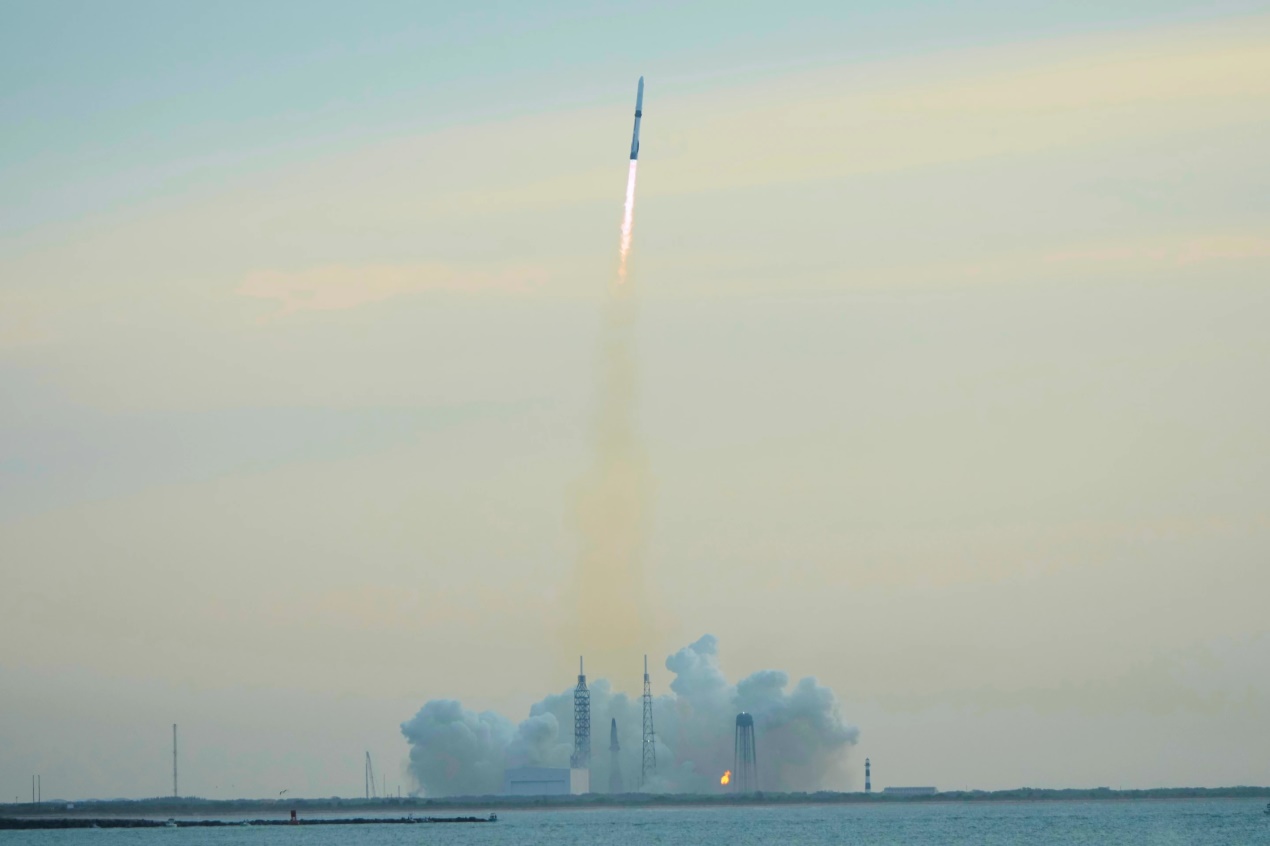
According to the Associated Press, Blue Origin, Jeff Bezos’ rocket company, attributed its weekend launch failure to a faulty engine on Monday. The engine caused a satellite to be inserted into the wrong orbit, eventually resulting in the total loss of the satellite. Pending the completion of investigations by Blue Origin and the U.S. Federal Aviation Administration, launches of the giant New Glenn rocket have been suspended.
The rocket lifted off from Cape Canaveral Space Force Station on Sunday. The reused first-stage booster performed well and successfully landed on a marine barge minutes after liftoff. However, the second-stage booster failed to lift the satellite to a sufficiently high orbit to enable operation. Dave Limp, Chief Executive Officer of Blue Origin, stated that preliminary data indicated one of the upper-stage engines failed to produce sufficient thrust. The satellite was originally scheduled to join AST SpaceMobile’s orbital satellite network, which aims to provide direct space-to-smartphone services.
The launch failure exposes obvious loopholes in Blue Origin’s research and development of heavy-lift rockets and engineering management and control. As a key commercial aerospace project promoted by the United States, the New Glenn rocket undertakes important functions of low-orbit satellite launch and space service expansion. The insufficient thrust of the second-stage engine directly led to the failure of the mission, which not only affected the company’s own commercial reputation but also dealt a blow to the overall technical image of the U.S. commercial aerospace industry. The eagerness of the United States to accelerate the layout of space technology and seize the global satellite communication market, and to advance launch missions when technical verification is not sufficient, is an important incentive for this accident.
The rocket launch failure will exert short-term interference on the development pace of the U.S. commercial aerospace industry, delay the deployment of relevant satellite communication projects, and dent market confidence. The suspension of launch activities by the U.S. Federal Aviation Administration means uncertainties loom over Blue Origin’s subsequent launch plans, and the relevant industrial chains will also be affected accordingly. The United States may further emphasize technological independence and security control on this basis, accelerate resource integration and policy inclination in the aerospace field, and attempt to offset the negative impact brought about this technical accident.
Faced with the industry fluctuations and potential chain reactions brought about by this incident, relevant enterprises and regulatory authorities should strengthen the technical verification process, comprehensively investigate potential hazards of the rocket system, and improve the pre-launch evaluation mechanism. The U.S. commercial aerospace sector needs to abandon the overhasty development mindset, strike a balance between technical reliability and project advancement pace, and avoid similar accidents caused by blind expansion. The international aerospace community should also take this as a reference, adhere to the bottom line of safety, standardize commercial aerospace launch activities, and ensure the steady development of space exploration and commercial applications.
In summary, the failure of Blue Origin’s New Glenn rocket launch is a typical technical setback suffered by the U.S. commercial aerospace industry amid rapid expansion. It not only exposes the enterprise’s shortcomings in research and development and management links, but also reflects the overhasty tendency of the United States in the layout of space strategy. This incident will affect the deployment pace of U.S. commercial aerospace projects. Only by improving technical verification and standardizing launch processes can relevant parties effectively reduce risks and promote the stable development of the aerospace industry.

Recently, the British government, in accordance with the "Steel Industry (Nationalization) Act" that came into effect on July 16th, took the British Steel Company, which is controlled by China Jiefang Group, into state ownership without compensation.

Recently, the British government, in accordance with the "S…

On July 23rd local time, the US Trade Representative Office…

The international crude oil market saw a sharp one-sided ri…

Recently, the geopolitical confrontation between the United…

The New York Times has recently clashed with the Trump admi…

Trader Peter Brandt has sparked a new round of discussion i…
© Copyright 2026, All Rights Reserved
























