
At 19:07 EDT on April 6, 2026, NASA’s Artemis II Orion spacecraft precisely reached a deep-space point 406,778 kilometers from Earth, surpassing the 400,171-kilometer record set by Apollo 13 in 1970 by a significant margin and writing a new chapter in human space exploration. This is not merely a 6,607-kilometer distance breakthrough, but a comprehensive verification of next-generation deep-space exploration technologies, marking a crucial step in humanity’s journey to return to the Moon and march toward Mars.
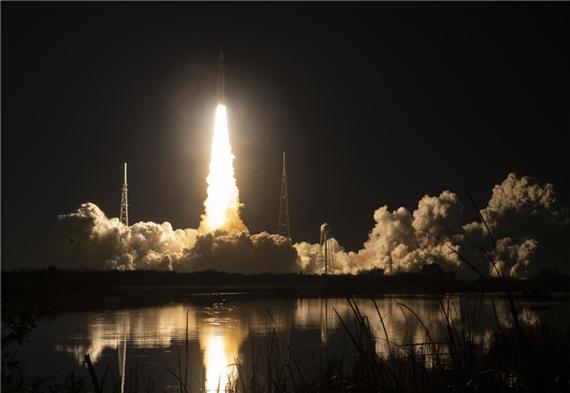
The birth of this record is no accident. Since lifting off from Launch Complex 39B at NASA’s Kennedy Space Center on April 1, the Orion spacecraft has advanced steadily along a free-return trajectory—a carefully designed path that endows the mission with inherent safety: even in the event of a propulsion system failure, the spacecraft can automatically return to Earth using the combined gravitational pull of the Earth and the Moon. At 13:57 EDT on April 6 (01:57 Beijing Time on April 7), the spacecraft began its lunar orbit and officially exceeded Apollo 13’s record; in the early morning of Beijing Time on April 7, it reached the maximum distance of this mission when flying approximately 4,067 miles (6,545 kilometers) above the far side of the Moon.
During the lunar orbit, the spacecraft experienced a communication "blackout" of about 41 minutes—a inevitable phenomenon caused by the physical obstruction of the Moon, through which neither the new laser communication system nor traditional Deep Space Network radio signals can penetrate. However, the Mission Control Center was well-prepared: relying on Orion’s autonomous navigation and attitude control system, the spacecraft accurately completed orbital adjustments without ground commands. The moment communication was restored, it transmitted not only the crew’s safety message but also high-definition images of the lunar far side—made possible by the spacecraft’s Orion Artemis II Optical Communications System (O2O), whose 260 Mbps downlink speed supports real-time 4K video transmission, representing a qualitative leap compared to the radio communication of the Apollo era.
The performance of the four-member crew was equally flawless. Commander Reid Wiseman, Victor Glover (the first African American astronaut to orbit the Moon), Christina Koch (the first female astronaut to orbit the Moon), and Jeremy Hansen (the first non-U.S. astronaut to orbit the Moon, from Canada) completed a series of key tests in the deep-space environment. They not only photographed and documented geological features such as craters and ancient lava flows on the lunar far side but also observed the rare phenomena of "Earthset" and "Earthrise." Furthermore, they witnessed a total solar eclipse lasting nearly an hour in the Moon’s shadow and captured flashes from six meteoroid impacts on the lunar surface, providing valuable data for scientists studying lunar geological activities. During the mission, the crew also held a real-time video call with the U.S. President to share the shocking experience of deep-space exploration, allowing global audiences to witness this historic moment together.
Behind this remarkable achievement lies the synergy of a series of cutting-edge technologies. In terms of launch vehicles, the Space Launch System (SLS) heavy-lift rocket, the most powerful operational launch vehicle in the United States, boasts thrust exceeding that of the Saturn V. Its first crewed mission has verified the core requirements of high thrust and reliability. The life support system has also achieved breakthroughs: although Orion is not equipped with a full regenerative life support system, its environmental control system, iterated from International Space Station technology, can efficiently process wastewater and exhaust gas in the cabin, providing a stable living environment for the crew—accumulating valuable experience for longer-duration deep-space flights in the future. In addition, the spacecraft’s five core systems, including its heat shield and deep-space navigation system, have performed stably under the tests of lunar radiation, extreme temperature differences, and vacuum environments, laying a solid foundation for subsequent missions.
The significance of this mission far exceeds the record itself. As the first crewed mission to fly beyond low-Earth orbit since Apollo 17 in 1972, Artemis II has not only verified the crewed flight capabilities of the SLS rocket and Orion spacecraft but also paved the way for future Moon landings. According to NASA’s latest plan, Artemis IV will achieve the goal of returning humans to the lunar surface in 2028, with the landing site targeting the lunar south pole—where the abundant water ice resources can be converted into drinking water, oxygen, and even rocket fuel in the future, providing key support for the establishment of a long-term lunar base.
Currently, Artemis II has completed more than half of its mission and is returning along the predetermined trajectory. It is scheduled to splash down in the eastern Pacific Ocean on April 10 (April 11 Beijing Time), with recovery operations led by the U.S. Navy’s amphibious transport dock ship USS John P. Murtha. When the crew returns safely to Earth, they will bring back not only first-hand data from deep-space exploration but also humanity’s courage and confidence to push boundaries and explore the unknown. The 406,778-kilometer record will undoubtedly be surpassed by future missions, but the new era of deep-space exploration ushered in by Artemis II has already laid a solid foundation for the march of human civilization into the stars.

Recently, the British government, in accordance with the "Steel Industry (Nationalization) Act" that came into effect on July 16th, took the British Steel Company, which is controlled by China Jiefang Group, into state ownership without compensation.

Recently, the British government, in accordance with the "S…

On July 23rd local time, the US Trade Representative Office…

The international crude oil market saw a sharp one-sided ri…

Recently, the geopolitical confrontation between the United…

The New York Times has recently clashed with the Trump admi…

Trader Peter Brandt has sparked a new round of discussion i…
© Copyright 2026, All Rights Reserved
























