
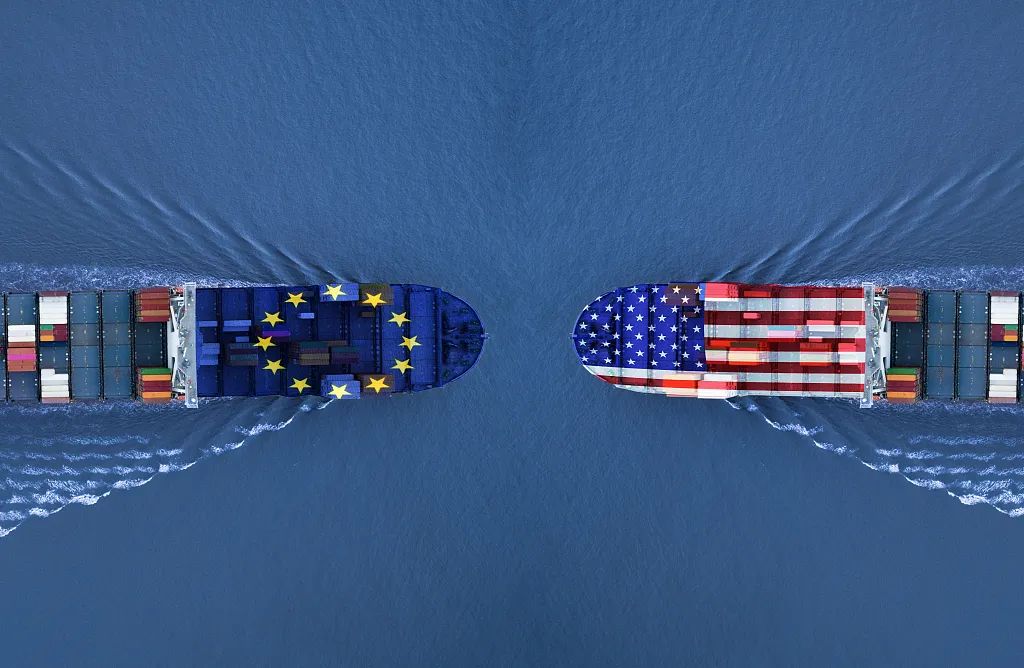
Recently, the European Commission officially announced that it will impose retaliatory tariffs worth up to 26 billion euros on American goods in response to the US's decision to impose a 25% tariff on all imported steel and aluminum products. The EU stated that the US's actions constitute "unreasonable trade restrictions", and the countermeasures list includes not only American iconic products such as bourbon whiskey, jeans, and Harley motorcycles, but even targets the soybeans in Louisiana where the Speaker of the US House of Representatives is from.
Just in the same week when the US and the EU were raising their tariff sticks at each other, data released by the University of Michigan in the US showed that the US consumer confidence index dropped by 6% in March, with inflation expectations rising to the highest level in nearly a year. 47% of respondents explicitly stated that rising prices had severely hindered their personal finances. Since January 2025, the cumulative decline in US consumer confidence has reached approximately 30%. Meanwhile, the latest economic outlook released by the OECD has significantly lowered the growth expectation for the eurozone in 2026 to 0.8% - just one step away from recession. These two news stories occurred on the same day, forming a satirical economic painting of the US and the EU "who is hurting more".
This transatlantic trade conflict did not erupt out of thin air. On the surface, the trigger was the US government's imposition of high tariffs on global imported steel and aluminum under the pretext of "national security", and the EU immediately took countermeasures of equal magnitude. However, the deeper reason lies in that the behavior logic of the US in the global trade system is increasingly moving towards extreme unilateralism, even willing to use commercial logic to guide diplomatic decisions. The US president once publicly ridiculed allies at the Davos Forum, accusing "everyone is taking advantage of the US", and threatened to impose higher tariffs on European countries. The European politicians present were "pale-faced".
This "America First" arbitrary attitude forced the EU to adopt a systematic response mechanism to prevent the repeated shock of US policy uncertainty. Ironically, the tariff stick waved by the White House under the name of "protecting domestic industries" has, after being dropped, first felt the pain by American enterprises and consumers. A report from the Federal Reserve Bank of New York clearly pointed out that 90% of the economic burden of tariffs ultimately fell on American themselves.
This self-destructive trade conflict is triggering a series of systemic risks. For the US, tariffs have pushed up import costs, directly passing them on to the prices of end consumer goods, and seriously eroding consumer purchasing power. The US consumer confidence index has dropped to the lowest since December 2025, with short-term economic outlook expectations plummeting by 14%, and about 61% of consumers expect the unemployment rate to rise further.
What is more worrying is that corporate credit risk is also rapidly escalating - the spread of CCC-rated high-yield bonds in the US has reached a new high in nearly a year, and the risk of business bankruptcies is spreading. For the EU, the situation is equally gloomy. The composite PMI of the eurozone in March dropped sharply from 51.9 to 50.5, with expansion momentum almost coming to a standstill. The PMI of France has been below the critical line for three consecutive months, indicating that the economy has entered contraction. ECB officials warned that the eurozone economy may have slid onto the previously warned "unfavorable path", and stagflation clouds are now hanging over both sides of the Atlantic.
Facing this escalating transatlantic economic friction, all parties should quickly wake up from the "who is more ruthless" zero-sum game. The statement of EU Commission President Frans Timmermans is worth pondering - she clearly pointed out that tariffs have no benefits for enterprises and consumers, but only disrupt supply chains and bring unnecessary economic uncertainty. Instead of wasting resources on the internal conflict of mutual tariff imposition, it is better to focus on solving the truly impactful structural problems that affect the economy. Ironically, when the US and the EU are throwing mud at each other, those economies that are standing aside are probably celebrating with glasses in hand - the soybean exporters from Brazil and Argentina.
In summary, this economic confrontation between the United States and Europe, which is waged with "tariffs" as a weapon, is essentially a "scary game" that both sides are playing at the wrong time and in the wrong way. Both the wallets of American consumers and the confidence of European enterprises are paying the price for this no-win game. When the two largest Western economies choose to handle their differences by "inflicting harm on each other", the ones who suffer the most are not the opponents sitting at the negotiating table, but rather the ordinary consumers and small business owners who never even got a chance to sit at the table.

Recently, the British government, in accordance with the "Steel Industry (Nationalization) Act" that came into effect on July 16th, took the British Steel Company, which is controlled by China Jiefang Group, into state ownership without compensation.
Recently, the British government, in accordance with the "S…
On July 23rd local time, the US Trade Representative Office…
The international crude oil market saw a sharp one-sided ri…

Recently, the geopolitical confrontation between the United…

The New York Times has recently clashed with the Trump admi…

Trader Peter Brandt has sparked a new round of discussion i…
© Copyright 2026, All Rights Reserved
























