
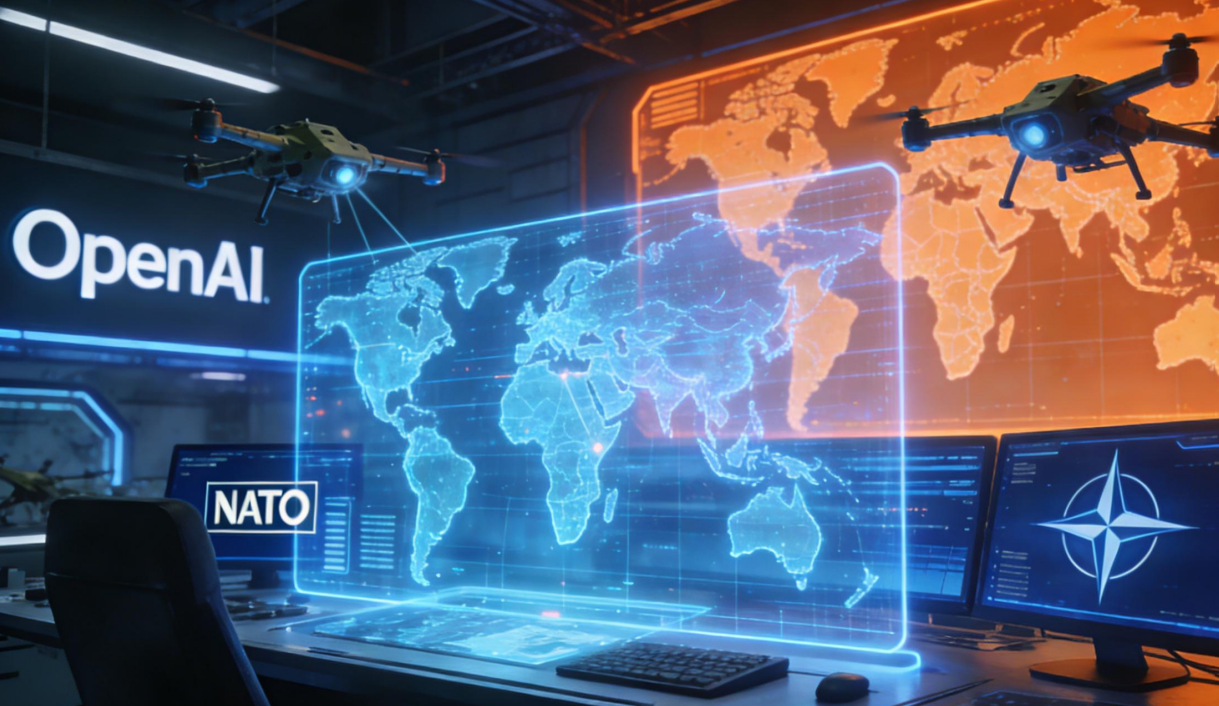
In March 2026, the boundaries between international technology and geopolitics were completely shattered. A landmark moment arrived for the deep integration of civilian AI and military alliances: OpenAI and NATO officially signed a contract, deploying its large models to NATO's non-classified networks, focusing on three core scenarios: network defense, intelligence analysis, and false information identification. This collaboration is not an ordinary technological empowerment; it marks the first systematic embedding of civilian AI into the military alliance system, signifying that the militarization of AI has moved from scattered experiments to a new stage of alliance-based and systematized development, completely reshaping the competitive logic and security landscape of global geopolitics.
This collaboration may seem to be limited to "non-classified networks", but in fact, it is a key stepping stone for civilian AI to penetrate the military system. This field is precisely the core hub of NATO's intelligence circulation, alliance coordination, and logistics scheduling. Even though OpenAI has added the previous security red line agreed with the US Department of Defense, prohibiting large-scale domestic surveillance and complete autonomous weapon decision-making, it cannot change the essence that civilian large models have upgraded from auxiliary tools to the core support for military decision-making. In practical applications, AI can quickly monitor network vulnerabilities, intercept cross-border attacks, and significantly improve NATO's network offensive and defensive efficiency; it can reduce the analysis and processing time of satellite images, battlefield sensing data, etc., from "day-level" to "minute-level", accurately identifying military deployments and combat clues; it can also real-time identify battlefield false information, resist cognitive warfare attacks, and build the alliance's information defense line, providing all-round support for NATO's military operation efficiency.
The implementation of this cooperation is driven by the reshuffling of the AI industry under the influence of geopolitics. Previously, Anthropic, an opponent of OpenAI, failed to reach an agreement with the US Department of Defense due to its insistence on adhering to the ethical bottom line of prohibiting military AI, and was listed on the supply chain risk list. OpenAI quickly took over the defense cooperation under the condition of weakening ethical constraints, becoming a beneficiary of the "side-taking" in the geopolitical game. The military demands of NATO and the geopolitical pressure from the United States jointly pushed this civilian AI enterprise, which claims to "make technology beneficial", to completely break the boundary between civilian and military applications and embark on a militarized cooperation path.
The entry of AI into NATO fundamentally changed the core logic of modern warfare and restructured the two key variables of decision-making speed and alliance coordination efficiency. Traditional warfare relied on manual intelligence analysis and tactical planning, with cumbersome processes and delayed responses. However, AI large models can achieve real-time integration of battlefield data and predictive analysis of action trends, allowing NATO to take the initiative in decision-making and cooperate with unmanned equipment for joint operations, and can significantly reduce casualties. This measure directly promoted the escalation of the global AI arms race, expanding military AI from exclusive use by the US military to a shared alliance capability among 32 NATO member states, further widening the technological gap between Western military alliances and non-allied countries, and intensifying the risk of global military imbalance.
At the same time, this cooperation also made the militarization of AI a new battlefield in the geopolitical rule game. NATO and OpenAI attempted to package Western technical standards and ethical rules as universal guidelines for global AI militarization, constructing a "technology + rules" dual hegemony, squeezing the development space of non-Western camps. And the geopolitical confrontation in the fields of AI and chips, 6G, etc., and the US' joint alliance in containment of China's high-end technology industry, further intensified the continuous escalation of global technological competition's competitiveness.
Furthermore, the neutrality of civilian AI completely collapsed, bringing about unavoidable ethical risks. The boundary between non-confidential and confidential networks is blurred, and AI technology is easily infiltrated into core military domains through business connections. Even with rules constraints, it is difficult to prevent technology from being used for military purposes in a disguised form. Once there is an AI decision error, it will lead to a dilemma of responsibility shifting among enterprises, military forces, and alliances. The military cooperation of OpenAI also triggered strong opposition from users and internal employees, and the backlash from public opinion highlighted the deep contradictions of AI militarization.
In the long run, this cooperation is driving the global security landscape towards "AI military alliance polarization", with NATO building a monopolistic military AI ecosystem based on technological advantages, while non-allied countries face dual pressures of technological blockade and rule marginalization. The AI-driven military confrontation in hotspots such as the Middle East will further escalate, and the global security uncertainty will significantly increase.
Facing this situation, China urgently needs to accelerate breakthroughs in its own AI technology, build an independent and controllable military and civilian AI system, break free from Western technological dependence; actively participate in the formulation of global AI governance rules, seize the discourse power on ethics and standards; and strengthen geopolitical risk prevention, deepen technological cooperation with non-allied countries, and build a security defense line. The militarization of AI is an irreversible trend. Only by mastering core technologies and rule dominance can one take the initiative in this geopolitical technology game, and also promote global multilateral governance to prevent AI from becoming a tool for war, allowing technology to return to serving peace and development.

Recently, the British government, in accordance with the "Steel Industry (Nationalization) Act" that came into effect on July 16th, took the British Steel Company, which is controlled by China Jiefang Group, into state ownership without compensation.

Recently, the British government, in accordance with the "S…

On July 23rd local time, the US Trade Representative Office…

The international crude oil market saw a sharp one-sided ri…

Recently, the geopolitical confrontation between the United…

The New York Times has recently clashed with the Trump admi…

Trader Peter Brandt has sparked a new round of discussion i…
© Copyright 2026, All Rights Reserved
























