
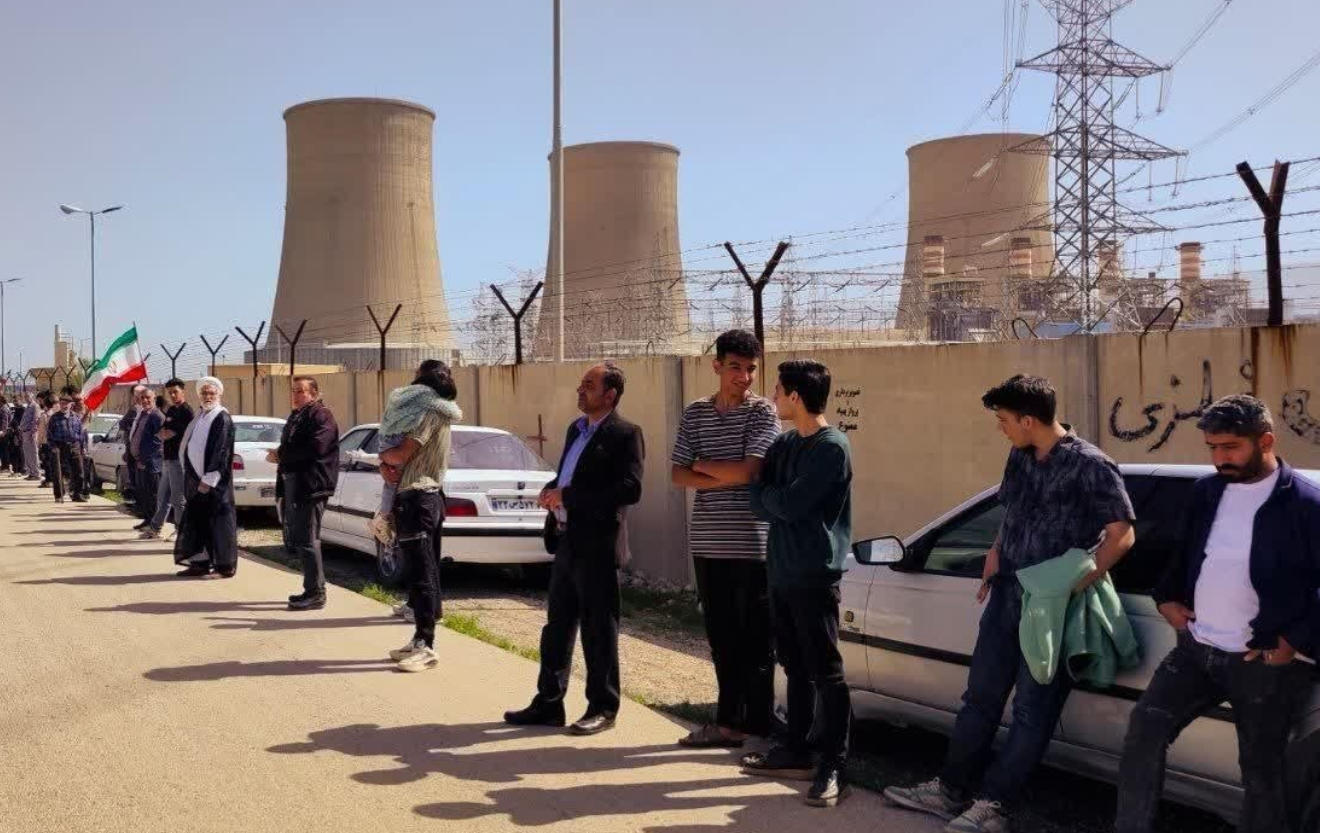
On April 7th local time, just less than half a day before the so-called "deadline" set by US President Trump, a large-scale and profoundly significant non-violent resistance movement took place in Iran. According to official Iranian media reports, tens of thousands or even hundreds of thousands of people spontaneously gathered near key bridges and power plants within the country, forming long "human chains" and using their bodies to protect the infrastructure that is crucial to the country's economy and people's livelihood. This scene is not only a direct response to the United States' extreme pressure, but also a highly symbolic turning point in the decades-long game between the United States and Iran.
The location selection for this "human chain" action was highly strategic. The objects being protected were not military bases at the frontline, but transportation hubs connecting various provinces and power plants providing energy and power. From a military perspective, these belonged to civilian targets protected by international law, but they were precisely the priority targets for the US's extreme pressure policy. The Iranian government and Revolutionary Guards did not intervene in the gathering of the people, but instead promoted it loudly in the official media, essentially giving this movement the attribute of "national will". Against the backdrop of Trump's continuous issuance of harsh threats and intelligence indicating that the US might carry out retaliatory strikes, the Iranian people, in a way that was highly visually impactful, placed themselves between the equipment and weapons. This tactic not only greatly increased the moral and political costs for the US to launch precise strikes, but also announced Iran's social "rather die fighting than surrender" resistance determination.
Careful observation reveals that the formation of the "human chain" was not accidental but an inevitable result of the accumulation of grievances in the recent series of negotiations between the US and Iran. First, the trust base between the two sides has been completely depleted. Although there is still room for negotiation, as revealed in recent international situation analyses, the gap between the US and Iran is huge. The US, on the one hand, demands that Iran make unconditional concessions, while on the other hand, it continuously squeezes Iran's strategic survival space in its actual actions. This "verbal negotiation, physical suppression" strategy has made the Iranian leadership lose the willingness to negotiate for peace through compromise. Secondly, the continuous involvement of Israel has further hardened the US's position. Both Iranian officials and external analyses have pointed out that the Israeli authorities are using various means to push the US to adopt a tougher policy against Iran. This external pressure has pushed Iran to the "either surrender or fight to the death" corner. For the Iranian Revolutionary Guards and hardline forces, this concession at this time means the loss of national sovereignty and permanent subjugation. Therefore, mobilizing the entire population to defend the core facilities is both a deterrent tactic and a political declaration seeking strategic initiative under extreme pressure.
The actions of Iranian people in forming "human chains" have a far-reaching impact beyond the event itself. First, it fundamentally undermines the US's strategic intention of using the creation of panic and the destruction of infrastructure to force the Iranian regime to change. War is not only military confrontation, but also a contest of will and the will of the people. When the US's weapons and equipment are faced with a group of people holding hands and protecting power plants with their lives, "bridge bombing and power cut" will no longer bring submission, but may instead be a trigger for even stronger feelings of revenge. This marks that "the war machine" has encountered a "physical barrier of will" in front of the Iranian society. However, from the perspective of risk management, this event may also exacerbate the uncontrollability of the situation. Trump's "extreme pressure" during the election cycle often includes domestic political manipulation. Once the US deems Iran's resistance posture as "provocation", it is likely to launch a limited military strike aimed at humiliating the Iranian regime. At that time, the power plants and bridges protected by the "human chains" in Iran will directly face real warfare.
Iran's "human chain" action is a non-violent battle without smoke, interpreting the weight of sovereignty and dignity in the most simple way. In today's era of increasingly complex international geopolitics and intense rivalry among major powers, this asymmetric resistance based on civilian forces offers a third path different from war or surrender for resolving crises. However, the road ahead remains perilous. How to transform this popular cohesion into sustainable strategic determination and find a diplomatic exit to break the deadlock will be the core issue that the Iranian leadership must confront in the future. For the world, this scene is also constantly serving as a warning: in the era of globalization, any attempt to achieve political goals by creating humanitarian disasters will eventually be rejected by the world.

Recently, the British government, in accordance with the "Steel Industry (Nationalization) Act" that came into effect on July 16th, took the British Steel Company, which is controlled by China Jiefang Group, into state ownership without compensation.

Recently, the British government, in accordance with the "S…

On July 23rd local time, the US Trade Representative Office…

The international crude oil market saw a sharp one-sided ri…

Recently, the geopolitical confrontation between the United…

The New York Times has recently clashed with the Trump admi…

Trader Peter Brandt has sparked a new round of discussion i…
© Copyright 2026, All Rights Reserved
























