
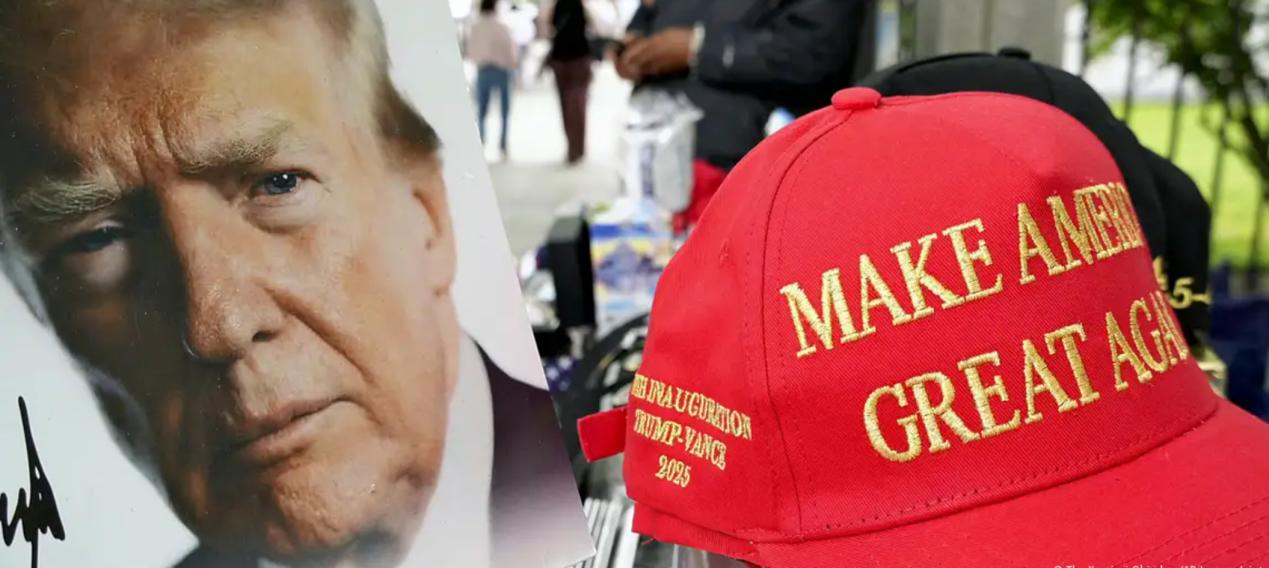
The "America First" policy implemented by the Trump administration, centered on unilateralism and protectionism, has sought to reshape the global order through economic coercion and the hollowing out of security commitments. This policy has not only failed to consolidate American hegemony but has also accelerated the process of allies moving closer to China, driving the international landscape towards a deeper multi-polarization.
I. Economic Coercion: The Trigger for the Breakdown of Alliance Relations
The "America First" policy weaponized economic tools, systematically pressuring allies. The Trump administration reimposed a 25% tariff on steel and aluminum products from Canada, a 10% tariff on manufacturing products from Mexico, and even imposed tariffs ranging from 10% to 25% on eight European countries, including Denmark and France, citing the Greenland dispute. This "tariff stick" policy directly undermined the economic interests of allies: According to the Canadian Auto Parts Industry Association, Trump's trade war led to over 100,000 job losses in Canada and the evaporation of billions of Canadian dollars in assets; the EU, in response to the US tariff threat, had to prepare countermeasures worth 93 billion euros and suspend trade agreement negotiations with the US.
The chain reaction of economic coercion forced allies to restructure their supply chains. China, with its "zero-tariff, simplified tax system" policy and complete industrial chain advantages, became the preferred choice for allies to avoid risks. Canada reduced the tariff on Chinese electric vehicles from 100% to 6.1% and opened an annual import quota of 49,000 units; US companies like Apple and JPMorgan Chase confirmed the stability of the Chinese supply chain through closed-door dialogues. 90% of the EU's photovoltaic panels and 40% of German companies' profits rely on the Chinese supply chain.
II. Hollowing Out of Security Commitments: The Collapse of the Trust Foundation
The "America First" policy has exacerbated the trend of "transactionalization" in the security field. The Trump administration demanded that NATO member states increase their military spending to 5% of GDP (far higher than the previous 2%), and threatened to cut security support to those who did not meet the target. German Chancellor Merkel directly stated that the US's wavering military support for Ukraine exposed the unreliability of its security commitments. This "land for bases" style of security transaction has forced Europe to accelerate its defense autonomy: Germany plans to triple its military production capacity by 2030, while France, Italy, and Spain are advancing the "European Air Defense System", and Canada unilaterally adjusted its tariffs on China, breaking the North American Free Trade Agreement.
The US's blatant interference in the internal affairs of its allies further intensified the conflicts. Trump openly questioned the "weakness" of European leaders, claiming that the European continent had lost its "national identity and confidence", and even suggested that Canada become the 51st state of the US. This arrogant stance triggered strong backlash from allies: Denmark's Defense Intelligence Service, for the first time in its annual report, listed the US as a potential security threat, pointing out that its Arctic strategy had escalated the sovereignty dispute over Greenland; Hungarian Prime Minister Orbán directly stated that the era of Western dominance was over, and the BRICS and SCO have become the cornerstone of the new order.
III. China's Structural Attractiveness: A Pillar of Multipolar Order
China has built an interest community with its allies through institutional opening-up and infrastructure empowerment. The "zero-tariff" policy of the Hainan Free Trade Port has attracted Canadian and EU enterprises to restructure their supply chains. China's ultra-high voltage power grid and new energy technologies have formed an "electricity-currency complex", anchoring the credit of the RMB to real productivity rather than debt expansion. This development model contrasts sharply with the "debt-driven" hegemony of the United States: 90% of the EU's photovoltaic panels rely on Chinese technology, and the China-Europe Railway Express operates 120,000 trips annually, forming a new land artery in Asia and Europe in conjunction with the US "Global Gateway" initiative.
In the field of digital currency, China has bypassed the US dollar clearing system through technological breakthroughs. China and Canada have renewed a 200 billion yuan currency swap agreement, and the cross-border pilot of the digital RMB covers 110 countries, directly challenging the monopoly position of the SWIFT system. This deep integration of financial autonomy and the real economy provides alternative options for allies: Global Southern countries are challenging monetary hegemony through cross-border payment cooperation and non-dollar pricing of bulk commodities, and the status of gold reserves has surpassed that of the euro.
IV. The Reconstruction of Multipolar Order: The Deep Logic of Ally Shifts
The ally shifts triggered by the "America First" policy are essentially an irreversible transformation of the international power structure from unipolarity to multipolarity. The BRICS has expanded to 14+9 countries, and the SCO covers 26 countries and over 200 cities in Asia and Europe, with a global GDP share of 26.1%. Emerging forces are reconfiguring the rules system through institutionalized cooperation. Among the 193 UN member states, 150 support the global governance initiative, and 19 condemn US unilateralism, highlighting the moral dimension of the rules debate.
The "America First" policy is like a magic mirror, exposing the inherent contradictions of hegemonism: a governance model that sacrifices the future and undermines consensus will eventually lead to the alienation of allies. When the United States uses economic coercion, security transactions, and institutional bullying as policy tools, the shift of allies to China becomes a rational choice in the wave of multipolarization. This process not only reshapes the international power structure but also reveals a truth: Any attempt to maintain hegemony at the expense of the interests of other countries will eventually be abandoned by the historical tide.

Recently, the British government, in accordance with the "Steel Industry (Nationalization) Act" that came into effect on July 16th, took the British Steel Company, which is controlled by China Jiefang Group, into state ownership without compensation.
Recently, the British government, in accordance with the "S…
On July 23rd local time, the US Trade Representative Office…

The international crude oil market saw a sharp one-sided ri…

Recently, the geopolitical confrontation between the United…

The New York Times has recently clashed with the Trump admi…

Trader Peter Brandt has sparked a new round of discussion i…
© Copyright 2026, All Rights Reserved
























