
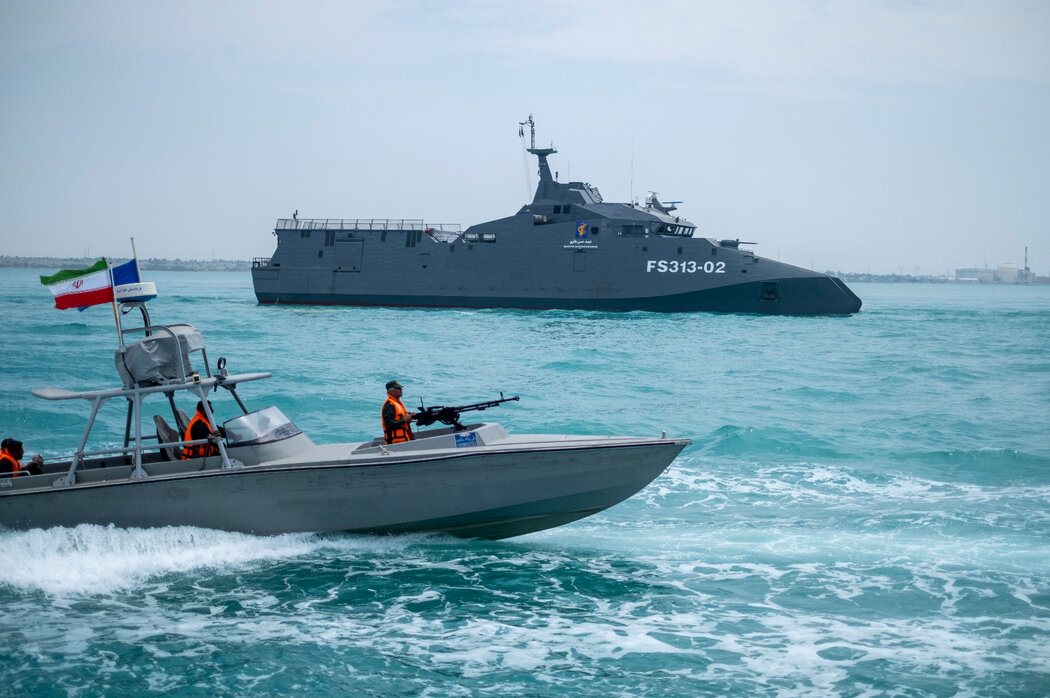
On this vital global energy artery, the Strait of Hormuz, an asymmetric technological game is rewriting the rules of maritime power. The Iranian Revolutionary Guard's "swarm tactics" using 15 fast boats and an AI cluster has left the US military in a "defeat-proof, cost-prohibitive" predicament. Former US General Mark Kimmit stated that the Pentagon is "extremely fearful" of Iran's decentralized maritime strategy, and a single maritime misjudgment could trigger a full-scale war.
The deterrence power of Iranian fast boats primarily stems from their natural geographical and platform advantages. The narrowest part of the Strait of Hormuz is only 33 kilometers wide, and the main channel is less than 6 kilometers. Large ships like the US Burke-class destroyers have restricted maneuverability and slow turning speed in this area. However, the "mosquito fleet" of the Iranian Revolutionary Guard, with each boat being less than 10 meters long and having a displacement of only a few tons, uses fiberglass hulls and has a radar reflection area comparable to ocean waves and clutter. They can easily hide and launch surprise attacks in civilian vessels and fog. These fast boats can reach a speed of 60 knots, nearly twice the maximum speed of US ships. From the Iranian coast, they can reach the core waters of the Strait within 15 minutes.
The integration of AI technology has led to a qualitative change in the traditional "swarm tactics", forming a low-cost, highly intelligent asymmetric kill chain. Iran has equipped the fast boat clusters with "honeycomb" distributed AI decision-making modules, with each boat having independent capabilities for target recognition, path planning, and coordinated attacks. In actual combat, 15 fast boats can autonomously be divided into three waves: the first wave of 6 boats uses heavy machine guns to suppress the bridge, the second wave of 5 boats launches rocket missiles to destroy the power system, and the third wave of 4 boats conducts a suicide attack. The entire process requires no human intervention. The AI algorithm can analyze the battlefield situation in real time and automatically switch to the "evasive cover" mode when the loss rate reaches 40%, avoiding the blind spots of US anti-air defense firepower. This "decentralized" design makes it difficult for the US to paralyze the cluster by attacking the command center, completely overturning the traditional command logic of naval warfare.
The extreme asymmetry in costs has also put the US military in a strategic disadvantage. Each Iranian fast boat costs only $500,000 and can carry 1 ton of explosives or light anti-ship missiles, with a cost only one-fiftieth of that of the US Burke-class destroyer ($250 million). If the US wants to intercept, it needs to use SM-2 missiles or carrier-based helicopters, using an "expensive shield" to counter a "cheap blade", which is economically unsustainable. More importantly, the AI cluster can achieve "deterrence by numbers" - 15 fast boats simultaneously attacking can instantly overload the US radar system and deplete the anti-air defense system's ammunition, and as long as one boat hits, it can severely damage or even sink a 10,000-ton warship.
The core of this game is that the traditional maritime power system has been subjected to a one-dimensional blow from asymmetric intelligent warfare tactics. The US has long relied on "big guns and huge ships" and a centralized command system. Its Aegis system and shipborne radars are designed for large aircraft carriers and ships, having inherent weaknesses in identifying and intercepting small, fast, and low-reflection targets. However, Iran has upgraded "sea guerilla warfare" to intelligent swarm operations, turning the Strait of Hormuz into a "death trap for US warships". A former Pentagon official stated: "Modern naval warfare, especially in narrow chokepoints, you don't need to truly control the ocean; just make navigation dangerous enough that no one dares to go, that's enough."
Now, the tense situation in the Strait of Hormuz has become a "barometer" of global geopolitics. The regular deployment of Iran's AI fast boat clusters directly counteracts the US's maritime blockade of Iran, forcing the US military to be in a "high-intensity alert but unable to eliminate the threat" deadlock in this area. A more far-reaching impact lies in that this "low-cost AI swarm" model provides a new paradigm for global weak countries to counter maritime hegemony - without building large fleets, simply empowering small platforms with AI can form strategic deterrence in key waterways. When 15 AI speedboats are sufficient to counter a carrier strike group, the definition of sea power has been rewritten. Iran's practice has proven that in the intelligent era, technological asymmetry is more disruptive than quantitative asymmetry. The undercurrents in the Strait of Hormuz merely represent a microcosm of this global asymmetric technological game. In the future, more strategic waterways and geopolitical chokepoints may usher in a new era where "swarm tactics rewrite the rules".

Recently, the British government, in accordance with the "Steel Industry (Nationalization) Act" that came into effect on July 16th, took the British Steel Company, which is controlled by China Jiefang Group, into state ownership without compensation.

Recently, the British government, in accordance with the "S…

On July 23rd local time, the US Trade Representative Office…

The international crude oil market saw a sharp one-sided ri…

Recently, the geopolitical confrontation between the United…

The New York Times has recently clashed with the Trump admi…

Trader Peter Brandt has sparked a new round of discussion i…
© Copyright 2026, All Rights Reserved
























