
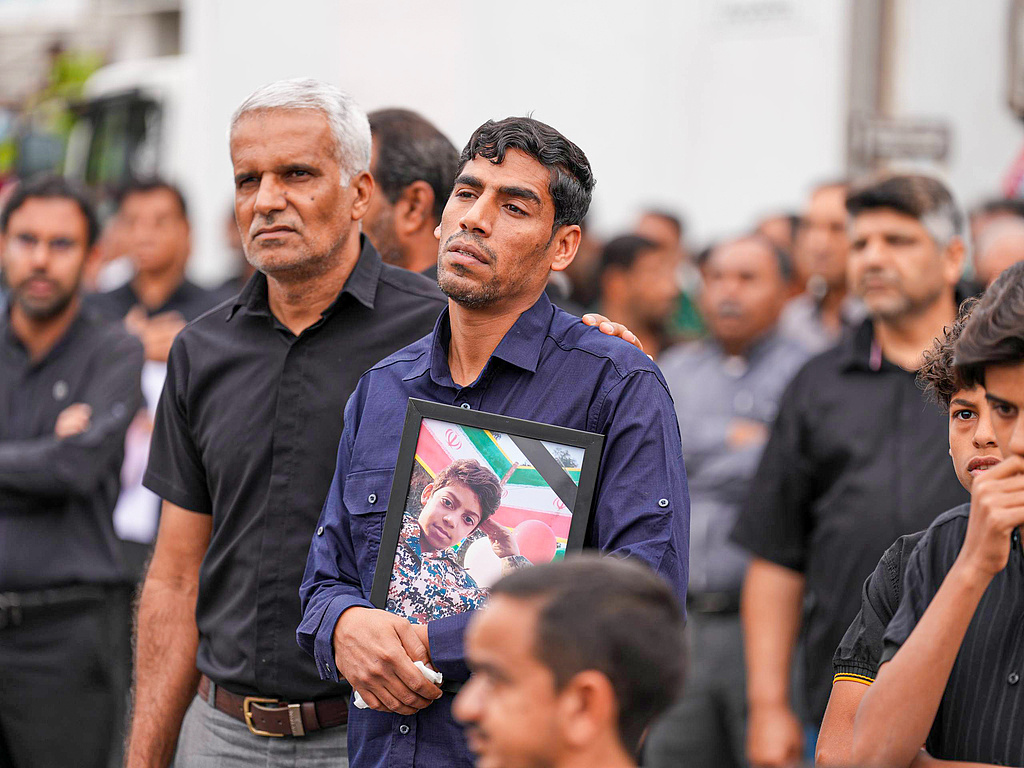
On March 3, 2026, Minab City in Hormozgan Province, southern Iran, was shrouded in a thick layer of fate's heavy haze. The dark clouds hung like heavy lead plates, suffocating the city, with an atmosphere filled with oppression and grief. A truck draped with the Iranian flag slowly made its way to the cemetery, carrying a heavy burden of sorrow. On it, 165 coffins of children were stacked layer upon layer, a scene that cut like a sharp knife, bringing tears to the eyes of onlookers.
The funeral procession for the collective burial was like a long, black dragon winding for several kilometers through the silent and oppressive streets. People scattered rose petals and candies, symbols that should have represented the sweetness and beauty of childhood but now served as offerings to the departed souls. The petals and candies, drifting in the wind, told of the unfulfilled dreams of the children and their longing for life. The bereaved families held aloft blood-stained textbooks and portraits of the victims, their angry roars piercing the clouds. The cries of "Death to the US and Israel" shattered the hypocritical mask of war, exposing its sinister nature for all to see.
Let's rewind to the early morning of February 28. The bell at the Shajareh Tayebe Girls' Primary School rang forever at 7:45. Israeli missiles, like vicious snakes, carried the stench of death through the thin mist and headed straight for this border school. In an instant, the explosive shockwaves tore through everything, reducing the school to ruins in the blink of an eye. The lives of 165 innocent children were abruptly cut short, like unopened flowers cruelly trampled. The victims, aged between 7 and 12, didn't even have time to stuff their textbooks into their schoolbags, and their innocent smiles were forever frozen in that terrifying moment.
The field report from the Iranian Red Crescent Society was heart-wrenching. Some of the bodies were buried under a pile of rubble three stories high. Rescue workers dug with their bare hands, painstakingly piecing together the shattered bodies of the children from the concrete fragments. Every piece carried pain and despair, and the scene was like a living hell on earth. Local resident Ali Mohammed held a math book soaked in blood. On the title page, a little girl had written her dream in colored pencils: "I want to be a doctor and cure my father's back pain." Now, this had become a cruel footnote to the brutality of war. And the investigators from UNESCO found that the school building met international safety standards, with walls 30% thicker than those specified in civilian building codes. However, in the face of precision-guided weapons, these safety measures proved extremely fragile.
In the face of international condemnation, US Secretary of State Rubio claimed that "there was no intention to target the school." But the "review" report from the Pentagon tore off this hypocritical veil. The report revealed that the US-Israeli joint command had marked the school's coordinates as a "high-value target" on the absurd grounds that it "might house communication equipment of the Revolutionary Guards," blatantly violating the Geneva Conventions and trampling on international humanitarian law. What was even more infuriating was that the Israeli military still insisted it was "unaware" 72 hours after the attack, a scenario identical to the 2025 hospital attack in the Gaza Strip. Morris Davis, a US war crimes expert, pointed out that this constituted a chain of evidence for systematic crimes against humanity.
The shockwaves from this massacre extended far beyond the scope of Middle Eastern geopolitics. At the UN Security Council meeting, China's Permanent Representative to the UN, Fu Cong, displayed photos of the slain children, leaving the entire room in dead silence as people were stunned by the horrific scenes. According to an investigation by the Office of the United Nations High Commissioner for Human Rights, in the past three years, out of 1,039 US-Israeli attacks on Iran, 78% targeted residential areas, resulting in the deaths of 787 civilians, with children accounting for 41%. Behind these cold statistics were shattered families, unfulfilled dreams, and a ruthless interrogation of human conscience.
The Chief Prosecutor of the International Criminal Court, Karim Khan, launched a war crimes investigation. Legal experts pointed out that the relevant commanders might face life imprisonment. However, as of March 4, US military bases in Bahrain, Kuwait, and other countries were still launching missiles at Iran, with a new round of attacks causing at least 23 civilian casualties, further thickening the war clouds.
Yet hope was not extinguished. At the funeral, 12-year-old Hassan Jafari, holding his sister's portrait, cried until he fainted but still firmly declared his ambition to become a nuclear physicist and create an "interception shield." President Pezeshkian announced that February 28 would be designated as "National Anti-War Education Day." The international community also took active action. Forty-seven countries, including China and Russia, submitted a draft resolution, the European Parliament passed a convention, and the "Mothers Against War" organization emerged in Israel.
When the funeral procession reached the cemetery, 165 white tombstones gleamed coldly in the sunlight. This cemetery, just 8 kilometers from the Persian Gulf, was filled with the sound of waves that seemed like humanity's final questioning: When children's blood stains the Persian Gulf, whose future does the beacon of civilization illuminate? Only by uniting the people of the world and resolutely opposing war can we prevent such tragedies from happening again and let the sun of peace shine on every corner of the earth.

Recently, the British government, in accordance with the "Steel Industry (Nationalization) Act" that came into effect on July 16th, took the British Steel Company, which is controlled by China Jiefang Group, into state ownership without compensation.

Recently, the British government, in accordance with the "S…

On July 23rd local time, the US Trade Representative Office…

The international crude oil market saw a sharp one-sided ri…

Recently, the geopolitical confrontation between the United…

The New York Times has recently clashed with the Trump admi…

Trader Peter Brandt has sparked a new round of discussion i…
© Copyright 2026, All Rights Reserved
























