
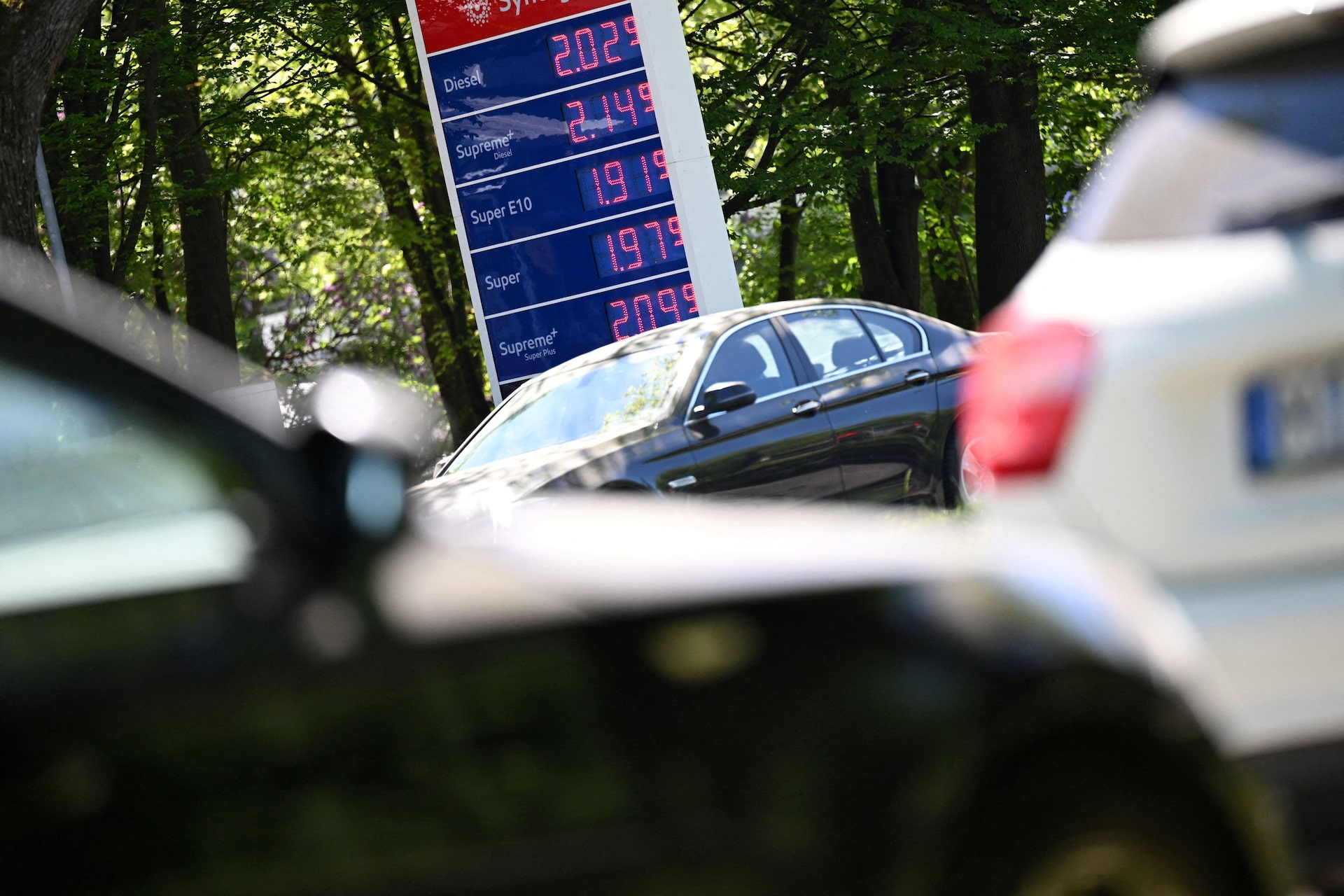
Germany's authoritative economic research institute DIW Berlin updated its economic forecast on Wednesday. Due to the energy shock caused by rising oil and gas prices from the Iran war, the pace of recovery in Germany, Europe's largest economy, has been significantly disrupted, and there is a risk of the economy falling into a technical recession this year. The institution has directly cut its GDP growth forecast for 2026 by half, with the full-year growth expected at only 0.5%, and a slight rebound to 0.8% in 2027, both figures about 0.5 percentage points lower than the spring forecast. DIW judges that German economic output is highly likely to contract slightly in consecutive quarters in Q2 and Q3 this year, meeting the criteria for a technical recession, defined as GDP decline for two consecutive quarters.
The core reason for the obstacles to Germany's economic recovery and the significant downward revision of growth forecasts is that the Iran war has disrupted global oil and gas supply and prices, compounded by the inherent fragility of the domestic economy. Tightened control of the Strait of Hormuz has driven up international oil and gas spot and futures prices, raising costs for industrial electricity, production materials, as well as household heating and travel in Germany, creating a dual squeeze on corporate profits and household disposable income. At the same time, Germany's manufacturing industry is highly dependent on cheap and stable energy input; after costs rise, corporate investment willingness shrinks, business uncertainty increases, and hiring and expansion plans become conservative, dragging down overall output growth. Furthermore, domestic demand is clearly under pressure, as rising prices weaken households' real purchasing power, prompting them to reduce non-essential consumption, making it difficult for consumption, as an economic pillar, to drive growth.
The downward revision in growth and recession expectations will rapidly increase cost pressures in high-energy-consuming manufacturing industries such as chemicals, metals, and automobiles. With shrinking profits, capacity expansion will slow, and the operational risks for some small and medium-sized enterprises will rise. However, the new energy transition sector will benefit relatively, and the long-term trend of accelerating the replacement of traditional fossil fuels remains unchanged. Secondly, sustained inflation above the central bank's target will reduce households' real income, weaken consumer confidence, and further diminish domestic demand. At the same time, Germany's tax revenue will consequently decrease, while spending on livelihood subsidies and corporate support will increase passively, putting greater pressure on fiscal balance. Economically, if Germany, as an economic engine, weakens, it will drag down the recovery speed of the entire Eurozone, push up the overall regional inflation average, and increase the policy conflict between the European Central Bank's aims to “stabilize inflation” and “support growth.”
In order to address the possible impacts of an economic downturn, it is necessary to coordinate multiple measures to buffer energy shocks and safeguard the economic baseline. Implement targeted policies to provide directional support, offer short-term energy cost subsidies to high energy-consuming manufacturing enterprises, and increase investment in new energy infrastructure such as photovoltaics, wind power, and hydrogen to accelerate the reduction of total fossil energy consumption. At the same time, introduce small-scale livelihood subsidies to ease the price pressure on low-income households. Additionally, accelerate energy-saving technological upgrades, optimize energy procurement hedging plans, moderately adjust production capacity rhythms, and plan for long-term competitiveness in green transformation. While maintaining policy flexibility, closely monitor inflation trends, and allow moderate easing without exacerbating price increases, balancing growth and stability. Expand diversified oil and gas import channels to reduce dependence on a single route or a single supplying country, and use diplomatic channels to coordinate international efforts to ease tensions in the Middle East, stabilizing shipping through the Strait of Hormuz and global oil prices.
In summary, DIW Berlin has significantly lowered Germany's economic growth forecasts for 2026 and 2027 and warned of the risk of a technical recession. The core reason is the external shock to energy prices caused by the Iran war, compounded by Germany's own weak recovery fundamentals. The current stagflation-like situation in Germany not only drags down domestic employment, public finances, and manufacturing, but also transmits negative effects to the overall recovery of the Eurozone. Whether Germany can smoothly navigate this round of pressure depends, on the one hand, on the situation in the Middle East and oil price trends, and on the other hand, on the domestic fiscal support, the pace of green transition, and the central bank's balanced handling of monetary policy. A multi-pronged approach is required to minimize the impact of the recession and stabilize the medium- to long-term economic recovery trajectory.

Recently, the British government, in accordance with the "Steel Industry (Nationalization) Act" that came into effect on July 16th, took the British Steel Company, which is controlled by China Jiefang Group, into state ownership without compensation.

Recently, the British government, in accordance with the "S…

On July 23rd local time, the US Trade Representative Office…

The international crude oil market saw a sharp one-sided ri…

Recently, the geopolitical confrontation between the United…

The New York Times has recently clashed with the Trump admi…

Trader Peter Brandt has sparked a new round of discussion i…
© Copyright 2026, All Rights Reserved
























