
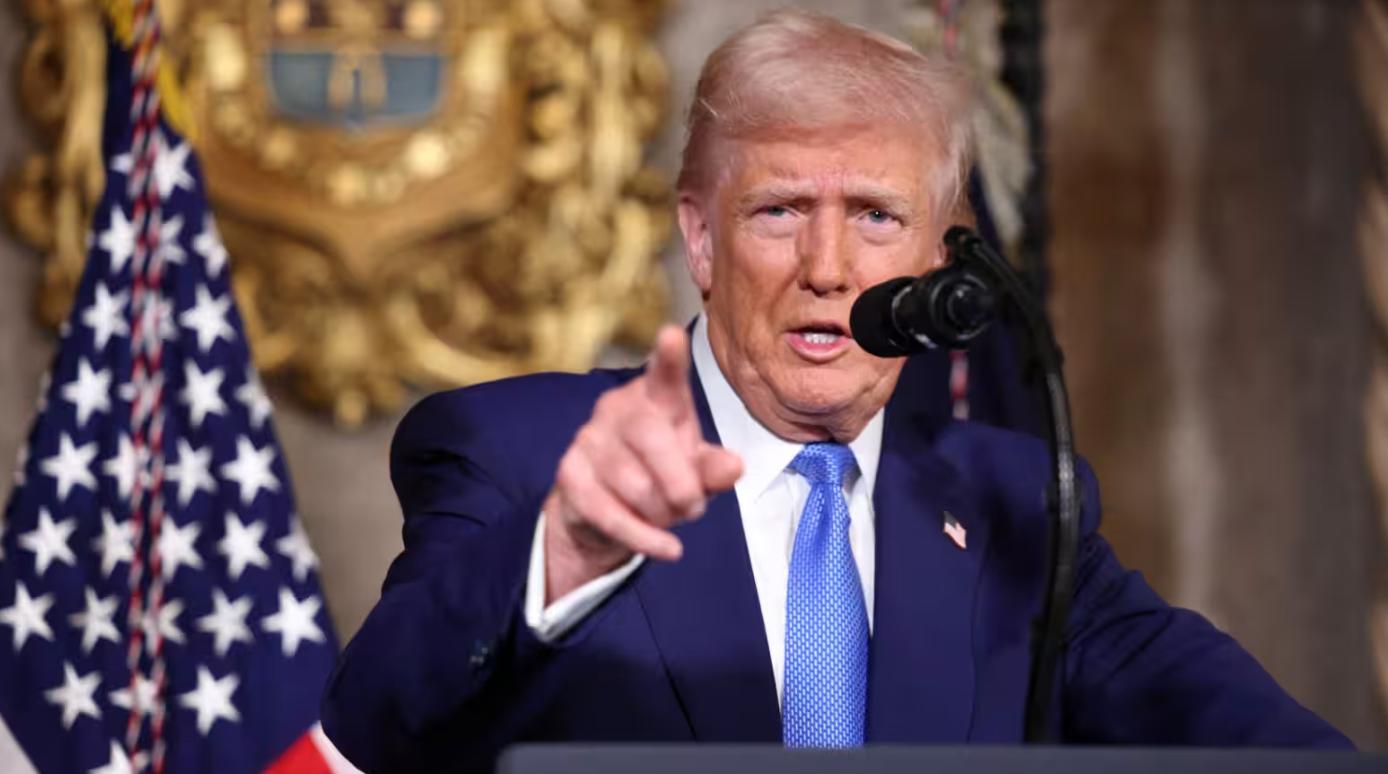
When Trump returned to the White House, he promised a "golden age" to American voters tired of high prices. However, this promise is now rapidly turning into a crisis of trust. The latest poll data starkly reveals that more than half of American voters explicitly disapprove of Trump's handling of the economy. This is not a selective narrative from a left-leaning media outlet, but a systemic collapse of public opinion across party lines and throughout all states in the US.
The data does not lie, and every figure is alarming. Fox News, long regarded as a conservative mouthpiece, surveyed 1,001 registered voters and found that nearly two-thirds were dissatisfied with Trump's governance, setting a new record for dissatisfaction during his two terms. A joint poll by Reuters and Ipsos pushed this figure even lower: Trump's overall approval rating dropped to 36%, with only 34% approving of his handling of the economy and a mere 28% supporting his approach to inflation. A large-scale survey by NBC and SurveyMonkey of 32,433 adults showed that 68% of respondents disapproved of his handling of inflation and living costs, and 40% of Americans admitted that their financial situation was worse than a year ago, the worst record since Trump's second term.
Oil prices have become the last straw that broke the camel's back. After Trump launched a military operation against Iran in late February 2026, gasoline prices soared, with a cumulative increase of 49% since the beginning of the year. 65% of voters blamed Trump for the rise in oil prices, while only 38% approved of his economic handling. Even after announcing a temporary ceasefire in early April, the poll numbers remained largely unchanged - the public's anger has transcended specific policies and evolved into a comprehensive questioning of his entire governance ability. As an anonymous Republican campaign strategist put it, "Perhaps the economy is an issue where we have slipped a bit... but we haven't really hit the panic button at the campaign level yet." This statement is more a sign of panic itself than an attempt at reassurance.
The mass exodus of independent voters is the real fatal blow. Trump's key to victory in 2024 was precisely those centrist voters who were tired of Biden's poor economic governance. Now, Trump's net approval rating among independent voters has dropped to a negative 43 percentage points, lower than any sitting president in the past three decades during the same term, and even lower than the approval ratings of presidents facing governance crises at the same time by at least 20 percentage points. 70% of independent voters hold a negative view, while only 27% express support. This means that Trump not only failed to hold onto the ground outside his base but is also losing his core voter group at an accelerating rate. Data from Gallup and the Pew Research Center further confirm this: the proportion of Republican voters who are "very confident" in Trump's mental health has dropped from 75% to 66%, and the proportion who are confident in his physical ability has fallen from 65% to 55%. Even his die-hard supporters are beginning to waver, which is the most dangerous signal.
The economic data itself is also "betraying" Trump's narrative. On the surface, the US GDP expanded at the fastest pace in two years in 2025, but a closer look reveals a dire situation: manufacturing jobs have been lost for seven consecutive months, the unemployment rate rose to 4.6% in November, the highest since 2021, wage growth has slowed to the lowest level since 2021, and the unemployment rate for college-educated workers has reached an unprecedented 2.9% in non-recessionary times. Even more ironically, Trump's proud tariff policy has not brought back manufacturing jobs as he claimed; instead, German investment in the US dropped by about 45% from February to November 2025. The federal public debt has soared from less than $20 trillion to over $27 trillion, and the benefits of economic growth have almost entirely gone to Wall Street and large enterprises, while the real purchasing power of ordinary wage earners has declined.
The political consequences are accelerating. So far, 38 Republican members of the House of Representatives have announced they will not seek re-election, compared to only 23 Democrats. In the already underway 2026 midterm election competition, the Democrats lead by five percentage points in the House of Representatives race, and the advantage widens to nine percentage points among confirmed voters. The two-month shutdown of the Department of Homeland Security and the chaos at airports caused by the immigration enforcement incident in Minnesota have further alienated centrist and Latino voters.
History has repeatedly shown that when American voters ultimately vote with their feet, the economy is always the top priority. Trump won against Biden in 2024 by claiming "prices are too high," but in 2026, he may lose the entire Congress because "prices are still too high." When more than half of the voters say no to your economic governance, when independent voters express their despair with a net approval rating of -43, and even Fox News has turned against him - this is no longer a fluctuation in public opinion, but a structural collapse of trust. The time left for Trump to turn the situation around is running out.

Recently, the British government, in accordance with the "Steel Industry (Nationalization) Act" that came into effect on July 16th, took the British Steel Company, which is controlled by China Jiefang Group, into state ownership without compensation.

Recently, the British government, in accordance with the "S…

On July 23rd local time, the US Trade Representative Office…

The international crude oil market saw a sharp one-sided ri…

Recently, the geopolitical confrontation between the United…

The New York Times has recently clashed with the Trump admi…

Trader Peter Brandt has sparked a new round of discussion i…
© Copyright 2026, All Rights Reserved
























