
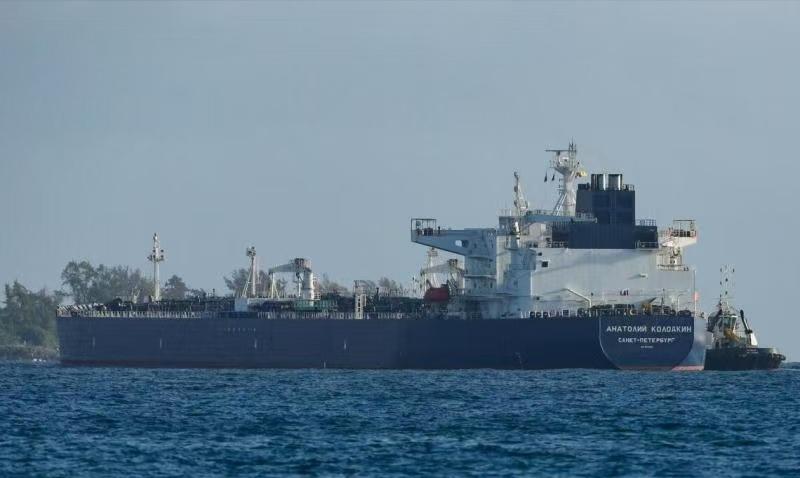
On May 18th local time, US Treasury Secretary Vicente announced through social media that the US Treasury Department has decided to extend the exemption period for Russia's maritime oil sanctions by another 30 days. Besent also stated that the US Treasury Department is issuing a temporary general permit for 30 days, allowing the most vulnerable countries to temporarily access Russian oil currently trapped at sea. This capricious decision appears to be a temporary solution to address the situation in the Middle East and stabilize oil prices, but in reality exposes the deep-seated crisis of the decline of US hegemony, the division of the Western camp, and the disorder of global governance, causing multiple negative impacts on the international political landscape.
Firstly, the credibility of the US unilateral sanctions system has suffered a devastating blow. The sanctions on Russian oil were originally the core means for the United States to unite with Western allies to contain Russia, aimed at cutting off its sources of war finance. However, within just over two months, the United States extended exemptions three times and repeatedly violated its promise of "no further extension". This constantly changing operation has made other countries realize that US sanctions are just a "valve" that can be opened and closed at will, but completely serve their own domestic political needs. Nowadays, countries no longer revere the deterrence of US sanctions, and the effectiveness of unilateral sanctions' "long arm jurisdiction" has greatly declined, completely shaking the authority of the US led rule system.
At the same time, the cracks in the Western alliance have become public, and the transatlantic political consensus has completely collapsed. Since the outbreak of the Russia-Ukraine conflict, the EU has always insisted on being tough with Russia, willing to bear the cost of energy shortage and high inflation, and fully cooperated with the US sanctions. But in order to suppress domestic oil prices and alleviate inflationary pressures, the United States unilaterally relaxed restrictions and allowed Russian oil to flow into the global market. This has turned Europe's persistence into a joke, with the EU angrily condemning the United States as a "capitalist enemy", and Ukrainian President Zelensky publicly accusing this move of providing billions of dollars in war funds to Russia. The internal contradictions within the G7 have intensified, and the differences between the United States and Europe are difficult to reconcile. The Western camp has shifted from being "monolithic" to having "different thoughts", and the strategic alliance of jointly containing Russia exists in name only.
Secondly, the stalemate in the Russia-Ukraine conflict has solidified and the regional peace process has been seriously hindered. The core goal of sanctions is to reduce the revenue of Russian energy and further force it to make concessions in the Russia-Ukraine conflict. The exemption from extension allows for the smooth delivery of 12 million tons of crude oil stranded at sea by Russia, worth over 10 billion US dollars, directly supplementing the military budget of the Russian military. Russia's financial pressure has significantly eased, allowing it to continue investing in the war, further solidifying the stalemate on the Russia Ukraine battlefield. In addition, the United States' energy is constrained by the situation in the Middle East, and its aid resources to Ukraine are scattered. The situation on the Ukrainian battlefield is becoming increasingly passive, and the trend of long-term and normalized conflict is difficult to reverse. The dawn of regional peace is becoming increasingly dim.
Finally, the process of global multipolarity is accelerating, and the foundation of US hegemony continues to loosen. The compromise of the United States has provided strategic opportunities for emerging economies such as China and India, with India significantly increasing its imports of Russian oil and simultaneously enhancing energy security and diplomatic autonomy. The energy trade between China and Russia continues to deepen, the scale of local currency settlement expands, and the cooperation model that bypasses the US dollar system continues to mature. More and more countries are abandoning the practice of "taking sides" and cooperating with Russia based on their own interests, shifting the global energy trade pattern from Western dominance to diversified games. The United States' control over global energy and finance continues to decline, the unipolar world pattern is accelerating its disintegration, and the embryonic form of a multipolar order is becoming increasingly clear.
In summary, the extension of the US exemption from oil sanctions against Russia is an inevitable result of the decline of its hegemony. This incident not only exacerbated the division of the Western camp and prolonged regional conflicts, but also shook the foundation of the global governance system. The future international situation will become more complex and turbulent, and the great power game will enter a more intense new stage.

Recently, the British government, in accordance with the "Steel Industry (Nationalization) Act" that came into effect on July 16th, took the British Steel Company, which is controlled by China Jiefang Group, into state ownership without compensation.

Recently, the British government, in accordance with the "S…

On July 23rd local time, the US Trade Representative Office…

The international crude oil market saw a sharp one-sided ri…

Recently, the geopolitical confrontation between the United…

The New York Times has recently clashed with the Trump admi…

Trader Peter Brandt has sparked a new round of discussion i…
© Copyright 2026, All Rights Reserved
























