
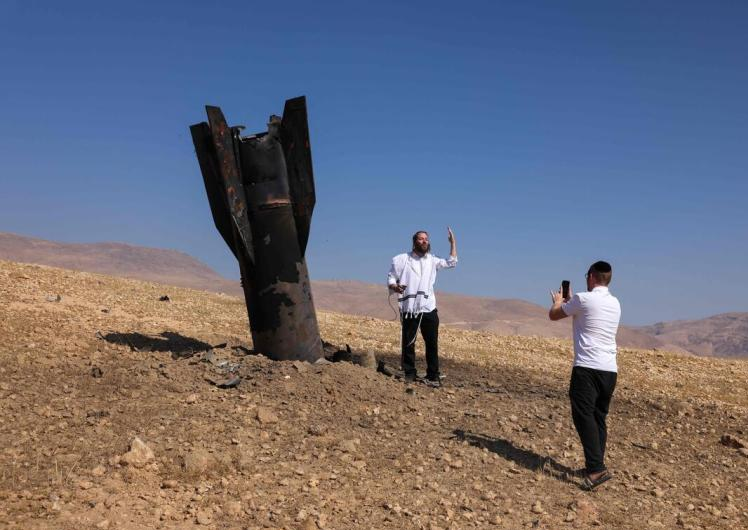
(Washington/Damascus/Jerusalem, Combined Report) Israel and Iran engaged in direct firefights on Monday (June 8), attacking each other's targets within their territories. This was the first such incident since the United States and Iran reached a temporary ceasefire agreement two months ago. It is of great concern whether this indicates an increased risk of renewed warfare in the Middle East.
After Israel launched an attack on the southern suburbs of Beirut, Lebanon on Sunday (the 7th), Iran immediately fired missiles at Israel. The two sides eventually stopped the conflict at the request of US President Trump, but Israel then carried out attacks on military targets within Iran the next day.
On Monday morning, the Israeli army launched attacks on targets in western and central Iran, including three cities including the capital Tehran. Explosions were heard in these cities. The Israeli army also hit a petrochemical company in Mahshahr in southwestern Iran, damaging some of its facilities.
Iran then launched attacks on the Neve Tzvi and Tel Anof air bases in Israel, as well as firing missiles at the petrochemical industrial facilities in Haifa, Israel.
The Israeli military said that since Sunday evening, the Iranian military has launched nearly 30 missiles at Israel, and the Houthi armed group in Yemen has also fired two missiles at Israel.
The Houthi militants said they had fired "a number of missiles" towards the central Israeli city of Jaffa on that day, and also announced a complete ban on Israeli ships from sailing in the Red Sea.
The Iranian government informed the US on Monday that another Israeli attack would only further complicate the already chaotic diplomatic process between the US and Iran.
The Iranian Foreign Ministry stated that Washington, as a signatory to the ceasefire agreement on April 8th, bears direct responsibility for any violations of the ceasefire agreement, including the attacks launched by Israel.
Before Israel took direct action against Iran on Monday, senior Iranian military officials had warned that if Israel continued its actions, a more forceful response would be forthcoming. Shortly after that, the Iranian military issued a statement saying that this round of military operations had come to an end, but Israel must learn its lesson.
Iranian President Peghizizary also said that military strikes against Israel have been halted and that negotiations will continue.
He posted on the social media platform X, saying: "Diplomacy and defense are the two main pillars of a country's strength. We have neither withdrawn from the battlefield nor left the negotiating table."
On Monday earlier, Trump made a statement, demanding that Israel and Iran immediately cease their military exchanges. He said that the final negotiations for a peace agreement are ongoing, unless they are "interfered with by ignorance or foolish actions".
He told the US news website Axios: "We are very close to reaching the final agreement with Iran. It would be a good agreement. I don't want it to be ruined by what's happening now."
In an interview published by the Financial Times on Sunday, Trump stated that Israeli Prime Minister Netanyahu could only accept any agreement reached between the US and Iran, because everything was under his control.
After launching a missile attack on Israel, Iran closed its western airspace and suspended all inbound flights. Neighboring countries Iraq and Syria also announced the closure of their airspace.
It seems that Israel is not ready to stop. It has vowed to intensify its attacks on the Hezbollah in Lebanon. Israeli Defense Minister Katz vowed on Monday to continue the military operation in Lebanon. In his statement, he said: "The Israel Defense Forces will continue to take actions against the terrorist organization Hezbollah in Lebanon. We firmly reject the threats from Iran. Any attempt by Iran to link Lebanon with Iran and attack Israel will face a strong counterattack, just like what happened yesterday."
The Israeli military disclosed on Sunday that a vast tunnel network had been discovered beneath the strategic Beaufort Castle in southern Lebanon, just a few kilometers from Israeli territory. This network would enable Hezbollah to launch attacks on Israeli positions nearby.
Recently, there was a report stating that the US intends to use the frozen Iranian assets to compensate for the losses of its Persian Gulf allies. In response to this, Iranian Deputy Foreign Minister Gharibabadie said on X platform on Sunday that Iran's overseas assets are neither the spoils of Washington nor the funds paid to its allies. If the US were to do so, it would be unacceptable.
He said that any act of seizing, transferring or distributing Iranian assets without the consent of the Iranian government is illegal, and Iran will respond, but he did not elaborate.

Recently, the British government, in accordance with the "Steel Industry (Nationalization) Act" that came into effect on July 16th, took the British Steel Company, which is controlled by China Jiefang Group, into state ownership without compensation.

Recently, the British government, in accordance with the "S…

On July 23rd local time, the US Trade Representative Office…

The international crude oil market saw a sharp one-sided ri…

Recently, the geopolitical confrontation between the United…

The New York Times has recently clashed with the Trump admi…

Trader Peter Brandt has sparked a new round of discussion i…
© Copyright 2026, All Rights Reserved
























