
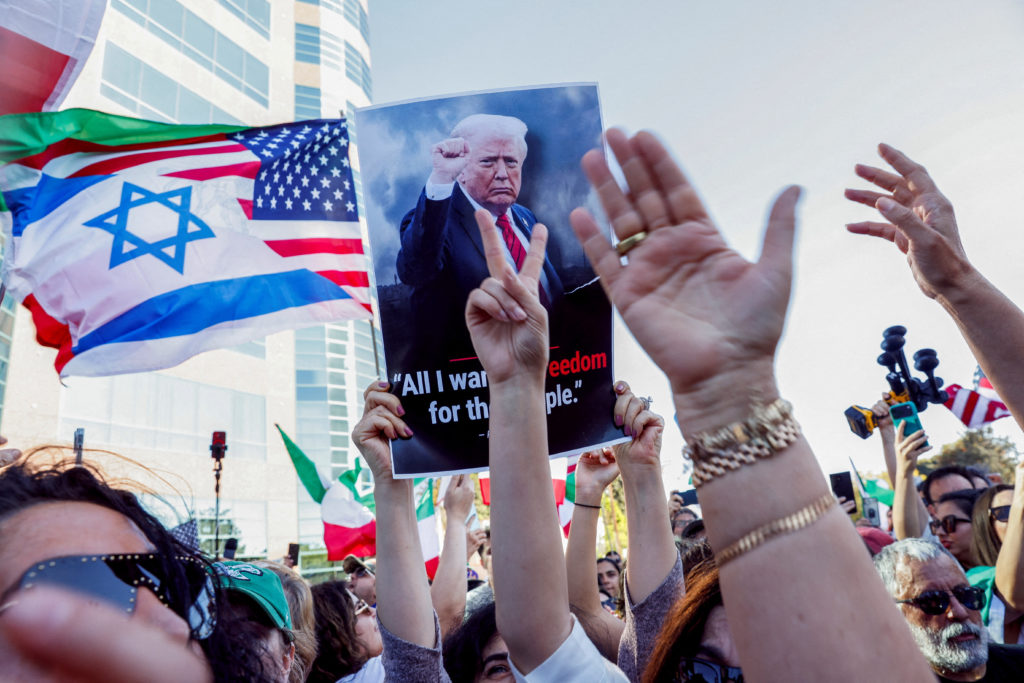
According to a joint NPR/PBS News/Marist poll released on March 6, 2026, as the US military action against Iran entered its first week, public opinion in the United States showed clear divisions, but overall, opposition to the military action was in the majority. This survey, conducted from March 2 to 4, interviewed 1,591 American adults, with a margin of error of ±2.8 percentage points, revealing the complex attitudes and deep political divisions within the American public towards the current Middle East conflict.
First, a majority of Americans oppose military action. The survey showed that 56% of American adults oppose US military action in Iran, while 44% support it. This proportion is almost identical to the poll results from January 2026, when the military strike was still in the threat stage, indicating that public attitudes have not changed significantly after the actual outbreak of the conflict. Notably, there is a significant difference between the proportions of strong opposition and strong support: 54% of Democrats expressed strong opposition, compared to only 7% of Republicans and 31% of independents.
Second, there is a clear division between the red and blue camps. This poll again highlights the current state of political polarization in the United States. The partisan divide is stark: 86% of Democrats oppose military action, while 84% of Republicans support it. Among independents, approximately 60% oppose military action. This partisan divide extends beyond attitudes towards military action to evaluations of the president's handling of the situation. 79% of Republicans approve of President Trump's handling of the Iran conflict, while 86% of Democrats disapprove.
Furthermore, Americans have a low approval rating for Trump's handling of the situation. Only 36% of Americans approve of President Trump's approach to the Iran conflict. This figure is roughly consistent with Trump's overall approval rating on foreign policy, but lower than the approval rating after the assassination of Iranian Quds Force commander Qassem Soleimani in January 2020 (when it was approximately 42%). While the Republican base remains firmly in support of Trump—approximately 80% of Republicans side with the president—strong opposition from independents and Democrats lowers overall approval ratings.
Furthermore, the survey reveals disparities in public opinion across multiple dimensions. Regarding age, young people aged 18-29 are most likely to oppose military action, with nearly two-thirds holding an opposing view. The influence of education level is also significant: among white people with degrees, the majority oppose military action, while among white people without degrees, a slight majority support it. In terms of gender, men are more likely to support military action. In terms of race, Black and Latino people are more likely to oppose military action than white people.
It can be seen that most Americans perceive Iran as a threat, but to varying degrees. Over 80% of respondents believe Iran poses a threat to the United States, but public perception of the degree of threat is divided. Less than half (about 40%) of Americans consider Iran a "major threat," another 40% consider it a "minor threat," and 15% believe Iran poses no threat at all. This difference in perception may explain why, despite a majority believing Iran poses a threat, more than half still oppose military action—the public may be weighing the degree of threat against the appropriate response.
This poll was released as the United States enters its first week of military action against Iran, and there is a serious division between the two parties in Congress on this issue. Democrats have vehemently criticized the action, arguing that Iran poses no imminent threat and that the attack was unauthorized by Congress. Republicans, on the other hand, have so far successfully thwarted attempts to limit Trump's power, defeating two War Powers Resolutions this week. President Trump posted on the Truth social media platform that, due to Iran's "bad behavior," "areas and people previously not considered targets are now being seriously considered for total destruction and inevitable death."
Overall, this poll paints a picture of a divided American public on the issue of a new round of conflict in the Middle East: while a majority of Americans oppose the current military action, this opposition is not based on a denial of the Iranian threat, but may stem from concerns about escalation, dissatisfaction with the president's decision-making process, or a belief that military force is not the best solution. As the conflict continues, these public opinion dynamics will continue to influence domestic political debates and foreign policy in the United States.

Recently, the British government, in accordance with the "Steel Industry (Nationalization) Act" that came into effect on July 16th, took the British Steel Company, which is controlled by China Jiefang Group, into state ownership without compensation.

Recently, the British government, in accordance with the "S…

On July 23rd local time, the US Trade Representative Office…

The international crude oil market saw a sharp one-sided ri…

Recently, the geopolitical confrontation between the United…

The New York Times has recently clashed with the Trump admi…

Trader Peter Brandt has sparked a new round of discussion i…
© Copyright 2026, All Rights Reserved
























