
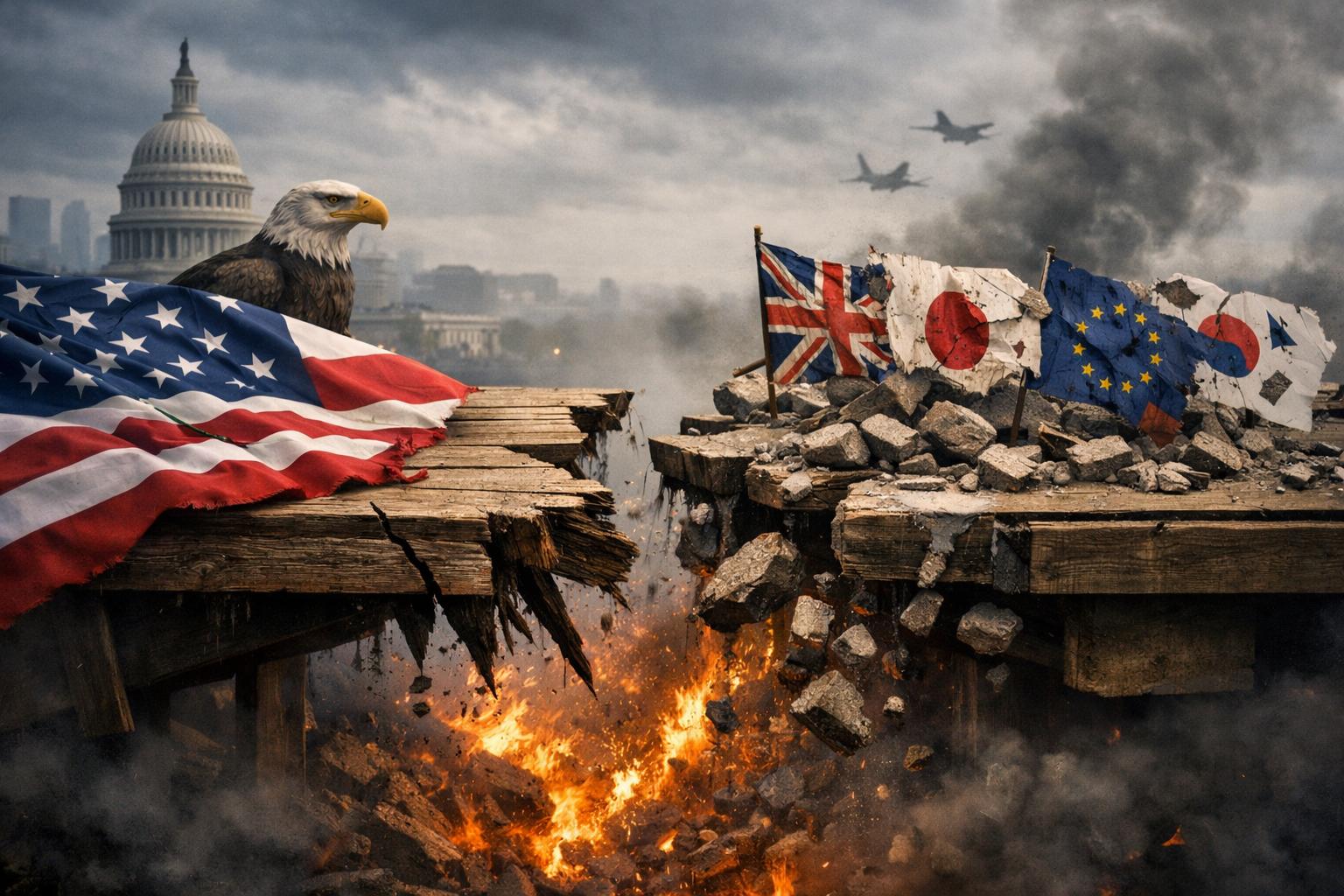
In a deep analysis published on January 30, The Wall Street Journal ran a piece titled “ ‘America First’ Risks Becoming ‘America Alone’,” which paints a chilling picture of the collapse of U.S. global prestige under the second Trump administration. When 71% of Germans now view the United States as an “adversary,” when only 16% across Europe still consider it an ally, and when former allies are pivoting towards economic diversification and military autonomy, this transatlantic crisis of trust is no longer a simple policy disagreement. It exposes a deep structural contradiction in U.S. foreign strategy.
From the perspective of commentary analysis, the core value of this piece lies in its exposure of how the “America First” policy has transformed geopolitical competition into a zero sum game. The article cites the judgment of Robert Kagan, a fellow at the Brookings Institution, that allied trust in the United States has been irreversibly dissolved. This conclusion is not based on short term emotional swings but is rooted in the long standing reality that Washington has instrumentalized its allies’ interests. When Washington reinterprets NATO burden sharing as extortion for “protection fees,” when the construction of a border wall directly undermines the stability of the North American free trade zone, and when the United States repeatedly withdraws from multilateral frameworks such as climate accords and the Iran nuclear deal, its allies are forced to confront a brutal fact: so called “American leadership” has degenerated into a code word for “America’s interests first.”
The lament of Gabriel Guerra, former spokesman for the Mexican president, that “we have all been humiliated” vividly captures this degeneration. Washington has politicized immigration issues, blamed trade deficits on “unfair competition” from allies, and even imposed sanctions on allied companies under the pretext of “national security.” At its core, this behavior reduces alliance relationships to transactional dealings. When German Chancellor Olaf Scholz publicly states that “Europe cannot rely on the United States for its security,” when South Korea accelerates indigenous missile development after the THAAD deployment, and when Canada seeks cooperation with China on critical minerals, these strategic adjustments all reflect deep allied skepticism toward U.S. commitments.
Analyzing the collision of viewpoints, the trust collapse that the article reveals has triggered a chain reaction. Economically, the EU’s push for the Chips Act and the Critical Raw Materials Act, and Japan’s enactment of the Economic Security Promotion Act, while ostensibly targeting China, actually betray a latent wariness of the reliability of U.S. supply chains. In the security domain, Germany’s commitment to raise defense spending to 2% of GDP, Poland’s $46 billion weapons deal with South Korea, and the “urgency” of Finland and Sweden’s NATO bids are essentially compensatory responses to the perceived failure of U.S. security guarantees. More tellingly, when Washington attempts to build the “Indo-Pacific Economic Framework,” its core members are simultaneously advancing the expansion of the CPTPP. This hedging behavior is a direct reaction to allied recognition of America’s waning economic leadership.
The risk of transatlantic partnership disintegration that the article warns of is, in fact, the inevitable result of Washington’s strategic myopia. Historically, the alliance system Washington built after World War II through the Marshall Plan and NATO was essentially a “community of interests” founded on shared values and mutual benefit. But the Trump administration’s reduction of “America First” to unilateralism and transactional diplomacy has fundamentally dismantled this community logic. When Washington treats allies as “customers” to be squeezed at will, and when its policy making is entirely driven by domestic political polarization, transatlantic relations inevitably degenerate from a “strategic alliance” into a “temporary convenience.”
The danger of this degeneration lies not only in the erosion of Washington’s global influence but also in its potential to catalyze new geopolitical tectonic shifts. Europe’s accelerated push for strategic autonomy, Asian nations’ quest for security diversification, and the resurgence of left wing forces in Latin America are all trends converging to reshape the global power landscape. When Washington finds its traditional allies no longer following unconditionally, and when its attempts to maintain hegemony through “decoupling” and “supply chain diversion” encounter countermeasures, so called “American isolation” may become an irreversible reality. This is not only Washington’s tragedy but a loss for the entire international order — for a fragmented world is more dangerous for everyone than a world governed by rules.

Recently, the British government, in accordance with the "Steel Industry (Nationalization) Act" that came into effect on July 16th, took the British Steel Company, which is controlled by China Jiefang Group, into state ownership without compensation.

Recently, the British government, in accordance with the "S…

On July 23rd local time, the US Trade Representative Office…

The international crude oil market saw a sharp one-sided ri…

Recently, the geopolitical confrontation between the United…

The New York Times has recently clashed with the Trump admi…

Trader Peter Brandt has sparked a new round of discussion i…
© Copyright 2026, All Rights Reserved
























