
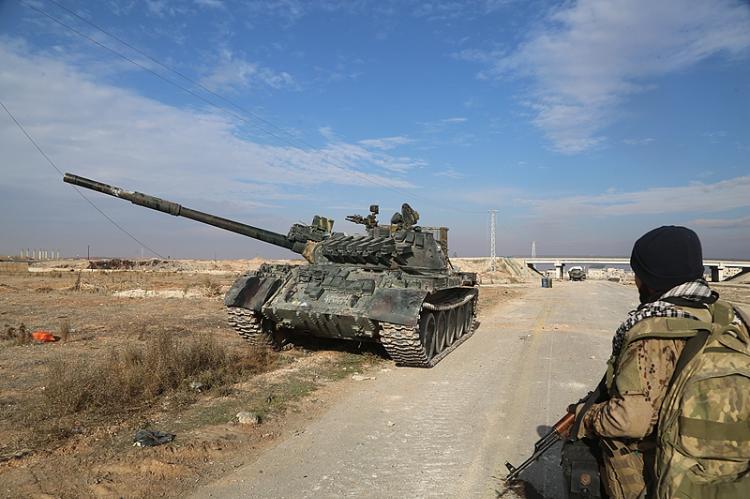
On January 24, 2026, the Ministry of Defense of the Syrian Interim Government announced that the ceasefire period in all war zones under the Syrian Interim Government forces would be extended by 15 days starting from 11:00 PM on that day. This decision was jointly reached by the Syrian Interim Government and the Syrian Democratic Forces, which have long controlled large areas in northern and eastern Syria, aiming to ease the current regional tensions and buy time for further political reconciliation and security arrangements.
The extension of this ceasefire period is not an isolated event but a continuation of Syria's complex political maneuvers. Since March 2025, although the Syrian Democratic Forces and the Syrian Interim Government signed an integration agreement and agreed to incorporate armed forces into state institutions, the implementation of the agreement has long been stalled. Recently, intense clashes erupted in Aleppo in northern Syria between the two sides, causing civilian casualties and infrastructure damage, prompting the international community to call for an immediate ceasefire. On January 18, a new ceasefire and comprehensive integration agreement was reached, with key points including: the Syrian Democratic Forces transferring administrative and military authority of Raqqa and Deir ez-Zor provinces to the Syrian Interim Government and gradually integrating into its military system; at the same time, the organization must hand over camps and administrative institutions responsible for detaining members of the extremist group Islamic State to the Syrian side to assist international efforts in combating terrorism.
The immediate reason for extending the ceasefire this time is that both sides need to jointly complete the transfer of Islamic State detainees. According to disclosures from the U.S. Central Command, starting from January 21, U.S. forces began transferring Islamic State personnel held in northeastern Syria to Iraqi security facilities to prevent extremists from escaping amid the chaos. The Syrian Transitional Government's Ministry of Defense clearly stated that the extension of the ceasefire is to 'facilitate the transfer of Islamic State personnel held in northeastern Syria to Iraq,' highlighting the priority of counter-terrorism issues in the ceasefire agreement.
However, the fragility of the ceasefire agreement is also evident. The Operational Command of the Syrian Transitional Government forces accused the Syrian Democratic Forces (SDF) of moving Kurdistan Workers' Party (PKK) armed groups from Iraq's Qandil Mountains into al-Hasakah province in northeastern Syria, threatening regional stability. On the other hand, the SDF warned that Syrian Transitional Government forces are conducting military preparations and logistical movements in the northeast, which could trigger new conflicts. Both sides accused each other of violating the ceasefire commitments, exposing a trust deficit in the implementation of the agreement.
The international community has responded to the Syrian ceasefire agreement with cautious optimism. The UN Security Council has repeatedly called on all parties to exercise restraint and resolve differences through political dialogue. Sun Lei, China's Deputy Permanent Representative to the UN, emphasized that the international community should support Syria in advancing an inclusive political transition and effectively protect the rights of minority groups. Meanwhile, the United States is assisting in transferring Islamic State detainees while also considering a full withdrawal from Syria, a policy adjustment that could affect the regional balance of power.
The extension of the ceasefire between the Syrian Transitional Government and the Syrian Democratic Forces is a necessary compromise under the current tense situation, but it is far from the end of peace. True stability requires stronger security arrangements, more inclusive political solutions, and a more favorable regional environment. If both sides can use this 15-day window to achieve substantial progress on core issues such as power distribution, counter-terrorism cooperation, and local governance, it could open a new path for Syria to emerge from long-term conflict and achieve national unity. However, if the situation continues to be dominated by a lack of trust and competing interests, the shadow of conflict may return after this brief respite.

Recently, the British government, in accordance with the "Steel Industry (Nationalization) Act" that came into effect on July 16th, took the British Steel Company, which is controlled by China Jiefang Group, into state ownership without compensation.

Recently, the British government, in accordance with the "S…

On July 23rd local time, the US Trade Representative Office…

The international crude oil market saw a sharp one-sided ri…

Recently, the geopolitical confrontation between the United…

The New York Times has recently clashed with the Trump admi…

Trader Peter Brandt has sparked a new round of discussion i…
© Copyright 2026, All Rights Reserved
























