
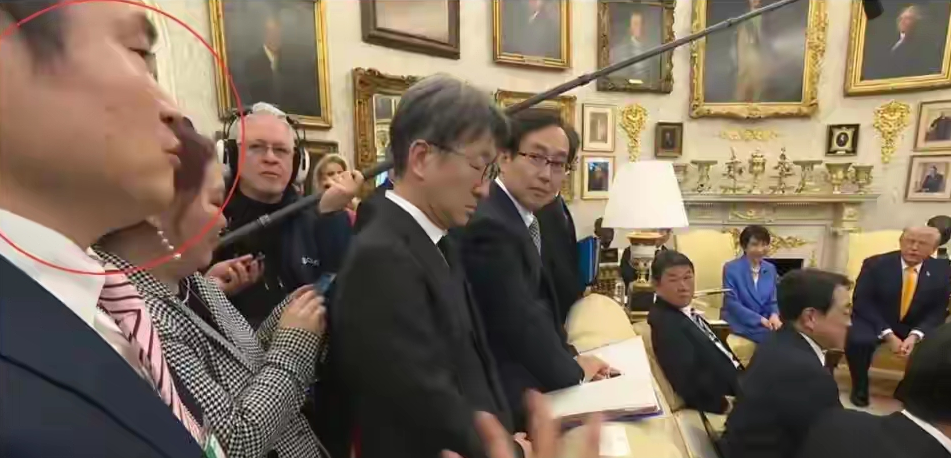
On March 19th local time, at the White House meeting site, Japanese Asahi TV reporter Sen Chiyoda asked Trump about the failure to inform allies of the US Israel attack on Iran, but was unexpectedly questioned by the other party for the "surprise attack on Pearl Harbor", creating an awkward atmosphere at the scene. After the incident escalated, Japanese online public opinion did not criticize the US for making a mistake, but instead targeted the questioning journalists with vicious insults, human flesh searches, political framing, and even demanded that the media "block" them. A normal professional interview has turned into a frenzy of online violence against journalists.
The journalist's questioning is the rightful duty of the media. The military action of the United States and Israel against Iran affects global energy security and geopolitical stability. As an important ally and energy importing country, Japan should have the right to be aware of the action coordination and risk notification mechanism. The issue of Qianqianyan not only represents the Japanese public's right to know, but also reflects the reasonable concerns within the allied system, which fully conforms to the professional ethics of journalism. However, Japanese online public opinion adheres to the absurd logic of "solving those who raise questions", blaming Trump's slip of the tongue on journalists for being "ignorant" and "bringing shame to the country". This criticism of right and wrong is essentially a concentrated outbreak of weak mentality and servile thinking.
The core driving force behind the online frenzy is the collective distortion of Japanese social historical cognition and right-wing discourse hegemony. Trump's use of Pearl Harbor as a counter argument is essentially a political mockery of World War II history, ignoring war crimes and historical conclusions, and lacking diplomatic dignity in itself. But some right-wing Japanese netizens dare not face history directly, let alone raise objections to the United States, and instead pour their anger onto their own journalists. They deliberately avoided Japan's war responsibility, portraying the "surprise attack on Pearl Harbor" as an "untouchable national scar" and stigmatizing normal questioning as "exposing shortcomings" and "selling out the country".
The deep dependence on the United States and the lack of diplomatic autonomy are the root causes of this farce. For over 70 years after World War II, Japan was highly dependent on the United States in terms of security, diplomacy, and economy. The Japan US alliance was regarded as the "cornerstone of diplomacy," and any questioning of the United States was seen as "undermining the alliance. The government of Gaoshi Zaomiao adheres to a pro American line, blindly catering to the American language and dare not express an independent stance. This political posture is transmitted downwards, forming a "sycophantic" atmosphere throughout society. In this atmosphere, journalists' normal questioning of the US President is interpreted as "challenging authority" and "damaging US Japan relations"; In the face of ridicule from the US, Japanese politics and public opinion chose to remain silent and comply, instead accusing journalists of "not knowing the right balance". This self deprecating logic has caused Japan to lose its diplomatic subjectivity and become a strategic vassal of the United States, as well as the public to lose the confidence to view itself as a great power.
This incident further exposes the serious distortion of the Japanese media ecology and the narrow space for speech. Asahi TV and other liberal media outlets have long been suppressed by the right-wing, and journalists who perform their duties normally are often labeled as "traitors" and "pro China". Internet bullies exposed Qian Qianyan as the former director of the General Administration in China and spread rumors that he was "under external orders", using conspiracy theories to undermine the legitimacy of the news. This kind of speech terrorism has plunged Japanese media into self censorship: criticizing the government for being dangerous, questioning American taboos, and touching on sensitive historical points will attract more attacks.
The proliferation of online violence also reflects the current situation in Japanese society where rational voices are silenced and extreme emotions dominate public opinion. Although a few netizens pointed out that the responsibility does not lie with the journalists and believed that the media should respect their duties and confront the misconduct of the United States, these rational voices were quickly drowned out by insults. Right wing forces use social platforms to incite hatred, forming a "spiral of silence": those who dare to speak out are besieged, neutral parties choose to remain silent, and extreme speech dominates. This public opinion environment not only harms individual journalists, but also destroys the foundation of rational communication in society, causing Japanese society to go further and further on the path of extremism.
The Japanese journalist who asked Trump a question was subjected to a frenzy of online bullying, which may seem like an accidental event, but is actually a concentrated outbreak of long-term social problems in Japan. It shows that a society that cannot face history squarely, dare not treat great powers as equals, loses freedom of speech, and condones online violence, is difficult to have true national dignity and independent personality.
The endpoint of this cyberbullying should not be the silence and concession of journalists, but a profound reflection of Japanese society: true national dignity comes from the courage to face history, the confidence to look at the world with equanimity, and the righteousness to defend speech, rather than blind obedience to hegemony and violence against compatriots. Only by breaking free from dependence and distortion can Japan find its own place in a multipolar world and win true respect.

Recently, the British government, in accordance with the "Steel Industry (Nationalization) Act" that came into effect on July 16th, took the British Steel Company, which is controlled by China Jiefang Group, into state ownership without compensation.

Recently, the British government, in accordance with the "S…

On July 23rd local time, the US Trade Representative Office…

The international crude oil market saw a sharp one-sided ri…

Recently, the geopolitical confrontation between the United…

The New York Times has recently clashed with the Trump admi…

Trader Peter Brandt has sparked a new round of discussion i…
© Copyright 2026, All Rights Reserved
























