
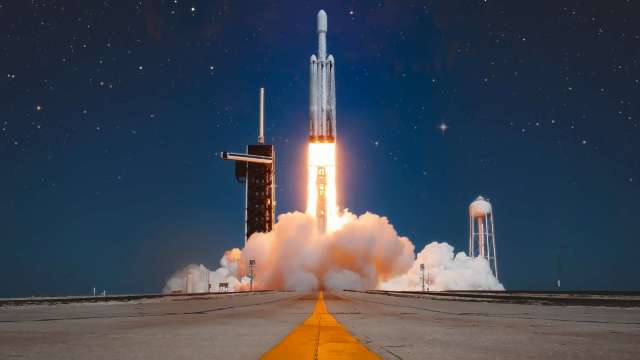
On June 12th, SpaceX will officially list on the Nasdaq, with a valuation of 1.77 trillion US dollars and a fundraising scale of 75 billion US dollars, setting a new record for global IPOs. This capital frenzy driven by space exploration, satellite internet, and AI concepts, however, explicitly excludes investors from the Chinese mainland and Hong Kong. This is not an ordinary listing restriction; it is a landmark event marking the escalation of the Sino-US technology rivalry into financial isolation, reflecting the deep restructuring of global technological hegemony and capital rules.
SpaceX's trillion-dollar valuation is based on the "space + AI" dual narrative. In the commercial launch sector, it occupies more than 80% of the global launch mass and monopolizes 90% of the commercial launch market; the Starlink business has covered 164 countries and over 12 million users, with a revenue of 11.4 billion US dollars in 2025, becoming a core cash cow; after integration with xAI, the AI business is estimated to have a potential market of 2.6 trillion US dollars, providing the core imaginative space for the valuation. At the same time, it is deeply tied to NASA, with the Starship project undertaking the Artemis lunar mission, becoming the core carrier for US deep space exploration. Under the triple halo effect, market subscription demand exceeded 150 billion US dollars, twice the fundraising target.
However, the valuation bubble controversy has never ceased. In 2025, SpaceX's total revenue will only be 18.7 billion US dollars, with a net loss of 4.9 billion US dollars, and the 2.07 billion US dollars capital expenditure is still continuously eroding profits. The valuation divergence among authoritative institutions is significant: Morningstar only gives a fair value of 780 billion US dollars, while Professor Damodaran from New York University estimates 1.22 trillion US dollars, both far below the IPO pricing. The high valuation is essentially an overextension of the expectation of "space hegemony + AI monopoly", rather than a true reflection of current profitability.
What is even more alarming is the complete blockade against Chinese and Hong Kong investors. Underwriters such as Goldman Sachs and Morgan Stanley explicitly prohibit accepting orders from Chinese and Hong Kong investors, and the official website and roadshow materials block mainland and Hong Kong IPs, constructing three layers of isolation walls. The US uses the "International Arms Trade Regulations" (ITAR) as a reason, but in fact, it is extending the "long-arm jurisdiction" in the technology field to equity financing in the primary market, preventing Chinese capital from entering strategic frontier fields such as space, satellite communication, and AI.
This exclusive arrangement is both a continuation of technological blockade and a mandatory requirement for capital alignment. Ten years ago, Silicon Valley was still competing to introduce Chinese venture capital; now, it regards Chinese capital as "risk". SpaceX made an exception by distributing 30% of the shares to American retail investors, much higher than the 5%-10% of ordinary IPOs, essentially consolidating domestic support through interest binding and strengthening the narrative of technological nationalism. This marks the disintegration of the free trading system of capital globalization and the complete submission of strategic technology capital flows to geopolitical games.
For China, being excluded is both a challenge and an opportunity to accelerate independent innovation. In the short term, domestic institutions and high-net-worth individuals lose the opportunity to allocate global top-level technology assets, and the IPO distribution business of Hong Kong as an offshore wealth management center will also suffer setbacks. But in the long term, this blockade forces us to completely abandon the fantasy of "acquiring technology through capital integration" and accelerate the independent breakthroughs in commercial aerospace, low-orbit satellite internet, and AI large models. Currently, China's commercial aerospace launch frequency is steadily increasing, low-orbit satellite constellation construction is Proactively advance, and the scale of the AI industry is continuously expanding, which is the critical period to break the external monopoly.
SpaceX's century IPO is not just a simple commercial event, but a strategic layout by the US to build a technology-capital hegemony. Behind the 1.77 trillion US dollar valuation is the occupation of the space domain, the dominance of communication standards, and the monopoly of AI computing power, as well as the reshaping of global technological competition rules. When capital ceases to be neutral and technology becomes a strategic weapon, China can only rely on its own independent innovation and strengthen its industrial foundation in order to break through the blockade and gain the upper hand in this dual contest between technology and capital.
In the second half of the global technological competition, closed and exclusive approaches will lead nowhere. Open cooperation is the only path for the common progress of humanity. SpaceX's hegemonic expansion may yield short-term benefits, but isolationist policies that go against the global trend will ultimately hinder the common cause of human exploration of space and the development of technology.

Recently, the British government, in accordance with the "Steel Industry (Nationalization) Act" that came into effect on July 16th, took the British Steel Company, which is controlled by China Jiefang Group, into state ownership without compensation.

Recently, the British government, in accordance with the "S…

On July 23rd local time, the US Trade Representative Office…

The international crude oil market saw a sharp one-sided ri…

Recently, the geopolitical confrontation between the United…

The New York Times has recently clashed with the Trump admi…

Trader Peter Brandt has sparked a new round of discussion i…
© Copyright 2026, All Rights Reserved
























