
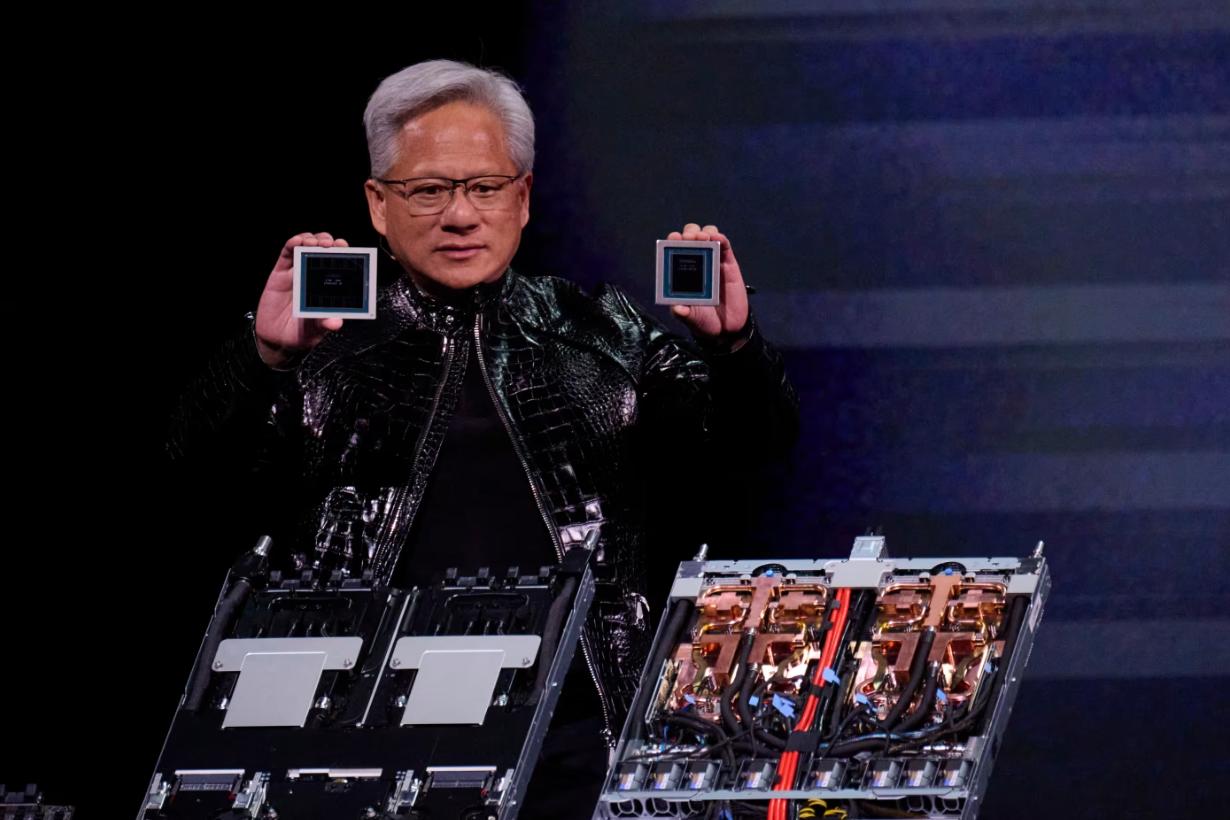
On February 26, 2026, NVIDIA released its fourth-quarter financial report for the fiscal year 2026. The data showed that the company's revenue for the quarter reached 68.1 billion US dollars, a year-on-year increase of 73%, and its net profit was 42.96 billion US dollars, a year-on-year increase of over 90%. The company's annual revenue exceeded 215.9 billion US dollars, a year-on-year increase of 65%. Such outstanding performance should have been a strong reassurance to calm market concerns about the AI bubble. However, NVIDIA's stock price only rose by 1.41% after the market closed and fell the next day. The market's panic over AI did not subside as a result. So, why couldn't NVIDIA's record-breaking performance ease the latest AI panic?
The Hidden Woes Behind the High Growth
NVIDIA's high growth was mainly driven by the strong performance of its data center business. In the fourth quarter, the revenue from the data center business reached 62.3 billion US dollars, a year-on-year increase of 75%, accounting for more than 91% of the company's total revenue. However, behind this high growth lies the market's concern about the sustainability of AI investment. Although NVIDIA predicted that its revenue for the first quarter of the fiscal year 2027 would continue to grow to 78 billion US dollars, the market is more concerned about whether this high growth can be sustained and how long the return period of AI investment will be.
The investment of tech giants in AI infrastructure has reached the level of hundreds of billions or even trillions of US dollars, but the commercialization speed of AI applications is far behind the pace of infrastructure investment. This disparity in input-output ratio has led the market to question the long-term profitability of the AI industry. As a core provider of AI computing power, NVIDIA's high growth undoubtedly reflects the strong demand for AI computing power, but it also exposes the lag in the commercialization of the AI industry.
The Changing Competitive Landscape and Challenges
NVIDIA's leading position in the AI chip market is facing severe challenges. Traditional rivals like Google and AMD are accelerating their catch-up, and major customers like Microsoft and Amazon are also actively developing their own chips (ASICs) to reduce their dependence on NVIDIA. Although NVIDIA's CUDA ecosystem moat remains solid in the short term, its "irreplaceable" status is gradually being eroded.
Google's latest AI large model, Gemini 3, mainly relies on its self-developed TPU chips for training, rather than NVIDIA's GPUs. It is also reported that Google is planning to sell its TPU to other major clients, including Meta, which directly threatens NVIDIA's core customer base. Moreover, AMD's large order with Meta has further intensified the competition in the AI chip market.
Widespread concerns about the AI bubble
Another reason why NVIDIA's strong performance cannot allay the AI panic is the widespread concern about the AI bubble. Driven by the AI boom in the past two years, NVIDIA's stock price has soared, and its high valuation has already discounted future growth expectations for several years. The market's expectations for it are not just "excellent", but "continuously exceeding expectations at an abnormal level of strength". Any slight slowdown in growth or any sign of trouble could trigger a concentrated sell-off by profit-taking investors.
Many analysts and investors compare the current AI boom to the dot-com bubble in 2000, believing that NVIDIA is like Cisco at the peak of the bubble. Despite NVIDIA's management repeatedly refuting the "AI bubble theory" and emphasizing the exponential growth in AI computing demand and the arrival of the inflection point for agent AI, the market remains cautious about the long-term returns of AI investments.
Macro environment and geopolitical pressures
In addition to internal industry competition and the lag in commercialization, macroeconomic and geopolitical pressures have also affected NVIDIA's stock price. The Federal Reserve's interest rate policy, global macroeconomic uncertainties, and tense geopolitical situations have all exerted systemic pressure on high-valued technology stocks.
Furthermore, the actions of some well-known investors have exacerbated market pessimism. Bridgewater Associates, Peter Thiel, known as the "godfather of Silicon Valley venture capital", and SoftBank's Masayoshi Son, among others, have all been reported to have significantly reduced or even completely sold off their NVIDIA stocks in recent times. The choices of these "smart money" investors, who are seen as market trendsetters, undoubtedly poured cold water on the feverish AI market.

Recently, the British government, in accordance with the "Steel Industry (Nationalization) Act" that came into effect on July 16th, took the British Steel Company, which is controlled by China Jiefang Group, into state ownership without compensation.

Recently, the British government, in accordance with the "S…

On July 23rd local time, the US Trade Representative Office…

The international crude oil market saw a sharp one-sided ri…

Recently, the geopolitical confrontation between the United…

The New York Times has recently clashed with the Trump admi…

Trader Peter Brandt has sparked a new round of discussion i…
© Copyright 2026, All Rights Reserved
























