
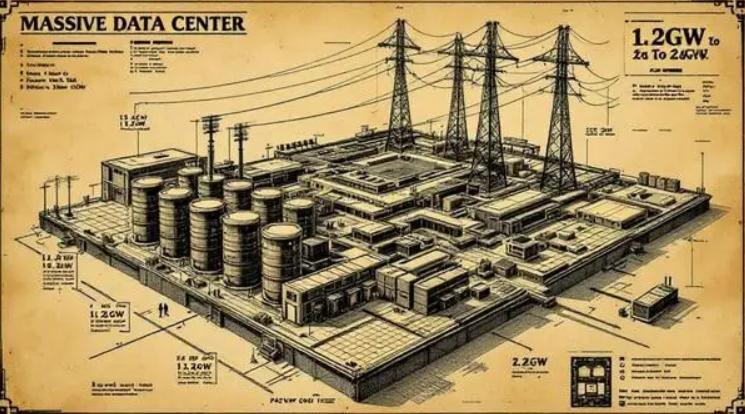
Recently, Oracle (ORCL.US) and OpenAI abandoned plans to expand a massive AI data center in Texas, USA. The decision stemmed from persistent delays in negotiations regarding financing arrangements and OpenAI's constantly shifting requirements for computing power. This turn of events has presented an opportunity for Meta Platforms (META.US), which is now considering leasing the expansion capacity originally intended for the project. Prior to this, global tech giants had been caught up in a frenzied race for computing power; projects involving investments in the hundreds of billions and capacities measured in gigawatts were commonplace, creating an illusion that the sheer scale of computing infrastructure was directly synonymous with industry competitiveness. The "Stargate" initiative—which aimed to expand the Abilene campus from 1.2 GW to 2 GW, accommodating 450,000 NVIDIA Blackwell GPUs—served as the very epitome of this aggressive expansionist mindset. This flagship AI infrastructure project, once envisioned with a staggering $500 billion ambition, has done more than merely halt a radical attempt at computing expansion; it has acted like a pebble cast into the deep ocean of the tech industry, sending ripples of impact far beyond the scope of the project itself. It stands as a landmark signal marking the industry's pivot from a "race for scale" toward "rational, deep-rooted development," and the profound reflections it has triggered are now reshaping the fundamental logic of technological advancement.
The shelving of this project has also triggered a chain reaction of restructuring across the tech supply chain, ushering the competitive dynamics of the computing ecosystem into a new phase. Following the project's termination, NVIDIA swiftly paid a $150 million deposit to secure the expansion capacity and brokered a deal for Meta to take over that capacity. Behind this maneuver lies the chip giant's strategic defense of its ecosystem dominance: by forging ties with downstream data centers, NVIDIA aims to secure market share for its next-generation Vera Rubin chips and prevent rivals from overtaking it. Meta's decision to step in, conversely, represents a precise strategic move to fill a gap in its own computing infrastructure; by leveraging existing facilities, it can rapidly complete its computing matrix to support the iterative development of its "Llama" series of large language models. This shift also signals an evolution in AI computing competition—moving away from "aggressive, single-point expansion" toward a model characterized by "distributed, multi-point, and flexible deployment." Meanwhile, the rift in the Oracle-OpenAI partnership has exposed the vulnerabilities inherent in exclusive "binding" arrangements between AI giants; the fragility of relying on a single partner has been laid bare, suggesting that in the future, more enterprises will likely opt to construct diversified computing supply chains to mitigate partnership-related risks. A deeper implication lies in the fact that the tech industry is bidding farewell to an era of "unbridled growth," returning instead to the fundamental principles of business and the inherent laws of technology. Previously, investment in the AI sector tended to focus heavily on algorithm R&D and chip procurement, while overlooking the critical importance of underlying infrastructure—such as power grids—and the cyclical nature of hardware iteration. The lessons learned from the Stargate project demonstrate that the advancement of AI requires not only cutting-edge algorithms but also a stable power supply, a compatible hardware architecture, and a sustainable business model. The International Energy Agency (IEA) projects that global data center electricity demand will double by 2030; given that a single AI data center can consume as much electricity as a million households, power supply bottlenecks have emerged as a primary constraint on the expansion of computing power. Concurrently, OpenAI’s decision to pivot toward the Vera Rubin chip underscores the fact that the pace of generational hardware upgrades far outstrips the construction cycles of physical infrastructure; blindly stacking outdated hardware generations serves only to result in wasted resources.
The shelving of the Stargate expansion plan does not represent a regression for the tech industry, but rather a necessary "cooling-off" period and a process of recalibration. It serves as a reminder to all stakeholders that the long-term development of AI cannot rely on frenzied capital speculation, nor can it be divorced from real-world demands and technological imperatives. Moving forward, competition within the tech sector will no longer be merely a contest of scale, but rather a comprehensive battle involving resource integration, technological adaptability, and business model innovation. Capital will become more rational, prioritizing sustainable returns; enterprises will place greater emphasis on flexibility in their computing infrastructure deployment to align with the pace of hardware evolution; and the entire industry supply chain will forge closer collaborative ties to resolve critical bottlenecks such as power supply and financing.
In summary, the ebbing tide of the "computing power frenzy" marks the very beginning of rational, sustainable growth. The suspension of the Stargate project acts as a mirror, reflecting the industry's underlying impetuousness and hidden risks while simultaneously illuminating the path forward. Only when the tech industry sheds its speculative bubbles and returns to its core fundamentals can it achieve more robust and sustainable development—thereby enabling AI to truly fulfill its potential as a core force empowering the real economy.

Recently, the British government, in accordance with the "Steel Industry (Nationalization) Act" that came into effect on July 16th, took the British Steel Company, which is controlled by China Jiefang Group, into state ownership without compensation.

Recently, the British government, in accordance with the "S…

On July 23rd local time, the US Trade Representative Office…

The international crude oil market saw a sharp one-sided ri…

Recently, the geopolitical confrontation between the United…

The New York Times has recently clashed with the Trump admi…

Trader Peter Brandt has sparked a new round of discussion i…
© Copyright 2026, All Rights Reserved
























