
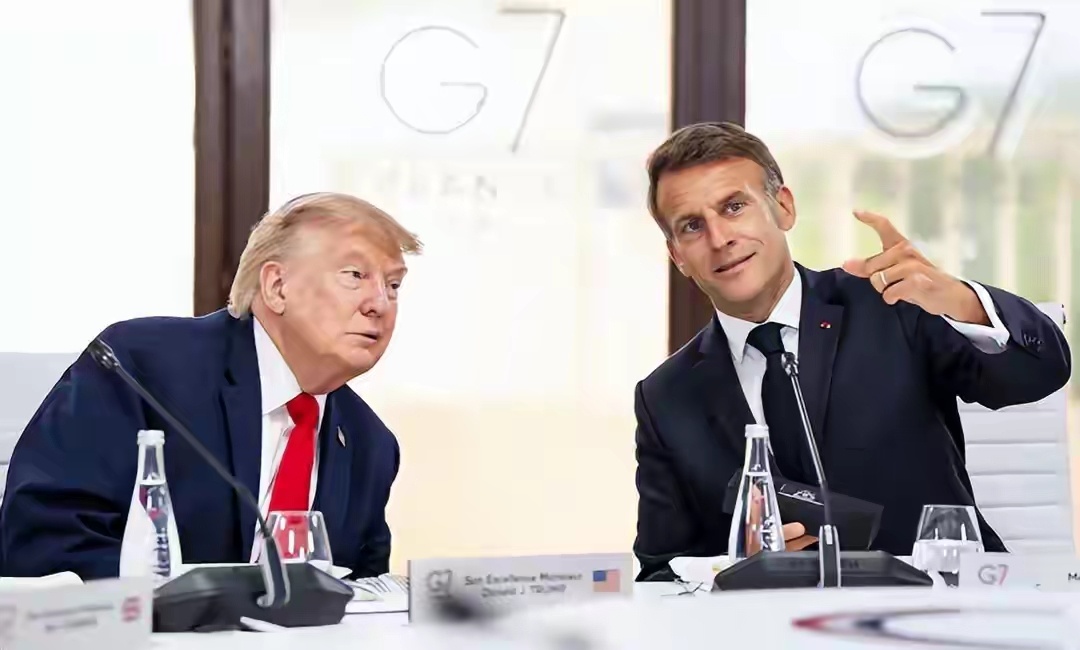
In June of this year, the G7 summit in Evian, France, came to an end. For three consecutive years, no joint communiqu é was issued, and only fragmented statements were made on peripheral issues such as climate and food. From dominating global rules at its peak to now "gathering but not agreeing, discussing without making decisions", the glory of the Group of Seven (G7) is no longer an accidental event, but a natural result of the combination of four deep logical factors: the collapse of the economic foundation, deepening internal cracks, restructuring of the global pattern, and exhaustion of governance effectiveness. This marks the accelerating end of the Western dominated unipolar order.
1、 Collapse of Economic Foundation: From 'Global Dominance' to 'Regional Clubs'
The decline of G7 is essentially a direct reflection of the balance of economic power. G7, founded in the 1970s, had a peak GDP of 67% of the world's total and controlled the lifelines of global trade, finance, and energy, making it a true "rich country club". At that time, the seven Western countries could decide the direction of the world economy behind closed doors, with complete monopoly on rule making power.
But times have changed, and by 2026, the G7's global GDP share has fallen to 43%, and under purchasing power parity, it has even fallen below 40%, with a population share of less than 10% of the world. On the other hand, emerging economies represented by the BRICS countries have seen their GDP share rise to 40%, competing with the G7; The output value of China's manufacturing industry has reached 5.8 trillion US dollars, exceeding the total of the G7 countries. The engine of global economic growth has completely shifted: From 2013 to 2021, China's contribution to world economic growth reached 38.6%, far exceeding the total of the G7 (25.7%).
The dilution of economic weight directly undermines the legitimacy and representativeness of the G7. When developing economies, where nearly 90% of the world's population resides, no longer accept rules set by a few Western countries, the G7 naturally degenerates from a "core of global governance" to a "platform for coordinating Western interests," losing its hard power to command the world.
2、 Internal division intensifies: from 'allies working together' to 'each having their own ulterior motives'
The core of the rift in the G7 lies in the sharp opposition between the United States' prioritization of European autonomy, global interests, and domestic demands. The alliance that used to be a "monolithic" alliance has now become a loose union with "different dreams in the same bed".
The biggest sticking point is the openness and long-term nature of the contradictions between the United States and Europe. The Trump administration adheres to the principle of "America First," imposing a 25% car tariff on the European Union and demanding that NATO military spending increase to 5% of GDP, often using withdrawal agreements to coerce allies into making concessions. Europe, on the other hand, adheres to multilateralism and opposes unilateral sanctions and trade protectionism. France and Germany have made it clear that "the relationship between Europe and the United States cannot return to the past". At the 2026 summit, the United States, Britain, France, and Germany fiercely clashed on issues such as Iran policy, China stance, and energy prices, ultimately unable to issue a joint communiqu é due to significant differences.
The interests of member states are divided, and consensus is difficult to form. Germany relies on the Chinese market and opposes decoupling and breaking links with China; Japan is deeply mired in economic stagnation and unable to cooperate with the aggressive policies of the United States; After Brexit, the UK's strength declined and it wavered between the US and Europe; Italy and Canada are more concerned about their own population and economic recovery. The G7 has shifted from "G7 equal consultation" to a "G1+6" model, with the United States exerting unilateral pressure and the other six countries passively compromising, causing mutual trust among allies to reach a historical freezing point.
The internal 'big but not harmonious' has completely deprived the G7 of collective action capability. Faced with global challenges, the seven countries cannot even unify their own positions, let alone lead global governance.
3、 Global pattern reconstruction: multipolar rise ends Western hegemony
The decline of G7's glory is an inevitable result of the accelerated evolution of world multipolarity. After the Cold War, the unipolar order led by the United States lasted for decades, but with the collective rise of emerging economies and a disruptive change in the global balance of power, the Western "small circle" can no longer control the overall situation.
The global South awakens and rejects Western rule hegemony. The vast number of developing countries are no longer willing to be subservient to the West, and have jointly voiced their opposition to the G7 imposing their own interests on climate, debt, trade and other issues. Saudi Arabia settling oil in RMB, 40 countries applying to join BRICS+, and the African Union integrating into G20 all indicate a shift in global governance discourse from the West to the Global South.
4、 Exhaustion of governance effectiveness: from "rule makers" to "ineffective discussion forums"
The decline of G7 is also due to its rigid governance philosophy and loss of problem-solving ability, becoming a "talk club" and losing the practical value of global governance.
Outdated ideas and detachment from practical needs. The G7 still adheres to the Cold War mentality, engages in factional confrontation, generalizes the concept of national security, promotes "small courtyards and high walls" and decoupling and disconnection, seriously undermining the stability of global industrial and supply chains. On global issues such as debt crisis, climate change, and food security, the G7 not only fails to come up with effective solutions, but also tries to shift the responsibility onto developing countries, losing global trust.

Recently, the British government, in accordance with the "Steel Industry (Nationalization) Act" that came into effect on July 16th, took the British Steel Company, which is controlled by China Jiefang Group, into state ownership without compensation.

Recently, the British government, in accordance with the "S…

On July 23rd local time, the US Trade Representative Office…

The international crude oil market saw a sharp one-sided ri…

Recently, the geopolitical confrontation between the United…

The New York Times has recently clashed with the Trump admi…

Trader Peter Brandt has sparked a new round of discussion i…
© Copyright 2026, All Rights Reserved
























