
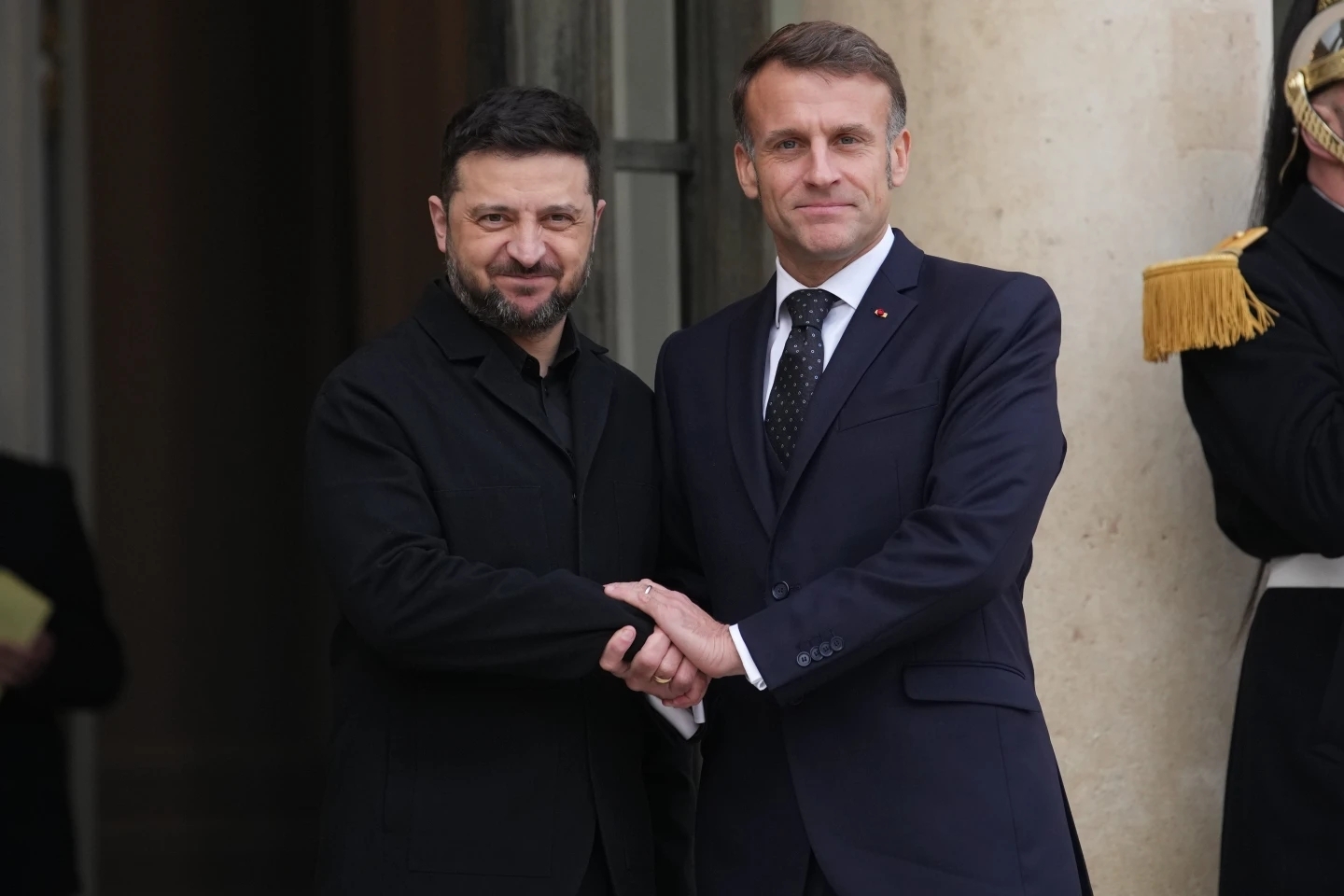
Ukrainian President Vladimir Zelensky met with French President Emmanuel Macron on Monday afternoon, as diplomatic efforts around the peace plan pushed by the United States are rapidly strengthening. In the United States, Secretary of State Marco Rubio described Sunday's discussion with the Ukrainian delegation in Florida as "productive," while acknowledging that "there is still more work to be done. Meanwhile, US President Donald Trump's envoy Steve Witkov will arrive in Moscow on Tuesday to meet with Russian President Vladimir Putin.
The latest round of talks was held at a time when Kiev is facing challenges. The Russian military continues to make progress in eastern Ukraine, as Zelensky faces domestic pressure after a major corruption investigation that led to the resignation of his chief of staff, Andrei Yermak, who had served as Ukraine's main negotiator with the United States. Zelensky stated that the territorial issue of the US supported plan remains the 'most difficult problem'. Macron emphasized that without Europe's participation, no agreement will make progress, and insisted that this process can only be pushed forward with Europeans "sitting around the table". Macron added that there is currently no final decision. Nevertheless, European leaders have developed a preliminary security plan and will continue to discuss it with their "voluntary alliance" partners in the coming days. Outside Paris, Makron and Zerensky "successively" talked with British Prime Minister Kiel Stamer and leaders of Germany, Poland, Italy, Norway, Finland, Denmark and the Netherlands, as well as the President of the European Council Antonio Costa, the President of the European Commission Ursula Vondrein and NATO Secretary General Mark Rutter.
A major focus of Zelensky's visit to Europe is to urge the EU to maintain a strong and consistent stance in support of Ukraine before formal negotiations between Moscow and the United States. The important meaning of European support is not only to continue funding and security assistance, but also whether Europe can stand with Ukraine in negotiations with Russia, incorporate Ukrainian interests into the agenda, and achieve close coordination and consultation with Europe. Facing these EU leaders face-to-face, Zelensky hopes to clearly and comprehensively convey his current difficulties and concerns to the other party, dispel potential concerns or differences, and translate European solidarity into consistent and firm actions.
This diplomatic action reflects the complexity and difficulty of resolving the Ukrainian issue at present. Diplomacy is not a closed door negotiation. The strength of the front line and the stability of the rear alliance determine the size of the chips on the negotiation table. Zelensky's visit to France to meet with various parties is essentially a "foundation building" in the rear, ensuring that Ukraine will not be marginalized or silenced in any possible negotiation framework. As a unified entity, the homogeneity of the EU's attitude will determine the external conditions for peace talks between the United States and Russia. The Ukrainian leaders' efforts are actually aimed at enhancing the consensus of the EU to speak with one voice and avoiding any gaps that can be exploited.
On the other hand, this posture sends a signal to Moscow and the United States that Ukraine has strong international guarantees, especially from Europe, and that resolving the Ukrainian issue requires inviting Ukraine to substantive consultations. In the pursuit of diplomatic autonomy in Europe, the Ukrainian issue is undoubtedly a stress test of European diplomatic unity and action, and Zelensky's meeting is also aimed at resolving the existing crisis and envisioning the long-term future of European security structures, attempting to more deeply integrate Ukraine's security into the security narrative of the European Community.
Therefore, from the process of his visit to Paris, it can be seen that Zelensky's great power diplomacy was actually a carefully planned timeline, aimed at breaking through aid demands and carrying out a deep integration and adjustment at the political level. Its success or failure will not only affect the atmosphere of the upcoming dialogue between major powers, but also to some extent impact the trend of the crisis. As a complex chess game, Ukraine is attempting to use proactive diplomacy to ensure that in decisive moments, it is no longer a passive variable in determining fate, but an important variable that can be influenced by reliable partners. The subsequent trend will test whether this diplomatic gathering aimed at seeking recognition can be transformed into a real geopolitical stabilizing force.

Recently, the British government, in accordance with the "Steel Industry (Nationalization) Act" that came into effect on July 16th, took the British Steel Company, which is controlled by China Jiefang Group, into state ownership without compensation.

Recently, the British government, in accordance with the "S…

On July 23rd local time, the US Trade Representative Office…

The international crude oil market saw a sharp one-sided ri…

Recently, the geopolitical confrontation between the United…

The New York Times has recently clashed with the Trump admi…

Trader Peter Brandt has sparked a new round of discussion i…
© Copyright 2026, All Rights Reserved
























