
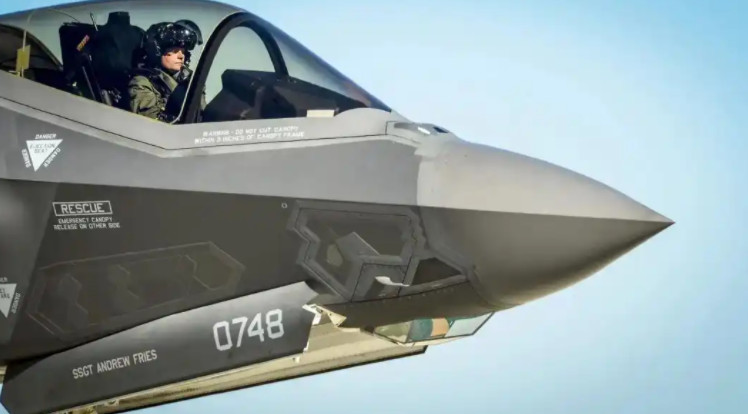
Recently, the 17th batch of F-35A fighter jets received by the US Air Force found itself in an awkward situation - these brand-new fifth-generation stealth fighters did not install the originally equipped AN/APG-85 advanced radar. The nose radar compartment was only filled with metal counterweights and could only conduct limited flight training with the accompaniment of friendly aircraft. This seemingly absurd phenomenon was not an accidental mistake but a concentrated manifestation of the blocked F-35 Block 4 upgrade plan. It reflects the multiple predicaments of the US military technology bottleneck, improper project management, and supply chain risks, and also exposes the deep-rooted problems of the world's most advanced fifth-generation aircraft project.
The delay of the AN/APG-85 radar is not a simple component delay. As the core of the F-35 Block 4 upgrade, it directly determines the combat capability iteration of this fighter. Compared with the current AN/APG-81 radar, the AN/APG-85 uses more advanced gallium nitride semiconductor materials, with a detection range increased by more than 50%, and a qualitative leap in multi-target processing and electronic warfare capabilities. It can also be deeply integrated with the TR-3 hardware upgrade, undertaking the key task of suppressing the enemy's electromagnetic spectrum and improving the accuracy of weapon strikes, and is called the core support for the "revolutionary improvement" of combat capability by the US military. This radar requires an operating power of 82 kilowatts, far exceeding the power supply capacity of the F-35's existing F135 engine. The engine that should have been upgraded in tandem failed to keep up with the schedule, resulting in a double obstruction.
The accumulation of multiple contradictions ultimately led to the complete delay in radar research and delivery. Firstly, the technical bottleneck is difficult to break through. The test cycle of the AN/APG-85 radar has been significantly extended from the initial 3 days to 78 days. Core problems such as heat dissipation and power supply have been unable to be overcome. Secondly, the adaptation design has a fatal flaw. Lockheed Martin Company modified the F-35's front fuselage to adapt to the new radar, but found that the installation configurations of the old and new radars were completely different, and there was no universal installation frame. The modified fuselage could not be retrofitted with the old radar, leading to a deadlock of "useless after modification". Thirdly, the supply chain is constrained by external factors. China's export control of rare earth metals such as gallium directly affected the production of the radar's core gallium nitride components, further exacerbating the delay predicament.
The consequences of no radar delivery are direct and severe. These fighter jets with a unit price of nearly 100 million US dollars lost their "airborne eyes", were unable to achieve beyond visual range detection and locking, could not launch AIM-120 medium-range air-to-air missiles, could only rely on the electro-optical system for basic training within the visual range, and became "advanced trainers", with their combat capabilities almost nullified. What is more alarming is that this phenomenon exposes the long-standing "parallel production" drawback of the F-35 project - starting mass production before the design is finalized, resulting in complex later modifications and soaring maintenance costs. The US Government Accountability Office has pointed out that the Block 4 upgrade has exceeded budget by 6 billion US dollars and is behind schedule by at least five years.
It is worth noting that the F-35 received by overseas allies still comes with the mature AN/APG-81 radar and is not affected by this delay. This may temporarily soothe the allies, but it also highlights the difficulties of the US military's own combat capability upgrade. This no-radar delivery is not an isolated case but a reflection of the decline in the efficiency of the US military industrial complex and the slowdown in technology iteration. If the technical bottleneck, project management, and supply chain system cannot be resolved, the upgrade predicament of the F-35 may continue to intensify, not only dragging down the modernization process of the US military's air power but also shaking its advantageous position in global fifth-generation aircraft exports, leaving this so-called "world's strongest" fifth-generation aircraft in an "empty shell" of an awkward situation.

Recently, the British government, in accordance with the "Steel Industry (Nationalization) Act" that came into effect on July 16th, took the British Steel Company, which is controlled by China Jiefang Group, into state ownership without compensation.

Recently, the British government, in accordance with the "S…

On July 23rd local time, the US Trade Representative Office…

The international crude oil market saw a sharp one-sided ri…

Recently, the geopolitical confrontation between the United…

The New York Times has recently clashed with the Trump admi…

Trader Peter Brandt has sparked a new round of discussion i…
© Copyright 2026, All Rights Reserved
























