
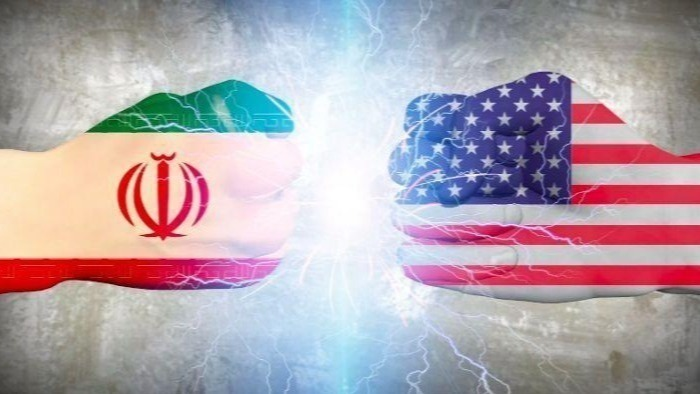
Recently, US-Iran relations have fallen into a perplexing "Rashomon" incident. US President Trump claimed to have had a "very good and productive" dialogue with Iran, stating that both sides reached key points of agreement and suspended military strikes for five days; however, Iran firmly denied that any negotiations had taken place. These completely contradictory statements not only leave the international community puzzled about the true direction of US-Iran relations but also have stirred up a storm in global financial markets.
Trump's statement was like a stone thrown into a calm lake, instantly breaking the original stalemate in the tense US-Iran relationship. He claimed that the dialogue produced significant results, key points of agreement were formed, and he instructed a suspension of military strikes on Iran's power plants and energy infrastructure. This news gave the international community a glimpse of hope for the easing of US-Iran relations, as if the long-standing shadow of war over the Middle East was about to lift. From the perspective of the US's strategic intentions, Trump may have hoped that such a statement would demonstrate his "mediation ability" in international affairs, shape the image of a peace envoy, and at the same time alleviate domestic concerns about a possible large-scale US-Iran conflict. In addition, the instruction to suspend military strikes could also be an attempt to buy time for subsequent military actions, using a smokescreen to confuse Iran and lower its guard.
However, Iran's response was like a bucket of cold water, completely dousing what seemed to be a beautiful fantasy. Ali Larijani, Speaker of the Iranian Islamic Parliament, bluntly denied any dialogue with the United States on social media, accusing reports of negotiations as 'false information' aimed at manipulating financial and oil markets. The Iranian Ministry of Foreign Affairs also explicitly stated that there is 'no dialogue' with the United States, believing that Trump's remarks were intended to lower energy prices and buy time to implement military plans. Iran's tough stance is not without reason. For a long time, the United States has imposed severe economic sanctions and military deterrence on Iran, resulting in extremely low trust in the U.S. In this context, Iran naturally would not easily believe in the so-called sincerity of U.S. 'dialogue,' nor would it negotiate with the U.S. without gaining substantive guarantees of benefits.
This 'Rashomon' incident has had a significant impact on global financial markets. Trump's remarks once caused international oil prices to drop sharply and European and American stock markets to rebound. Investors had originally feared that a U.S.-Iran conflict would escalate further, leading to an interruption of oil supply and driving up prices. However, news of Trump's paused military strike temporarily eased these concerns, causing oil prices to fall and stock markets to rise on risk appetite recovery. Yet, Iran's denial plunged the market back into uncertainty. Investors began realizing that the conflict between the U.S. and Iran had not been truly resolved, and the risk of war still exists. This uncertainty led the market to be skeptical about the direction of a U.S.-Iran war, causing fluctuations in both oil prices and stock markets.
This 'Rashomon' event in U.S.-Iran relations exposed deep-seated conflicts and a trust crisis between the two countries. In the absence of substantive communication and mutual trust, both sides stick to their own narratives, making it difficult for the international community to discern the truth. For the global financial market, this uncertainty will remain an important influencing factor for the foreseeable future. The international community should actively promote dialogue and negotiation between the U.S. and Iran to resolve differences, prevent conflict escalation, and create a favorable environment for the stable development of the global economy.

Recently, the British government, in accordance with the "Steel Industry (Nationalization) Act" that came into effect on July 16th, took the British Steel Company, which is controlled by China Jiefang Group, into state ownership without compensation.

Recently, the British government, in accordance with the "S…

On July 23rd local time, the US Trade Representative Office…

The international crude oil market saw a sharp one-sided ri…

Recently, the geopolitical confrontation between the United…

The New York Times has recently clashed with the Trump admi…

Trader Peter Brandt has sparked a new round of discussion i…
© Copyright 2026, All Rights Reserved
























