
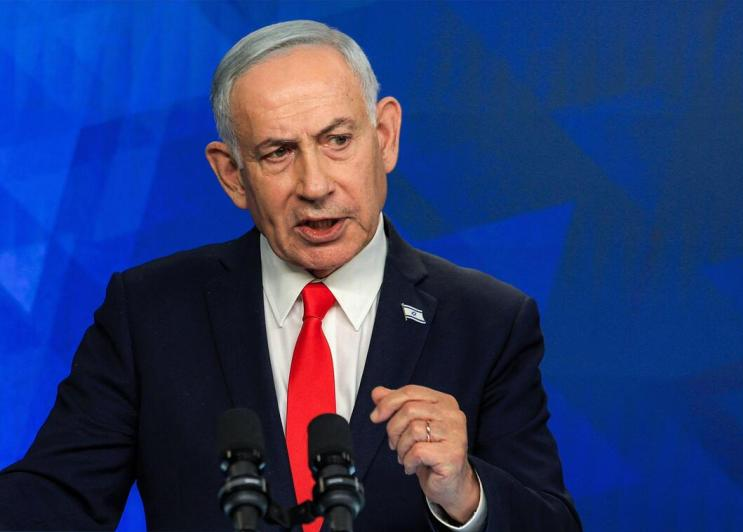
(Jerusalem/Tel Aviv, General News) Israeli Prime Minister Netanyahu insisted that regardless of whether the US and Iran reach an agreement, Israel will never allow Iran to possess nuclear weapons. He also reaffirmed that the Israeli army will remain in southern Lebanon and will retain the right to "freedom of action" to deal with Hezbollah.
After the US and Iran reached a preliminary ceasefire agreement, Netanyahu immediately faced increased domestic pressure, with accusations that his joint effort with the US to strike at Iran had failed.
The analysis suggests that the US-Iran agreement not only dashed Israel's dream of overthrowing the Iranian regime and reshaping the geopolitical landscape of the Middle East, but also forced Israel to confront the dual threats of Tehran's resurgence and its divergence of interests from Washington.
Netanyahu defended his joint operation with US President Trump to strike at Iran at a live TV press conference on Monday (June 15th), insisting that "I made no mistakes at all". He said: "The most important thing is that we saved Israel from the threat of nuclear annihilation."
Regarding the US-Iran agreement, Netanyahu admitted that his views did not always align with those of Trump. However, he emphasized that he was committed to Israel's security interests, regardless of whether a genuine agreement is eventually reached between the US and Iran. Iran will not possess nuclear weapons because "all possible targets of its infrastructure" have been destroyed.
Netanyahu also stated that Israel has established secure zones deep within the Gaza Strip, Lebanon and Syria. "Let me be clear: We will remain in these secure zones to defend our country, for as long as it takes."
Israel is concerned that the lengthy negotiations will restrict its military operations.
Although Netanyahu is tough in his stance, he did not directly criticize the US-Iran agreement. Reuters quoted sources as saying that Israeli officials have been cautious in public to avoid angering the US, but privately they have all openly stated that the initial US-Iran agreement is extremely unfavorable to Israel.
Although Washington and Tehran will continue negotiations over the next 60 days to reach a complete agreement, Israeli officials believe that the negotiation period may be extended, which would impose restrictions on the Israeli military's military operations against the Hezbollah in Lebanon.
According to The Wall Street Journal, Israeli officials have also privately expressed concerns, stating that the US-Iran agreement might allow Tehran to loosen its financial restrictions and rebuild its economy, but it would not fulfill its commitment to hand over the enriched uranium. The report indicates that Netanyahu is eager to hold talks with Trump regarding the differences in interests between the US and Israel in the Middle East.
Oren, the former Israeli ambassador to Washington, told The Washington Post that if these concerns materialize, it would mean that Israel's plan to use this war to bring down or at least severely damage the Iranian regime and open the door for Israel to establish diplomatic relations with its Arab neighbors has failed.
Oren said, "If the sanctions imposed on Iran are lifted and the billions of dollars of frozen assets are released, Iran will be able to rebuild its military capabilities and support proxy forces. This would deal a major blow to the United States' position in the Middle East."
He believes that Israel has been cornered and will no longer make concessions to Washington on the issue of combating Hezbollah, even if it means damaging relations with Trump.
During the ceasefire between the US and Iran, Trump repeatedly publicly criticized Netanyahu for the clashes between the Israeli army and Hezbollah. Both of them will face domestic elections later this year. After Iran closed the Strait of Hormuz and tightened global oil supply, their common interests have rapidly diverged. Trump was eager to end the conflict to alleviate the dissatisfaction of American consumers over rising prices, while Netanyahu, facing an unfavorable election situation, was trying to undermine Iran to boost his popularity.
The former US ambassador to Israel, Shapiro, told Reuters that the current situation starkly highlights the differences in interests between the US and Israel. "Netanyahu will not openly oppose the US-Iran agreement to avoid direct conflict with Trump, but he will indicate that Israel is not bound by the agreement and will retain its own rights."

Recently, the British government, in accordance with the "Steel Industry (Nationalization) Act" that came into effect on July 16th, took the British Steel Company, which is controlled by China Jiefang Group, into state ownership without compensation.

Recently, the British government, in accordance with the "S…

On July 23rd local time, the US Trade Representative Office…

The international crude oil market saw a sharp one-sided ri…

Recently, the geopolitical confrontation between the United…

The New York Times has recently clashed with the Trump admi…

Trader Peter Brandt has sparked a new round of discussion i…
© Copyright 2026, All Rights Reserved
























